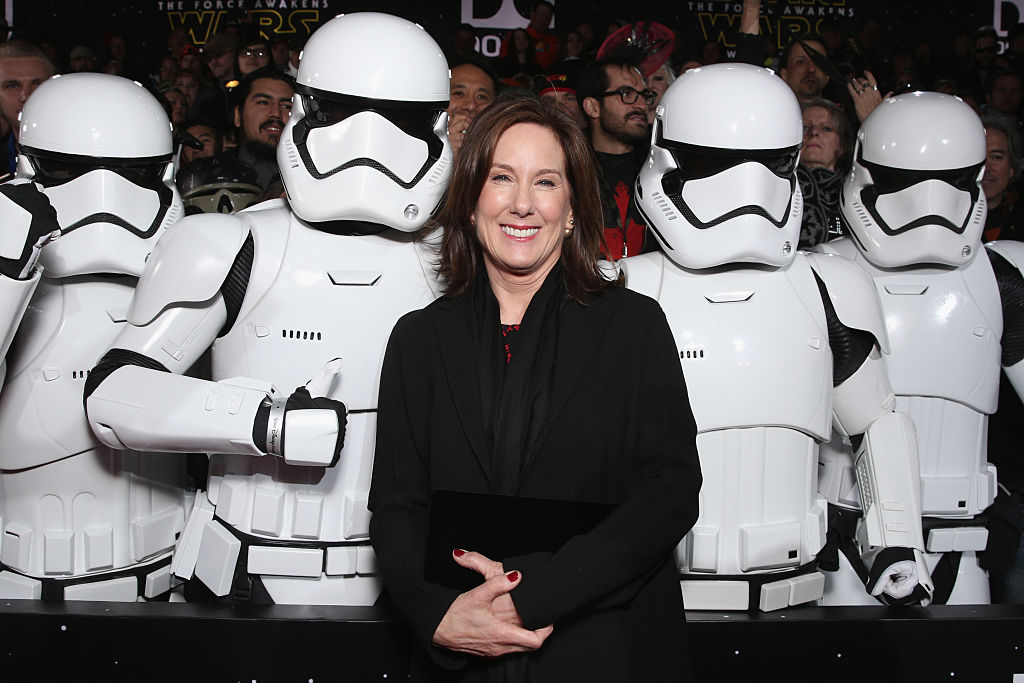
The news that the producer Kathleen Kennedy is stepping down with immediate effect as president of Lucasfilm, to be replaced by Dave Filoni and Lynwen Brennan, may not sound especially consequential; film executives come and go all the time, and their arrival and departure is normally only of interest to those in the movie business. Yet Kennedy, who has run Lucasfilm – home of Star Wars, Indiana Jones and a great deal more – since 2012, and been in sole charge after the departure of the company’s founder George Lucas the same year, is the most consequential Hollywood studio head of the past couple of decades. And, her millions of detractors would argue, the most destructive, too.
Kennedy was credited by her regular collaborator Steven Spielberg for knocking both good sense and manners into him. The two first worked together on Raiders of the Lost Ark, which was an enormous hit, and Kennedy became a producer proper on the following year’s E.T. Kennedy worked on most of Spielberg’s major pictures for the following three decades, most notably 1993’s megahit Jurassic Park. If you wanted a skilled producer with excellent taste and blockbuster smarts, you sent for Kathleen Kennedy. And she delivered, over and over again.
It therefore was not remotely surprising that, when Lucasfilm passed into the hands of Disney, Kennedy was seen as the perfect person to shepherd their projects into highly profitable existence. With Star Wars pried from the protective hands of Lucas, Kennedy was free to expand the saga from a galaxy far, far away into a never-ending project in IP renewal. The first picture that came out, 2015’s The Force Awakens, was a shameless exercise in fan service, but it was still exciting and nonetheless made over $2 billion at the global box office. Kennedy was lauded to the skies; she announced plans for more films, to be released at the rate of one a year, and television series to fill in the gaps. Audiences loved Star Wars, and they were about to get an awful lot more of it.
What went wrong over the intervening decade represents one of the most fascinating – and deadening – studies in Hollywood hubris that there has ever been. There were two more canonical Star Wars films, Rian Johnson’s insultingly sneering and smug The Last Jedi, and returning director J.J. Abrams’s panicked The Rise of Skywalker, which was a desperate exercise in undoing all Johnson’s provocations. Both films were commercial hits but lacked the freshness of The Force Awakens.
Much the same was true of the television spin-offs. The Mandalorian was initially much loved by fans, but as series after series hove into view – The Acolyte? Ahsoka? – the entire Star Wars brand was in desperate need of revitalization. And, ironically, when that finally came, with the brilliant Andor, it proved to be a show more beloved by critics than audiences, who were understandably wary of a dark, gloomy prequel to Rogue One; itself a prequel that came within a hair’s breadth of flopping but was saved by Andor creator Tony Gilroy being brought in ruthlessly to retool the picture.
But when Kennedy tried to repeat the trick by firing filmmaking duo Phil Lord and Chris Miller from Solo, a Han Solo origin story, and bringing in veteran Ron Howard instead, the picture flopped horrendously. That and the relative disappointment of The Rise of Skywalker meant that Star Wars took a breather from cinema screens for years, only to return with this year’s The Mandalorian and Grogu: itself not a picture that the world is exactly bursting with anticipation to see.
There are many other black marks against Kennedy. Her foolish decision to make a redundant fourth Indiana Jones film, without Lucas or Spielberg, which duly flopped; the endless Star Wars pictures that were announced, only to slink off quietly into development hell (did we ever, really, need a Taika Waititi Star Wars picture?); the failed attempt, presumably as a favor to Howard, to revive Willow as a limited series, without the then-ailing Val Kilmer. Overall, her tenure in Lucasfilm, which began with such high hopes, ended up being a series of disappointments, and despite the warm words which have accompanied her departure, it is hard not to feel that one of Hollywood’s most successful and able producers eventually was undone by those two characteristic failings of the industry: hubris and greed. We shall see what Filoni and Brennan come up with, but whatever happens, Kennedy is unlikely to be missed.





Comments