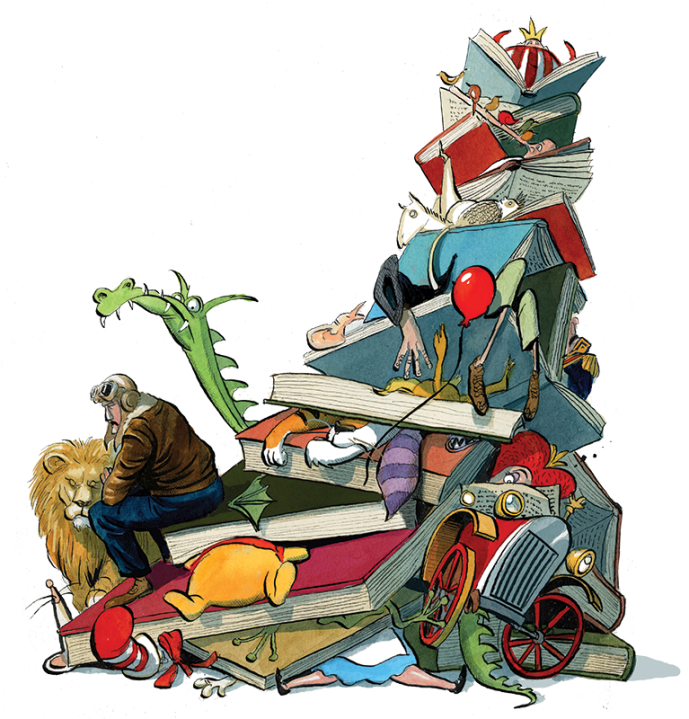
It was only recently that I fully appreciated how the books I read as a child formed me. A pregnant friend asked me about my parenting philosophy and I realised it amounted to ensuring my son would survive a tour of Willy Wonka’s chocolate factory. I never had the money of Veruca Salt’s daddy to indulge his every desire, but I came down hard on chewing gum, gorging on chocolate and, above all, staring at a screen.
Despite my son’s complaints that I was acting like a father from Victorian times, it seemed to have worked, and, as the Oompa–Loompas predicted, not being glued to a screen encouraged him to become a reader, out of boredom if nothing else. If the house was quiet, too quiet, I would usually find him reading a book in a corner.
It was a surprise, then, that when he started at secondary school, a local academy, his biggest complaint was about the English homework – which was reading. He got a detention – his first – for not reading a storybook. I was on the verge of becoming Victorian Dad again when he showed me how he was supposed to read this book: all reading, to be counted by his English teacher, has to be done through an app on his tablet.
Sparx Reader gives you a choice of just four books to read – supposedly to avoid ‘decision fatigue’ – and won’t let you change your mind if, say, a couple of pages in you realise the story is LGBTQIA+ vampires talking about feelings rather than the bloodcurdling horror you expected. It dictates the speed at which you can go so you can’t skip the passages on the weather, or kissing, and it divides stories into short gobbets after which it asks silly questions. The questions are generated by AI, so are wholly superficial and uninteresting: a test of short-term recall rather than comprehension. How many keepy-uppies did Bukayo want to do? ☐ Fifty ☐ A thousand ☐ A hundred ☐ Ten.
In case you suppose I have cherry-picked a particularly banal specimen, this is the example in the app’s marketing literature, which my son’s teacher sent me. I say ‘literature’, but it was four, two-minute YouTube videos. The company behind the app said that although interrupting the flow of reading was disruptive, ‘our young people are constantly skimming and scrolling, and there is an urgent need to reteach the habit of careful and controlled reading’. In other words, the app needs to be like this to counteract the downsides of reading on screens. I can’t help feeling there is a more obvious solution.
Improvement in comprehension is six to eight times greater when children read on paper than on digital devices. The cognitive neuroscientist Professor Maryanne Wolf suggests in her book Reader, Come Home that because children associate screens with TV and movies, their perception of what is presented on a tablet or computer screen is processed unconsciously like film. The Oompa-Loompas, in advance of modern neuroscience, were less tactful about the screen-addled child with brains as soft as cheese who cannot think but only sees.
When it became obvious that my wife and I weren’t going to be satisfied with YouTube videos from Sparx Ltd, the head of English invited us to a meeting. We put forward our objections to the app and how it could not be better designed to suck the joy out of reading for pleasure, to which the head of English said that the homework was not supposed to encourage reading for pleasure. The head of English. But she did try to show me the teachers’ version of the app, a sort of panopticon where they can tell the precise number of pages each child has read: as if numbers were the only thing that mattered to the English department.
I’m afraid I got cross at her belief that saying something was ‘school policy’ was a knock-down argument, and so I slammed an academic paper (‘Do new forms of reading pay off? A meta-analysis’) on the table – this is what we believe. It didn’t do any good: we knew it was an Apple™ school, and so we should accept that homework would be set through the Apple™ tablet. They were Preparing Children for the Future – or the present, anyway. I didn’t suggest that, by that rationale, they could replace the sports fields and PE staff by giving everyone a subscription to the Joe Wicks app; it would only have given them ideas.
I escalated matters to the principal and the curriculum lead. Neither of them bothered replying to my email. So I had to explain to my son that, because it was an Apple™ School, he had no choice but to read on the app for an hour every week. If he didn’t, he would get a detention – of half an hour. He realised pretty quickly that this was precisely 30 minutes less than actually doing his homework. Almost as if numbers were the only thing that mattered.





Comments