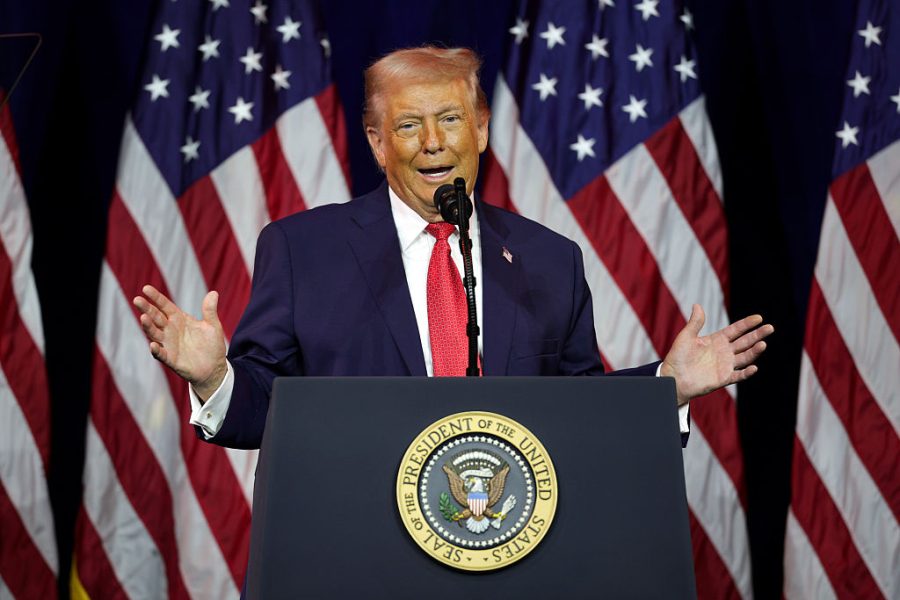
Donald Trump is playing hemispheric monopoly. Depending on what day of the week it is, the President’s focus alternates between Venezuela, Canada, the Panama canal – and for the last twelve months or so, Greenland. Given what Trump and his team have said over the past week, their acquisition plans for the island are well advanced. But why exactly does he want Greenland?
The world’s largest island is an integral part of the Kingdom of Denmark and is about three times larger than Texas. While the term du jour is geopolitics, perhaps the most plausible reason for why Trump is gunning for Greenland is ego-politics. We have a president eager to make America great again and complete the task that his predecessor President Monroe started some 200 years ago. Over 40 percent of the United States was acquired via land purchasing and the Trump purchase (if that what it turns out to be) would unquestionably secure this president’s place in history and geography. No doubt there would be sponsors for Trump’s profile to be carved out of Mount Rushmore.
Acquiring Greenland, beyond ego-politics, dovetails with the White House’s national security strategy, published in November, that is grounded in hemispheric power. The US’s strategic priorities are the Indo-Pacific region (code for China), western hemisphere, new strategic domains such as the oceans and space, and finally the Euro-Atlantic theater. America is not turning its back on Europe. It is, however, sending a clear message that the long era of financial free-riding in security terms is over.
Greenland is bearing the brunt of Trump’s ambition. He wants it.
If the western hemisphere is America’s domain, then what the Trump administration appears to accept is that others, such as Russia, have their sphere of influence and domination too. The unsavory deal-making in Ukraine that the President is attempting with Putin is one element to all of this. Another is simply that a Greenland acquisition greenlights Russia’s quest to acquire not only a large chunk of Ukraine but also the Norwegian territory of Svalbard. Russia wants the northern archipelago as part of its naval defense. The idea is that a nuclear deterrent around the Kola peninsula in the northwest of Russia is safer if the country has this piece of real estate – a gateway, as it is, to both the North Atlantic and Arctic – under its control.
Acquiring Greenland and dominating Venezuela also sends a message to China. The United States’s great power rival has been active across the western hemisphere. Beijing has been cutting trade and investment deals and showing quite some interest recently in Greenland’s resource sector and island infrastructure.
Copenhagen, which is formally responsible for Greenland’s foreign and security affairs within the Kingdom of Denmark, has in the past stepped in to stop this. In 2016, for example, a Chinese company was interested in purchasing a former naval base at Grønnedal. Lars Løkke Rasmussen, the then prime minister of Denmark, reportedly blocked the sale. A few years later, Chinese companies expressed interest in building new airports on the island. This did not happen because of Danish concerns about what kind of role the Chinese state would take on in the projects.
Trump is clear that under US control there would be no danger of that happening again and Greenland’s mineral resource potential would be dominated by American commercial operators. Greenland’s mineral potential, especially in rare earths, is a work in progress. Operationally, there are plenty of challenges to circumnavigate including remoteness, skilled labor availability, maturity of mine projects, environmental and political licensing hurdles, and competing demands for investment in the United States and elsewhere. Dozens of licenses have been issued by the government of Greenland, but for now there is no doubt that fish and tourism remain the dominant economic interests of the island. Greenland has in recent years developed economic ties with China, which is a recipient of fish and prawns.
Trump also understands that other countries are engaging in their own form of resource grabbing against a backdrop of a world that is shrinking ecologically. He understands that the demand on resources will grow and that minerals from copper to lithium will be in high demand. Breaking China’s stranglehold is an existential matter. Critical minerals are the appeal in Greenland’s case, oil in Venezuela. It might be that he also thinks the US would do a better job finding oil and gas than others around Greenlandic waters.
The American president is known to hold grudges and does not forget slights. He will not have forgotten how his 2019 proposal to purchase Greenland was very publicly rejected. A state visit to Denmark was canceled and maybe all of this happened because no one could imagine him being a two-term president in Europe. Except that he is.
The US-Danish defense relationship dates to the early 1950s and gave America plenty of latitude to conduct its affairs. A military base at Thule on Greenland’s northwest coast was constructed and the US operated nuclear-carrying bombers from there during the Cold War. The purpose of the base was to help track and trace long-range Soviet bombers. Nowadays the renamed Pituffik Space Base carries out both missile and space surveillance and monitors space debris, which poses a danger to satellites.
Since Trump warmed to his theme of acquiring Greenland ‘soon’, the Danish government have been eager to demonstrate their commitment to the defense of the island. Both Copenhagen and Nuuk have received support from other European leaders. All have expressed alarm at how Trump’s initiative is undermining Danish and Greenland’s own territorial sovereignty. The President’s demands are also exposing the fundamental hollowness of Europe’s geopolitical credentials, as the continent faces Russian belligerence in the east and US rhetorical expansionism to the west.
What is happening is a game of real-world geopolitical monopoly. President Trump is a latter-day Willard Whyte. And Greenland is bearing the brunt of this ambition. He wants it. The immediate next step will be a US offer to the people of Greenland: come and join the United States in a free association agreement. Money will be thrown in the direction of Nuuk. Copenhagen will be bypassed. If the agreement proposal is turned down, then things could get uglier.
It is, at this point, worth remembering that the United Kingdom and France have their own territories in the western hemisphere. From Bermuda in the north to the Falkland Islands in the south. Could they be next on Trump’s list?


Comments