Bbc

It’s hard to take Lucy Worsley seriously

From our UK edition

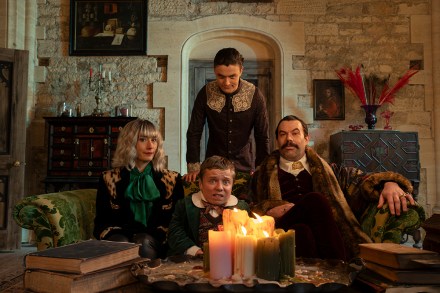
BBC1’s new ghost-story drama The Witch Farm certainly can’t be accused of lacking what’s known in the trade as ‘respect for the genre’. It began with a vicar walking through a field of crows to an isolated Welsh cottage, where he just had time to find a room covered in runic scribbles and cry out in fear before a caption appeared reading: ‘20 years later. June 1989’. To prove it, the radio brought news from Tiananmen Square and played Transvision Vamp as a family of three from London drove to their new home in that very cottage. On arrival, teenage son Jonathan noted with alarm the absence of a TV aerial (for younger readers, the nightmarish equivalent of no wifi).To the parents Liz and Bill, though, it seemed like an idyll. But not for long.

BBC1’s Honey is a dog’s breakfast

From our UK edition

I’m currently working on a screenplay set in 1066 about a precocious young woman who is absolutely sick of the patriarchy. She wants to become a housecarl in the elite royal guard but thanks to sexism, homophobia and racism all the white Anglo-Saxon males sniff that she’s unsuitable. But then one day, while she is practising her two-handed long-axe skills in a forest clearing, who should ride by but the King’s clever and beautiful wife (‘It’s Ealdgyth. But everyone calls me Edie’) and, a few exchanged hair-styling and make-up tips later, an enduring friendship is born. If the BBC won’t commission it I’ve no doubt Netflix will. And that’s the problem, isn’t it?

I’m mourning the loss of BBC Sounds

Provence The other Friday, via the reader comments section, I was contacted by a chap, Simon, inviting me to attend a piano concert in the next village, the proceeds of which were going to those affected by the recent wildfires. I was thrilled, Radio 3 is on at home 16 hours a day sometimes. Especially since those heartless wankers at the BBC pulled the plug on the Sounds app last year for people outside the UK. Living abroad has its advantages. The cave here above the medieval village feels right to me: safe, quiet, unique – and the terrace has a terrific view. And being so tiny and south-facing, it’s relatively inexpensive to heat and maintain, but it can be isolating.

The fibs of Blue Planet III

Whenever I hear the phrase ‘national treasure’ I reach for my shotgun. Take David Attenborough. Yes, he may be impressively old – and modest and charming and sweet, so people claim – but he is also a menace who has probably done more to promote environmental hysteria, devious misinformation and spectacular misallocation of your scarce resources than Greta Thunberg, Al Gore and Prince William combined. The most effective propaganda takes you unawares, when your guard is down. So where better than in the cosy 8 p.m. Sunday slot when you are slumped on a sofa, hypnotised with that familiar soothing voice, manipulated by a score (Hans Zimmer) so soupy it could put Heinz out of business, and mesmerised by some of the most visually arresting images you’re ever likely to see.

A new BBC series that captures some of the channel’s old values

From our UK edition

I watched Smiley’s People on BBC iPlayer recently because I fancied a nostalgia trip back to the days (1982) when viewers were literate and had attention spans, when even bit players could act because they’d all done rep or been voice-coached by Cicely Berry at the RSC, and where directors still had leeway to attempt to create art rather than product. What I loved – though not quite as much as the scene where Alec Guinness as George Smiley sits imperturbably through a throbbingly percussive live show at a seedy German sex dive – was the refreshing slowness.

BBC1’s Time isn’t subtle – but it’s still riveting

From our UK edition

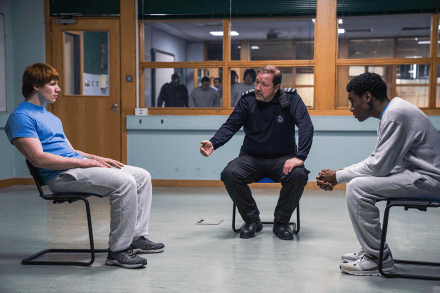
Jimmy McGovern is a writer whose sleeve is rarely heart-free. Since cutting his teeth on Brookside in the early 1980s, he’s served up one crunching drama after another (Priest, Hillsborough, Broken etc. etc.), all of them characterised by a mix of dark personal stories and even darker social issues conveyed in a way that leaves us in little doubt about how we should respond. Granted, there are some concessions to light and shade – but if there’s such a thing as unsubtle nuance, then McGovern has mastered it. Even so, Time may be the most crunching of the lot. The first series of this anthology show took place in a men’s prison and spared us none of the violence, mental illness and institutional failures involved. The second, set in a women’s prison, didn’t either.

War is as good as Succession

In his ruefully funny 2012 novel The Man Who Forgot His Wife, John O’Farrell compares the increasingly uncivilised process of divorce to war: ‘In 1939 the RAF thought it was immoral to bomb the Black Forest to deprive the Germans of timber. But by 1945 they were deliberately creating firestorms to kill as many civilians as possible.’ As the title suggests, the starry new divorce-based drama War makes a similar comparison – except that here the unhappy couple are cutting straight to Dresden. The show began as it meant to go on: which is to say, glitteringly. At a London awards ceremony of ineffable poshness, Morgan Henderson (Dominic West) was named Pioneer of the Year for creating one of the world’s biggest yet nicest social media platforms.

Now I’ve left Today, I can finally say what I really think…

From our UK edition

Hello, what’s this I see before me? A blank page; and a pen unencumbered by the heavy weight of BBC News impartiality. I still present University Challenge, it’s true; but having left the Today programme, perhaps I can now asseverate opinions that a fortnight ago would have got me sacked. This feels good! Here goes… Dominic Cummings was right. I’m referring, obviously, to a speech he gave to the IPPR in 2014. It’s on YouTube and, being something of a weirdo and misfit, I have watched it a dozen times at least.

I didn’t want to like Rod Liddle

One of the joys of being director of digital at The Spectator, back in 2015, was seeing the magazine proofs before they went to print. Rod Liddle’s column was the first thing I looked for, always the one I was most eager to read. He made me laugh every single time, something very few columnists are able to do. I was annoyed I liked those columns, because I didn’t want to like Rod Liddle. All I knew of his personal life was through the scandal that followed him leaving his wife during the so-called “Sextator” years. I took a dim view of that. Although we both worked for The Spectator, I didn’t actually meet Rod for a long time because, woke snowflake that he was, he only ever worked from home. The first time we met was at a Spectator summer party, years later.

rod liddle

I didn’t want to like Rod Liddle

One of the joys of being director of digital at The Spectator, back in 2015, was seeing the magazine proofs before they went to print. Rod Liddle’s column was the first thing I looked for, always the one I was most eager to read. He made me laugh every single time, something very few columnists are able to do. I was annoyed I liked those columns, because I didn’t want to like Rod Liddle. All I knew of his personal life was through the scandal that followed him leaving his wife during the so-called ‘Sextator’ years. I took a dim view of that. Although we both worked for The Spectator, I didn’t actually meet Rod for a long time because, woke snowflake that he was, he only ever worked from home. The first time we met was at a Spectator summer party, years later.

‘I asked for a substitute for the f-word. He suggested the c-word’: the joy of editing Rod

It was in Westminster Magistrates’ Court, where I was sitting waiting for the judge’s verdict, that I decided I needed a better way of handling Rod Liddle’s column. As editor of this magazine, I had inherited one of the greatest writers; a force of nature loved by his readers for his bravery and candour. But it sometimes led to difficulties: in this case, criminal prosecution. The judge had a choice: prosecute our owners, the editor, or the magazine. The magazine was fined. ‘Rod was right,’ I was told by Aidan Barclay, who as proprietor had nearly ended up in the dock himself. ‘But truth is no defence. Not any more. You need to spot these things before they blow up.’ Our lawyers were kept busy, too.

Rod’s genius? Driving his enemies nuts

There is a reason the death of Rod Liddle has provoked such a swirling tide of grief among his millions of followers, including readers of this magazine, and that is that in the last 25 years Rod came to occupy a crucial position in journalism, and indeed in our country as a whole. His columns became a haven, a refuge, in which he gave us permission to think things that are in fact common sense, but which have for some reason become taboo. He gave us a renewed permission to laugh – at him, at ourselves, at our collective absurdities – at a time when laughter is increasingly controlled and often suppressed.

To be a Spectator reader was to love Rod

Since becoming Spectator editor there was one observation I heard more often from readers than any other: ‘Rod is the first page I turn to every week.’ Whatever people’s politics, background or other interests, to be a Spectator reader was to love Rod. Rod did his best, of course, to be unloveable. At least in print. Nothing, and no one, apart from possibly Millwall, was spared from his criticism. Savage, foul-mouthed, merciless. But also hilarious, superbly well-informed and honest. Above all honest. There are all sorts of enlightened souls in and around journalism who pretend to that virtue.

I suspect a lot of TV is AI-generated

AI slop is not a new phenomenon. But it is becoming more prevalent as the lazy, the modish and the sub-literate take advantage of an apparently beneficial and cost-free leap in technology that will save them the time and effort formerly required to construct a speech, CV, article or image. I only started picking up on it myself quite recently. But now, when I get the feeling I’m being fed AI-generated pictures, I react like those dogs in the movies that are trained to spot Terminators. Thanks to the proliferation of sites such as Netflix, Amazon Prime, Apple TV etc. there’s an awful lot of cable-TV slop about these days, as there has to be with all that space to fill, all those subscription costs to justify.

Burnham’s solutions must not lie in the 1970s

Andy Burnham is right. The cost of living is foremost in people’s minds just now. Naturally his electricity bill VAT holiday and freeze of bus fares find agreement in television news vox pops and focus groups. But he offers no explanation for the causes and concentrates only on the symptoms. Obviously, the removal of the 5 percent VAT will be nice for consumers. But underlying inflation today relates to government debauchery of money and disruptions of supply caused by Donald Trump’s tariffs and his short war, by Vladimir Putin’s long war and Ed Miliband’s net-zero trap, which makes us pay expensive green levies and bans new domestic fossil-fuel production. The remedy does not lie in the 1970s-style pretense that things can be made cheaper by fiat.

Alexis de Tocqueville’s America has vanished

From our UK edition

When Alexis de Tocqueville arrived in New York in 1831, he found a city a quarter of the size of Paris, perched on the lower tip of Manhattan, roamed by pigs. Speaking to everyone he met, high and low, he was struck by how many of the rich used to be poor. There was, he observed, an ‘equality of conditions’ that filtered down to the way parents treated their children. The 25-year-old ‘wiry aristocrat’ filled 14 notebooks during his nine-month road trip across America to 17 of the 24 established states. It formed the basis of Democracy in America. ‘The American inhabits a land where everything is constantly moving, and each movement seems to be progress,’ he wrote.

Labour’s mad media protectionism

From our UK edition

Just when you think this government cannot get any madder, it publishes a truly mental green paper. Called ‘Watch this Space’ and produced by the Department for Culture, Media and Sport, it suggests forcing social media platforms to make content produced by public-service media providers, like the BBC, ITV and Channel 4, ‘prominent and easily discoverable’. So, if you search for an instructional video on YouTube about how to do the foxtrot, it would steer you towards an episode of Strictly Come Dancing. And the content recommended for you by a platform’s algorithm wouldn’t be based on your personal preferences, but on what DCMS – or possibly Ofcom, the details are vague – thinks you ought to be consuming.

The peerless Penelope Keith

From our UK edition

The news that Dame Penelope Keith has died at the age of 86 has devastated lovers of great British humour, to say nothing of Spectator readers. The two are, after all, closely linked. Keith was that rare actress who was the lead in not one but two seminal sitcoms, The Good Life and To The Manor Born. It would perhaps be an exaggeration to describe her performances as the aspirational Margo Leadbetter and the aristocratic Aubrey fforbes-Hamilton as showing thespian range. But there was no actress better at skewering the pretensions and absurdities of a certain kind of Englishwoman. Even today, if you say of someone that they are a ‘Penelope Keith type’, it is shorthand for Middle England in excelsis – even if that type is vanishing far quicker than is desirable.

Why does Farage care if he’s on Desert Island Discs?

From our UK edition

The big revelation in Lord Ashcroft’s forthcoming biography of Nigel Farage is that he’s been banned from Desert Island Discs. According to Ashcroft’s sources, an appearance by the Reform UK leader would make some BBC employees feel ‘unsafe’ and might lead to other high-profile figures boycotting the long-running show. ‘I have come to expect nothing less from the BBC,’ Farage told the Mail on Sunday. ‘Their blatant bias has been obvious for years.’ The BBC has categorically denied the story and, in fairness, its ‘blatant bias’ doesn’t extend to Question Time, which Farage has appeared on about 40 times in the past 26 years.