Viv Groskop

Caroline Aherne’s comedic genius is much missed

From our UK edition

Who do we have on television now, or even on social media, who can unmask pomposity and self-obsession quite like Caroline Aherne did in the guise of Mrs Merton? What sitcom since 2010 is as original – and as British – as The Royle Family, always near the top of any best British sitcom list? This July marks the tenth anniversary of the death of Aherne. Given the popularity of The Mrs Merton Show, The Royle Family, which ran for 15 years, and her characters on The Fast Show (not least Poula Fisch, the weather girl who can only announce one type of weather), it’s perhaps odd that this is the first ever biography. It quickly becomes evident why. Aherne is not the easiest subject: having been hounded by the press, she was not fond of giving interviews.
No laughing matter: The Material, by Camille Bordas, reviewed

From our UK edition

There are a lot of reasons why something is funny. It’s hard for everyone to agree on those reasons. And it’s virtually impossible to agree on whether something is actually funny or not in the first place. But one thing is incontrovertible: the more you unpick, analyse and dissect comedy, the less funny it becomes. So what is left behind after that? Into this tricky arena – cue tapping on microphone and feedback noise – steps this experimental and sometimes infuriating novel. The Material is, to its credit, fluid, inventive and often, yes, funny. But it’s also confusing and challenging in ways that don’t always feel intentional.

Love in idleness: The Four Corners of the Heart, by Françoise Sagan, reviewed

From our UK edition

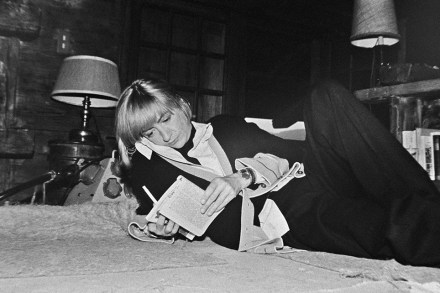
Do not be alarmed. You have not suffered a blow to the head. Françoise Sagan, the author of the 1954 phenomenon Bonjour Tristesse (published when she was 18; two million copies sold), is indeed no longer with us. She died in 2004, aged 69. Yet here is her brand new novel, recovered by her son Denis Westhoff from the mass – and presumably mess – of her papers. Perhaps better described as an unfinished story, there’s a romantic charm, innocence and otherworldliness to this book of a kind unlikely to be found in a contemporary novel. But it’s also an uncomfortable read in parts, no matter how ironic the text is supposed to be.

Is this the end of travel writing?

From our UK edition

Thirty years ago, in the days when friendships were sustained not by email but by air mail, a friend of mine was spending time in some exotic faraway place. He would send me beautiful, florid accounts of his travels and I would read out the most hilarious passages to the flatmates I was living with at the time. When I next replied to him, I sent him their regards and let him know how much they had enjoyed hearing about his adventures. The next letter was angry. Although part of me understood why (I suppose I had rather naively and stupidly shared something that was supposed to be private), another part of me struggled with an expression that was new to me. I had apparently committed what he called an act of ‘cultural appropriation’.

The art of the short story: what we can learn from the Russians

From our UK edition

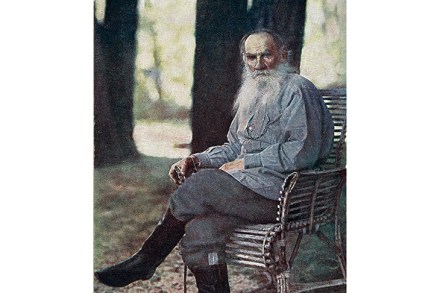
This is such a superb idea that it’s a wonder a book like this has not cropped up before. Here we have a critically acclaimed, best-selling novelist, who also happens to be a highly sought-after creative writing teacher, setting out the curriculum of his over-subscribed ‘How to Write’ class in a way that is accessible to anyone... and the book reproduces the texts under discussion. Wow. This has to be the best York Notes ever, flawlessly designed for the exam we all sit without realising: life.

A far cry from Chekhov

From our UK edition

It would be hard to have better travel-writer credentials than Sara Wheeler. Here the author of The Magnetic North and Terra Incognita, a specialist in Arctic and Antarctic adventure, turns her attentions to the land mass that sprawls across eight time zones, where any traveller is guaranteed to receive an ostentatiously frosty reception — initially, at least. Wheeler’s task has been to capture Russia through a bifocal lens: first through the eyes of the classic Russian authors she loves, and second through the lives of contemporary Russians we rarely hear about, outside of the Moscow–St Petersburg axis. ‘I was searching for a Russia not in the news — a Russia of common humanity and daily struggles — and my guides were writers of the Golden Age.

Amused and confused

Tibor Fischer has a track record with humour. His first novel, the Booker shortlisted Under the Frog, takes its title from a Hungarian saying that the worst possible place to be is ‘under a frog’s arse down a coal mine’. And he also has form with being a bit meta: his third novel, The Collector Collector, was narrated by an earthenware pot. Here he throws his weight behind a character who feels like he’s walked off the set of Brass Eye or Charlie Brooker’s Black Mirror. It’s not entirely clear whether we are supposed to loathe him or sympathise with him. Baxter Stone is a filmmaker whose best days are behind him and who is struggling to stay relevant in an industry that is itself dying.

Beyond the pale

From our UK edition

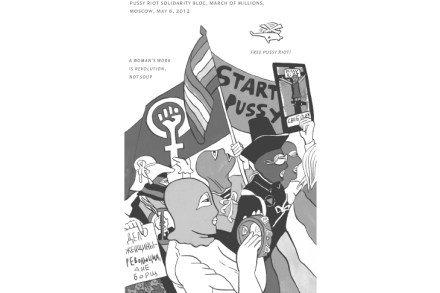
You can tell everything you need to know about what Victoria Lomasko thinks of her homeland by the titles of this book’s two sections: ‘Invisible’ and ‘Angry’. A graphic artist from Serpukhov, just south of Moscow, Lomasko spent eight years documenting people from all walks of life across Russia, producing drawing and commentary about the ‘Russia that is hardly ever seen’. Many of her fellow citizens feel invisible. Almost all of them are angry. The effect of seeing this in cartoon form is disturbing, impressive and fascinating. The subject matter she is dealing with is almost unbearable: juvenile prison wards, sex workers, protesters affected by Russia’s homophobic laws.

An epic for our times

From our UK edition

Trailing rave US reviews, fan letters from Yann Martel and Khaled Hosseini and a reputation as ‘Doctor Zhivago for the 21st century’, comes this outstanding historical saga from debut novelist Sana Krasikov. It’s a dazzling and addictive piece of work from an author born in the Soviet Republic of Georgia whose family emigrated to New York when she was eight. Not only is this novel accomplished and packed with believable detail and entertaining dialogue, it also feels curiously relevant, tip-toeing around the complicated relationship between the United States and Russia during and after the Cold War. Raised in 1930s Brooklyn, Florence Fein escapes a stifling existence with a seemingly glamorous job entertaining Soviet dignitaries on business trips to the US.

Brexit Britain needs a large dose of proper political satire

From our UK edition

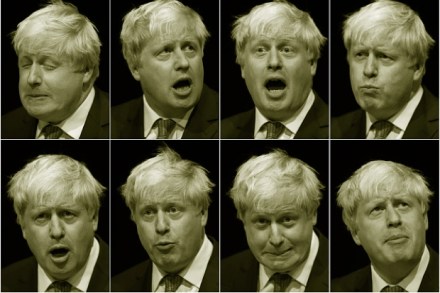
After Brexit, satire is well and truly dead. Now we have Boris Johnson answering questions at press conferences about how he’ll explain to Hillary’s face that he once said she looks like a nurse in a mental institution. We have an unelected prime minister who got the job largely because another woman baited her about not having children. We have Andrea Leadsom: a non-entity who is swiftly revealed to be exceedingly stupid and tactless and is then rewarded with a serious cabinet role. And we have no opposition, except Jeremy Corbyn with a leadership style entirely lacking in leadership or style. This stuff just writes itself. How can you be funny about an entire political set-up that is already a joke? And it’s a joke of epic proportions.

Broken dreams

From our UK edition

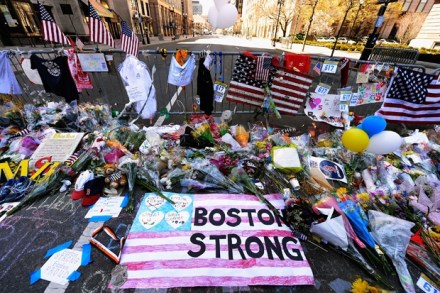
As Masha Gessen herself admits — and as friends and journalist colleagues repeatedly told her — it was a strange choice to write this book. But you only have to get a few pages in to realise that Gessen, the author of a bestselling analysis of Putin, is ideally placed to take on the story behind the Boston marathon bombers. And she is the perfect person to situate it in the wider context of ‘the war on terror’ in a way that illuminates and inspires. This is quite simply a remarkable piece of old-school journalism. On 15 April 2013 two homemade bombs exploded near the finish line of the Boston marathon, killing three people and wounding 264 others.

Made in Chelski

From our UK edition

It’s surprising there haven’t been more novels drawing on London’s fascination with Russian oligarchs. But how to write about them without it all seeming a bit Jackie Collins? Vesna Goldsworthy has hit on the perfect solution with her witty novel Gorsky. If you’re going to write about being nouveau riche, why not model your book on the classiest thing ever written on the subject, The Great Gatsby? Gorsky doesn’t advertise on the cover that this is a thinly veiled rewriting but it’s obvious from the first page (and explained at length in the acknowledgments). F. Scott Fitzgerald’s writer/narrator Nick Carraway becomes Nikola Kimovic, who grew up in poverty in Serbia and has ended up in London running an antiquarian bookshop. His Kensington neighbour?

The Dear Leader’s passion for films — and the real-life horror movie it led to

From our UK edition

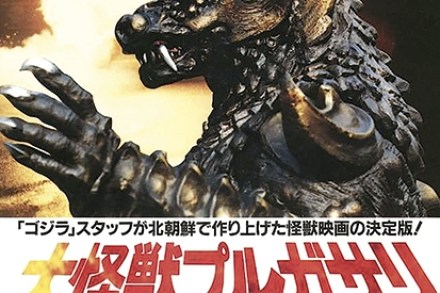
Ahead of last year’s release of The Interview, the Seth Rogen film about two journalists instructed to assassinate Kim Jong-un, North Korea interpreted the film as ‘an act of war’. Sony Pictures were hacked by a group linked to North Korea and hundreds of humiliating titbits about spats between celebrities and Sony execs made public, most memorably the description of Angelina Jolie as ‘a minimally talented spoilt brat’. The film was first cancelled and then given a limited release. Kim Jong-un had the last laugh when the reviews came out, however. ‘About as funny as a communist food shortage, and just as protracted,’ said Variety.

Transnistria: a breakaway republic of a breakaway republic

From our UK edition

Transnistria is not an area well-served by travel literature or, really, literature of any kind. The insubstantial-seeming post-Soviet sandwich-filling between Moldova and Ukraine, it doesn’t have a bad reputation. It has no reputation. As Rory MacLean, the author of the ‘across-the-old-Iron-Curtain-in-a-Trabant’ bestseller Stalin’s Nose, explains: ‘Transnistria is a breakaway republic of a ba lot smaller than Devon. And it is recognised by no country in the world except itself. You could indeed be forgiven for thinking that Transnistria is a made-up place (and at times the author of this book almost treats it as if it is).