Tom Stacey

The deep instinct that Britain’s immigration debate still ignores

The issue of immigration won’t go away, because it threatens the soul of the nation. Nobody in political authority uses such language today, because they are unsure of the validity of ‘soul’ and of the political safety of the term ‘nation’. They will use the term ‘we’ in the context of Britain and its people, but would surely dodge defining it. Try as he might this election year, neither Cameron nor Miliband can do anything to persuade anxious voters they care about immigration, because they don’t use language which reaches the soul. No one else does either, not even Nigel Farage — it just won’t do. Yet only this abandoned language will work if the issue is to be faced up to and the electorate is to hear it and believe it.
Witness to a stoning

Attending public executions, whether beheadings or stonings, is not my predilection, yet one does come across them in the course of life in Arabia and Pakistan. Beheading and stoning are the accepted penalties for a range of presumed offences in much of the Muslim world, and the all-male crowd — especially the old men — push and shove outside Riyadh’s main mosque after Friday morning prayer for a better view of offenders losing their heads by the ceremonial sword. The seeping cadavers and their heads are left on the tarmac pour encourager les autres.

African Adventure

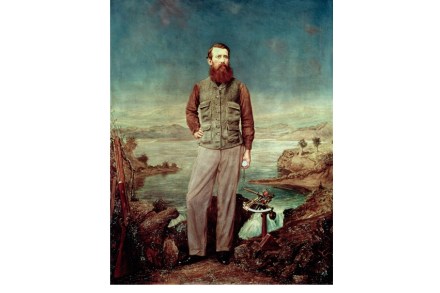
Every day in Kensington Gardens I jog round the bleak granite obelisk inscribed IN MEMORY OF SPEKE. VICTORIA NYANZA AND THE NILE 1864, which my family calls ‘Speke’s Spike’. That river is known to me a bit: I have stood on the glaciers of Ruwenzori at 16,000 feet, which feed it via Lake Albert. I was the first (with two others) to descend for 100 miles the water of the Blue Nile from its Ethiopian source. I have waded the Sudd with Anuak guerrillas.   Tim Jeal’s gripping book pulls the whole astonishing story together. Many a red-blooded Spectator reader will relish it, and buy it, since it’s as intricate and unexpected as the source of the river itself.

We need the occasional war or economic collapse

Tom Stacey says that there is a part of man’s collective soul that yearns for tribulations like the financial crisis and the philosophical and spiritual questions they force us to confront Amid all the doom and gloom, do you ever get the feeling we had it coming? I do. During all those balmy years of ever-rising property values, non-stop invitations to borrow more, to get-now-and-pay-tomorrow, wasn’t there a little bird telling us it can’t go on like this? And now that it’s all come to a stop, does anyone else get a whiff of relief, almost gratitude, that the bubble’s burst, we’ve all come back to earth, terra jolly firma, albeit with quite a jolt?

Sick heart river

Love can drive a man to his grandeur. H. M. Stanley, greatest of all of Africa’s explorers — let us agree with this fine biographer, Tim Jeal, on Stanley’s pre-eminence — was driven by the reverse: love denied, love rebuffed. And with Stanley, that deprivation was a good deal more complex. ‘This poor body of mine has suffered terribly,’ he was reflecting in his diary in June 1877, closing upon the final desperate stretch of his descent of the Congo river, having solved one of the last big geographical conundrums of central Africa: it has been degraded, pained, wearied and sickened and has well nigh sunk under the task imposed on it; but it is a small portion of myself.

Expel foreign crooks? No, we’re far too nice

Tom Stacey, a prison visitor for 30 years, says that jails devote scandalous resources to ‘diversity’. No wonder the Home Office has so little time to manage deportations Political defenders of Charles Clarke insist it’s unreasonable to expect ministers to be acquainted with ‘every nook and cranny’ of the department they are responsible for, especially one as cumbrous as his. It’s hardly his fault, they say, that 1,023 foreign prisoners were freed without being considered for deportation. And true enough that the Home Secretary cannot be familiar with everything that’s going on. He’s only human.

Window of opportunity

Tom Stacey on how, as an act of penance, his great-great-uncle donated the great west window to King’s College Chapel As the choristers of King’s College Chapel, Cambridge, fill our ears on radio and our eyes on television with their double Christmas bill of carols for the birth of Jesus, the light that plays upon the Chapel’s sublime fan vaulting is, as ever, exquisite. Yet behind that light I have a tale to unfold, mysterious and dark. The Chapel’s great west window was the largest single scene in stained glass in Europe when consecrated in 1879. For all I know, it is so still. It depicts the Last Judgment — what mediaeval iconography called a ‘Doom’.

Shooting lions and lines

It’s not fair to blame a book for its subject — a book by a decent fellow who delights in Africa in the wild, a book of charm and perception, thoughtfully put together on fine paper with pictures in sepia which make you see and smell the African bundu where the author followed loyally in Hemingway’s footsteps or vehicle tracks or light aircraft hops.

The all-purpose bogeyman

One has to be careful of saying anything nice about people like Idi Amin, even when they are dead and gone. It is easy to get a reputation for being deliberately provocative, or for seeking compassion kudos like the late Lord Longford, who befriended convicts for the sheer magnitude of their infamy. For many years, Idi Amin was the civilised world's stock example of 'pure evil'. Nearly a quarter of a century after the end of his outrageous tyranny, everybody still knows about him. Not so long ago, after spending a long weekend in Idi's company in seaside Jeddah, I was collecting a roll of developed film from Happy Snaps in Notting Hill Gate. When the man behind the counter awoke to the subject of my happy snaps, he was agog with a tremulous awe.