Thomas W. Hodgkinson

Thomas W. Hodgkinson is the author of How to be Cool.

Sweetest songs of saddest thoughts

From our UK edition

In February 1966, in the first flush of his fame, an interviewer asked Bob Dylan what his songs were about. ‘Oh, some are about four minutes,’ he responded. ‘Some are about five. And some, believe it or not, are about 11 or 12.’ The joke was justified, in a sense. Why should any artist be made to reduce his work to a soundbite? At the same time, in Dylan’s case, the verbal sleight was part of a pathology of evasiveness, a refusal, even an inability, to meet the eye of a question, which presents the would-be biographer with serious difficulties.

Not grinning but scowling

From our UK edition

I am deeply envious of Chris Cleeve, so maybe everything that follows should be taken with a pinch of salt. This is a guy whose first novel won the Somerset Maugham Award and whose second nestled snugly in the New York Times bestseller list for over a year. ‘Stunning,’ said the International Herald Tribune. ‘Stunning,’ said Newsweek. ‘Stunning,’ said Bookmarks Magazine. From the dust jacket of his latest, the author’s wry, clever, benevolent features (I just wish I were as nice as him) radiate calm: relax, they seem to say. I’m going to take you on a journey. All of which can only leave you thinking: wow. And: boy, this better be good.

Old Man of Corfu

From our UK edition

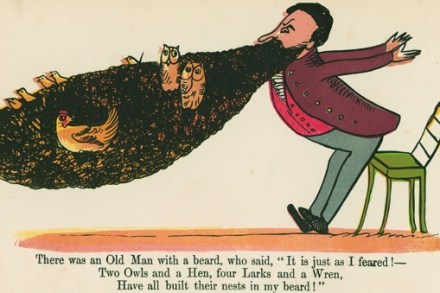
‘The woes of painters!’ lamented Edward Lear in a letter to a friend in 1862. Earlier that day, he was pottering around his apartment in Corfu Town, when, glancing out of the window, he spotted a troop of soldiers marching past. One of them, a certain Colonel Bruce, spied Lear and saluted. At which, forgetting he had a clutch of paint-brushes in his hand, Lear saluted back — ‘& thereby transferred all my colours into my hair and whiskers, which I must now wash in turpentine or shave off’. As a cameo, it sums him up. In that age of pomp and protocol, he always had (or felt he did) paint in his bushy beard.

The dirty dozen

From our UK edition

I have this fantasy in which I’m the Emperor Nero. I’m relaxing in my toga, and there are these slave girls dancing for me, and one of them has the most incredible … Like all the best fantasies, it’s a little unrealistic, let us say, but I didn’t know how unrealistic until I read this magnificent book by Matthew Dennison. For Nero’s life, as absolute ruler of the known world, was hell, haunted by twitching doubts and gibbering fears. He was bisexual, to begin with. That was OK in ancient Rome, but when it came to sleeping with men he received rather than gave, and that was definitely uncool. (During the act itself, the sources say, Nero would ‘imitate the cries and laments of a maiden being deflowered’.

On the way to the forum

From our UK edition

In 150 BC, Cato the Elder arrived in the Senate House in Rome with an eye-catching basket of figs. This redoubtable statesman — often referred to as ‘censorius’, an epithet I have coveted since my childhood — was famous, apart from his censoriousness, for his conviction that the most important thing for Rome at any given moment was the military destruction of its enemy, Carthage. Yet here he was, instead of making another swingeing speech on that topic, apparently about to eat his lunch. Cato picked out an especially juicy looking fig. He took a bite. And then he asked, in his most censorious of tones, ‘Do you know where these figs come from?’ As was his habit, he answered his own question. ‘Carthage! That’s right.

Who’s the real monster?

From our UK edition

‘The first monster that an audience has to be scared of is the film-maker. They have to feel in the presence of someone not confined by the normal rules of decency.’ Thus decreed Wes Craven, that maestro of horror who gave us, among other gems, The Last House on the Left (1972), in which a girl is forced to urinate on herself by a gang of rapists. And on some level, he is obviously right. But as Jason Zinoman points out in his deft study of the rise of New Horror — that is, horror movies of the late 1960s and 1970s, which were more realistic, and so a hell of a lot scarier, than the Hammer-style schlock that had gone before — the pioneers of the style actually tended to be mild-mannered, geeky types, at least to outward view. Peaceniks. Film buffs.

The best and bravest

From our UK edition

‘The candle is burning out and I must stop. Darling I wish you the best I can ­— that your anxiety will be at an end before you get this — with the best news, which will also be the quickest. It is 50-to-1 against us but we’ll have a whack yet and do ourselves proud. Great love to you. Ever your loving, George. ‘ Thus wrote the magnificent (and in many ways muddle-headed) mountaineer George Mallory on 27 May 1924. It was his last ever letter to his wife Ruth before he disappeared into the blizzard that swirled around the summit of Mt Everest, never to return. Did he reach the top? That is a question that cannot conclusively be answered and Wade Davis doesn’t try to. Instead, in his quite brilliant new book, he applies himself to the question of why.

Driving on a dark night

From our UK edition

Ken Nott is the most annoying man in England. It's his job (he's a shock jock, a prime-time talk-radio DJ), and also his hobby (he's unfaithful to his girlfriend, has bedded his best mate's wife, and, worst of all, likes to take his controversial opinions into the pub with him). And then, just when you thought he couldn't be any more irritating, he attends a flash drinks party where he meets - on a roof, and, yes, in a thunderstorm - Celia, a mysterious and beautiful woman who apparently wants nothing more than to have passionate, no-strings-attached sex with him in a series of eight-star hotels. The only downside is that her husband is a violent criminal. This is just one of the many U-turns, dead ends and blind corners in Dead Air. Someone (I think it was E. L.