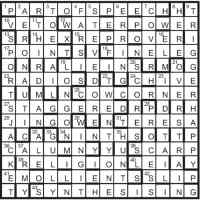
2523: Monstrous regiment – solution
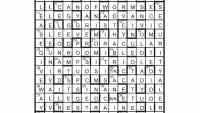
The unclued Across lights can be preceded by MISS and the unclued Down lights. MRS 2/15D is the pair.
There’s a great revival under way in the British TV and film industry, but it’s not the BBC that’s behind it. Netflix is normally secretive about its figures but this week published a list of its most popular shows and top of the pile is Bridgerton, which imagines Regency London as a racially mixed society. Although funded with US money, it is shot in Yorkshire with a British cast, using British technical know-how, and, thanks to Netflix’s global audience of more than 200 million, this British show has now become the most-watched series in the history of television. Not so long ago, it was argued that subscription television would never work in Britain because we had all the broadcasting we could wish for.
Parish problems Sir: Emma Thompson draws attention to a serious problem in the Church of England (‘Power to the parish’, 25 September). Why are they trying to make it easier to close down parishes when the parish is where the people are to whom the church must minister? The parish is also the major funder of the C of E through the generosity of its many local donors. If you take away the incumbent, you take away a major portion of the income for both parish and diocese. One reason many parishes struggle to pay their parish share is because it has been swelled by the diocese to pay for the ever-growing bureaucracies. In most cases, parish share is at least 50 per cent greater than the actual cost of paying and housing an incumbent.
Home The crisis of the week was a shortage of fuel at garages. ‘There is no need for people to go out and panic buy,’ said Paul Scully, the small-business minister. That set motorists queueing. BP had shut some petrol stations and blamed a shortage of heavy goods vehicle drivers. Grant Shapps, the Transport Secretary, blamed ‘one of the haulage associations’ for leaking details of a government meeting at which fuel industry people expressed concerns that fuel stocks were at two-thirds of normal levels. But Rod McKenzie, the managing director of policy and public affairs at the Road Haulage Association, said it wasn’t him.
There’s a great revival under way in the British TV and film industry, but it’s not the BBC that’s behind it. Netflix is normally secretive about its figures but this week published a list of its most popular shows and top of the pile is Bridgerton, which imagines Regency London as a racially mixed society. Although funded with US money, it is shot in Yorkshire with a British cast, using British technical know-how, and, thanks to Netflix’s global audience of more than 200 million, this British show has now become the most-watched series in the history of television. Not so long ago, it was argued that subscription television would never work in Britain because we had all the broadcasting we could wish for.
The Spectator is back at Conservative party conference, where we’re delighted to be hosting a packed schedule of entertaining fringe events. We’ll be discussing the biggest topics of the day with a range of exciting guests, hosted by our top team of political journalists. Every event includes a free G&T – make sure to arrive 15 minutes early to claim it and join our team for a drink (ticket for event required). Our full schedule is below: Monday 1 - 2 p.m. Can green growth really supercharge the north? Katy Balls with Jake Berry and Ben Houchen. Purchase tickets here. 2.45 - 3.45 p.m. Coffee House Shots Live: Fraser Nelson, James Forsyth, Katy Balls and Isabel Hardman. Purchase tickets here. 4.30 – 5.30 p.m.
Seeds of change The Chelsea Flower Show opened in autumn for the first time, delayed thanks to the pandemic. The show has been cancelled before due to the world wars — during the second world war the site was used for an anti-aircraft gun emplacement. But it wasn’t always held in Chelsea. It began as the Royal Horticultural Society show in Chiswick, held from 1827 onwards. It moved to Kensington Gardens in 1861 when rival flower shows were attracting visitors away. In 1888 it moved to Temple Gardens, between Fleet Street and the Thames. It was first held in Chelsea — in a single marquee — in 1913. Highly charged Energy prices spiked. Which countries have the most expensive electricity for domestic customers (US cents per kWh)?
Britain is caught in an energy crisis of the government’s own making. It is true that gas prices have spiked all over the world — but Britain is suffering more than most. Energy suppliers are going out of business, thanks to the government’s price cap. Even fertiliser companies are going bust, with serious knock-on effects for the food industry: the British Meat Processors Association says shortages could hit within a fortnight. The trigger for this crisis has been the sudden surge in demand for gas as the global economy recovers from the Covid lockdowns. Gas prices have doubled in the United States, for example. In Britain, however, prices are five times higher. Why? Because America exploited fracking technology and capitalised on its huge inland gas reserves.
Driving force Sir: As a long-distance UK lorry driver I am very aware of the issues raised by Rodney Pittam (‘So long, truckers’, 18 September). However the job can provide an income of more than £40,000 to those with a practical rather than an academic bent. Yes, there is unpleasantness, discomfort and a combative attitude from other road users. But there is also a high degree of independence, a chance to see this country and others, and a sense of pride in the job. Better facilities are overdue in this country for drivers, and this may go some way — together with greater remuneration — to creating more respect for the work we do.
Home To prevent a shortage of meat, which relies on carbon dioxide in its packaging, the government gave millions of taxpayers’ money to an American company to reopen a fertiliser works at Stockton, Co. Durham, that produces the gas as a by-product. The plant had been shut down because of a rise in wholesale gas prices caused by calm weather preventing rival wind-energy production, a fire at an interconnector reducing electricity supplies from France, and Russia putting up the price of its gas exports. Gas-supply companies began to go bust because the government price-cap prevented them from charging as much as they paid for gas. There was clamour for money from the government, either for gas companies or to keep down consumers’ bills next year.
Unclued lights were synonyms of NOTHING. ‘A trifle’ is one definition of nothing given in Chambers.
Many feared mass unemployment as a fallout from Covid-19. Instead, we have ended up with the opposite problem: a labour shortage. The lack of lorry drivers has led to some items missing from supermarkets. Pubs, restaurants and many other businesses are struggling to re-open as completely as they would like for want of adequate staff. As Matthew Lynn says in his article, the labour shortage has already had a positive effect on workers’ wages. The situation also presents a rare opportunity for long-overdue reforms elsewhere — particularly when it comes to processing asylum seekers. For years, there was public concern that there were far more immigrants coming to work in Britain than ministers ever expected.
The question was ‘What is THE THREE HUNDRED AND SIXTY(-)NINTH PRIME NUMBER’ (7A/10/22/40/16/31/32/28)? The answer is 2521, the number of the puzzle, which solvers were to shade.
A kick up the assetocracy Sir: While it was heartening to see Fraser Nelson take a stand against the ‘assetocracy’ (11 September), it made for a depressing read too. As a millennial, voting Conservative today feels increasingly like an act of social charity. Something done at my own economic expense to shield my fellow citizens from the negative impacts of the alternatives. Should I continue to vote for my values, or should I vote for my own self-interest? For all the hypothetical benefit of a society run by a party that believes in the virtues of liberty, free enterprise and our national institutions, for young people the value proposition of a Conservative government is woeful. Ever higher property prices.
Home The government decided to offer booster vaccinations to those over 50. Children aged 12 to 15 would be offered one dose of the Pfizer-BioNTech vaccination. This followed a declaration by the Joint Committee on Vaccination and Immunisation that it could not recommend vaccination for these children for their own health benefit alone; the chief medical officers of England, Scotland, Wales and Northern Ireland then recommended it, taking into account the effect on disrupted schooling. Sajid Javid, the Health Secretary, said that plans for vaccine passports in England would not go ahead. But Boris Johnson, the Prime Minister, held up a Plan B in terrorem for the winter if people insisted on falling ill with Covid.
For 18 months, the government has held power over us as never before in peacetime. The emergency powers granted by parliament in March last year can cancel our events, separate families and send us back into our homes. The argument for giving politicians this kind of control was that leaders needed to make huge decisions at short notice because an invisible enemy was surging through Britain and posed a deadly threat to our elderly and vulnerable. There was no time for proper democratic debate or scrutiny. That emergency has passed, but the government wishes to keep the powers. What’s the case for doing so? Vaccines have significantly weakened the link between Covid infections and severe illness.
Out of practice Sir: GPs are not ‘hiding behind their telephones’ (Leading article, 4 September). In-person appointments are the core of general practice, and practices have been delivering millions of them throughout the pandemic. GPs share patients’ frustrations with the limitations of telephone consulting, which can often take longer than a face-to-face appointment, and with longer waits to be seen. However, as with other areas of the NHS, practices continue to follow national infection control guidance to keep patients and staff safe. You talk of pubs and nightclubs reopening — but how many nightclubs force very sick people, many of them elderly and living with a number of long-term illnesses, into a confined space at the same time?
Home Boris Johnson, the Prime Minister, announced a new tax in the Commons branded a ‘health and social care levy’. It would increase National Insurance paid by employees and employers by 1.25 percentage points from April 2022. A year later it would become a separate tax that even pensioners still earning would have to pay. Share dividends would also see an extra 1.25 per cent tax rate. Of the £12 billion a year raised, only £1.8 billion would go to social care for the next three years. Some of the tax would go to meet the increased tax bill of the NHS as an employer paying the levy. From October 2023 there would be a cap on personal care liabilities of £86,000 over a person’s lifetime, though this would not cover accommodation.
Floating vote Voters in St Petersburg were presented with three candidates all calling themselves Boris Vishnevsky, with two believed to have changed name and appearance to draw votes from the other. It is not the first time voters have faced a confusing choice: — In a Moscow city election in 2019 voters had the option of voting for ‘Alexander Solovyov’ — though it turned out not to be the Alexander Solovyov who was in prison at the time and barred from standing. — In the 2017 local election in Ferguslie Park, Glasgow, Conservative John McIntyre was elected, with many speculating that voters had meant to opt for an independent candidate called John Goudie McIntyre.
The unclued lights are the names of the six principal presenters of COUNTDOWN (hence 5 4 3 2 1 as the title). The pairs are 16/33, 22/1A, 24/13, 37/34.