The Spectator

Livestream: Tim Shipman meets Nick Clegg

From our UK edition

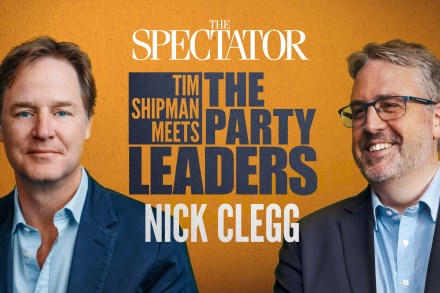
Watch the live recording of Tim Shipman meets Nick Clegg here. With a journalism career spanning nearly three decades, Tim Shipman has broken some of the biggest stories in modern British politics. In our event series, Tim Shipman Meets the Party Leaders, The Spectator’s political editor learns the triumphs and setbacks of party leaders, past and present, as well as reveals the behind-the-scenes stories that you won’t hear anywhere else. In the second instalment of this series, we’re joined by former Liberal Democrat leader Nick Clegg. Shipman and Clegg will discuss the decline of the two-party system, the upending of global alliances, his move to Meta and even the opportunities and threats of AI.

How many people get arrested for terrorism?

From our UK edition

Dying of heat Have this year’s heatwaves really killed 2,700 people? The claim has been made in a paper by Imperial College. – The figure was arrived at by taking the temperature recordings and modelling the theoretical number of deaths based on past heatwave events. However, actual data on deaths tells a different story. The UK Health Security Agency, which measures recorded deaths against a five-year average, declares there was ‘no signal of high mortality above the baseline’ for the week ending 31 May, the first heatwave this year. – As for the second heatwave, provisional data shows there were 768 fewer deaths (or 7.4%) than would have been expected from the five-year average. The later figures might yet be revised upwards.

Let Shabana Mahmood finish the job at the Home Office

From our UK edition

We currently know more about what Count Binface would do in power than Andy Burnham. The joke candidate in the Clacton by-election has published a manifesto that goes into considerably greater detail about what the government’s priorities should be than anything we have yet heard from the man who becomes our prime minister on Monday. Those preparing for a new administration, including the Parliamentary Labour Party and the Civil Service, have had to rely on speculation and briefings to the press. There is no better guide to what we might expect than the analysis of our own political editor, Tim Shipman, in his article. He reports that the incoming premier has a high opinion of the Home Secretary, Shabana Mahmood. That reflects well on him.

2758: Thousa – solution

From our UK edition

Each of the six quartets of initial letters of the Across clues reveal DCLL which equals 750. When correctly arranged, the unclued lights reveal ‘Doc’s seven hundred and fiftieth crossword’. The title ‘Thousa’ is three-quarters of 1,000 which is 750.

Letters: bring on devolution

From our UK edition

The right kind of devolution Sir: Your leading article ‘The Burnham Question’ (11 July) suggests that the putative prime minister’s enthusiasm for devolution might be a good thing, provided that it is the right kind of devolution. Although Andy Burnham would never admit it, devolution of the Manchester and Teesside type succeeds because, in both cases, business is given the chance to thrive. By contrast, devolution to the Scottish parliament and Senedd has stifled economic growth, while providing a platform for nationalist politicians to bash the UK. A true believer in effective devolution would scrap these national institutions and transfer power to business-friendly bodies in cities and regions across the UK.

Beware Andy Burnham’s ‘devolution revolution’

From our UK edition

Andy Burnham is a lucky politician. And Nigel Farage has just given him another piece of surprising good fortune. The Reform leader’s decision to call a by-election so his voters can express their preference for him over a comedian in a dustbin is more than just a narcissistic farce: it is a blessing for Project Burnham. Just as attention should be focused on a man with neither a mandate nor a manifesto for running the nation, Westminster’s gaze is directed once more to the dreary beachfronts of Jaywick and Frinton. Burnham’s unscrutinised, unelected, unready administration moves closer to power while Reform achieves a feat hitherto thought impossible: becoming even more of a vehicle for the ego of its leader.

2757: Obit VIII – solution

From our UK edition

NEIL SEDAKA (anagram of LEEK/NAIADS 23A/7D), who was a fine COMPOSER (1A), SINGER (4A) and PIANIST (36A), died on 27th February 2026. Two of his best-known works, ‘Breaking Up Is Hard To Do’ and ‘Stupid Cupid’, are cryptically suggested by DHOOTIS (39A), an anagram of IS H (sym) TO DO, and AMOUR FOU (21D/17D). First prize D.V.

Which World Cups saw the most red cards?

From our UK edition

To go or not to go? Would Andy Burnham be wise to call a general election? The record of PMs since 1945 who took office mid-term: Anthony Eden called an election straight away and increased the Conservatives’ majority to 60. Alec Douglas-Home waited almost a year after taking office. Lost his majority. James Callaghan didn’t call an election until three years after taking office, when he lost to Margaret Thatcher. John Major didn’t call an election for 16 months, when the parliamentary term was nearly up. Won on a reduced majority of 21. Gordon Brown blinked when he might have called an election in autumn of 2007. Didn’t do so until 2010. Lost his majority. Theresa May called an election roughly nine months after taking office.

Letters: The British Empire was a force for good

From our UK edition

Unjust William Sir: It is a bad idea for schools to be recommending their pupils listen to William Dalrymple’s podcast Empire (‘Striking back’, 4 July), without also suggesting they listen to, for example, Niall Ferguson on the same subject. Dalrymple does not prize the British Empire, but many of us who have studied it in detail admire the many benefits it conferred on its subjects. Balance is essential in educating children and from Dalrymple they will get an unduly pejorative view. Hearing his analysis, one might wonder how such an inefficient and corrupt entity succeeded in governing about a third of the world for a long period. There were two main failures.

Burnham’s unwillingness to face the media should worry us all

From our UK edition

There are so many hopes invested in Andy Burnham’s premiership that disappointment is inevitable. In some cases, it is also desirable. The member for Makerfield has been co-opted by Labour’s soft left and communitarian right for their respective agendas. To govern will be to choose. But a particularly poisoned chalice has been proffered to the next prime minister, one he should dash from his lips. Of all the figures on the left who made the pilgrimage to Makerfield to campaign, the presence of Hugh Grant was most ominous. Perhaps the actor who played the prime minister in Love Actually with such élan was there to school our would-be premier on how to deal with obstreperous American presidents. But Hugh Grant is not just a more metrosexual Cary Grant.

Portrait of the week: No. 10 heads north, Stokes retires and earthquakes hit Caracas

From our UK edition

Home Andy Burnham, who was expected to become prime minister on 20 July, took off his tie and put on a dark T-shirt for a speech in which he said he would establish a ‘No. 10 North’ in Manchester as the ‘nerve centre of a rewired Britain’. He promised council houses, welfare reform and ‘good growth in every postcode’ by means of ‘Manchesterism’. He took no questions. Sir Keir Starmer, the Prime Minister, presented the delayed defence investment plan, and said that spending would rise by £15 billion by 2030. He landed his successor with £4.7 billion of the sum being left unfunded. The Ministry of Defence would also have to find £10.7 billion in efficiency savings in the next four years.

What kills more: heat or cold?

From our UK edition

Absolute mayor Andy Burnham wants more devolution and elected mayors. Do voters want that? – Since 2001 there have been 55 referendums on whether to establish the post of elected mayor. Only in 17 cases was there a majority in favour. – The towns and districts keenest on having an elected mayor were Middlesbrough (84% in favour), Croydon (80%) and Mansfield (70%). – The areas least keen on an elected mayor were Guildford (81% against), Bath (79%) and West Devon (77%). Ratings game Which attracts the biggest TV audience in Britain: Wimbledon or the World Cup? – England’s opening match in this World Cup, vs Croatia, attracted a peak audience of 15.4m. England’s quarter-final defeat to France in 2022 had an audience of 19.4m. – This compares with the 8.

Letters: Burnham is a master brand-builder

From our UK edition

Telling stories Sir: As a filmmaker by training and a marketer by profession, I couldn’t agree more with your leading article (‘Northern soul’, 27 June) on the absence of narrative in our politics. The appeal of figures such as Burnham and Nigel Farage lies in the storyworld they build around themselves – be it via pints shared down the pub, off-the-cuff honesty, or a Monty Python line landing in the Commons. But the PM who stays the course, as any brand-builder learns the hard way, must know two things: their own story, well enough to tell it plainly; and the people they speak to, well enough for them to make it their own. Aim a dull narrative at everyone and you reach no one; tell a story worth sharing and both left and right will see themselves in it.

Who’s the most underrated American?

Bill Kauffman Luther Martin: a voluble and drunken Maryland attorney who walked out of the Constitutional Convention of 1787 after warning his fellow delegates that their handiwork provided the framework for a centralized and militaristic empire that would efface regional distinctions and erode the liberties for which American patriots had fought and bled a decade earlier. An unheeded prophet who breathed the Spirit of ’76. Lionel Shriver Edith Wharton. Hardly unrecognized, but under-taught and too little familiar to the international literary readership (e.g., in Britain). A spectacular stylist, she wrote novels that still sound modern and perfectly accessible 100 years later – and she was a real feminist before the days the word meant humorless pill.

American

How does this week’s heatwave compare with 1976?

From our UK edition

Prime numbers It looks as if Britain will just miss out on having seven prime ministers in the space of a decade as nominations for the Labour leadership election will not open until 9 July (David Cameron left office on 13 July 2016). Have we ever had seven PMs in the space of ten years? – After Lord Liverpool left office on 9 April 1827 Britain saw a further eight premierships within the following decade. Two, however, saw the same person returning to office, so we had seven different prime ministers within the space of ten years.

Portrait of the week: Burnham wins, Starmer resigns and a heatwave hits

From our UK edition

Home Sir Keir Starmer, the Prime Minister, stood outside 10 Downing Street and said that he would resign as leader of the Labour party. Nominations for a successor would open on 9 July (though he still meant to unveil his defence investment plan in time for the Nato summit on 7 July). His decision to depart followed the convincing victory in the Makerfield by-election of Andy Burnham, bringing him back into parliament. An election for mayor of Greater Manchester in his place would take place on 30 July, with Bev Craig, the leader of Manchester City Council, as Labour’s candidate. Mr Burnham packed a suit and tie into which he changed on the train from Manchester Piccadilly to London. He was sworn in as an MP that afternoon. Mr Burnham had received 24,927 votes (54.

How Burnham can avoid Starmer’s fate

From our UK edition

Welcome to the cabaret, Andy Burnham. Last year, the editor of this magazine wrote about ‘Weimar Britain’: the fear that political instability, economic turmoil and rising anti-Semitism was making our country as decadent and dangerous as inter-war Germany. As our sixth prime minister of the post-Brexit decade departs, and our seventh looms into view, we have developed a national addiction to perma-crisis, seemingly trapped in a game of ‘Topple the PM’. We are far from a January 1933 moment. But the joke isn’t funny any more. This turbulence is not inescapable, though. What is needed is a premier able to stay the course, to set out how they want to change Britain and to discover the drive and charisma to bring their party and the country with them.