George III has not been well remembered on either side of the Atlantic. Despite reigning for almost 60 years, in Britain he is known, if at all, for losing the Thirteen Colonies and his madness in his later life. But in America, he is the villain of the national story; in Thomas Jefferson’s phrasing, the ‘Prince, whose character is thus marked by every act which may define a Tyrant’. The Declaration of Independence is a lurid list of his alleged crimes against his American subjects.
But 250 years after that document was signed by the Founding Fathers, George III has been going through a renaissance. In recent biographies, Andrew Roberts and Jeremy Black have argued that he was a much-misunderstood monarch. He ruled America with a light touch – his subjects there paid a 26th in tax of their British equivalents – and was a conservative defender of parliament’s established rights. Had he really been a tyrant, he may have possessed the ruthlessness to cling on to the colonies. Instead, he was a model ruler: patriotic, methodical and kind.

Transatlantic relations have not yet deteriorated to the nadir of 1776. But the past two weeks have covered neither country in glory. Downing Street’s dithering over American access to British bases left the President complaining that Keir Starmer was ‘no Winston Churchill’. Outraged by the White House’s invective, the Lib Dem leader Ed Davey has urged the King to cancel his forthcoming state visit to the United States, since the President ‘repeatedly insults and damages our country’. Unusually for Davey, nearly half of the public agrees with him.
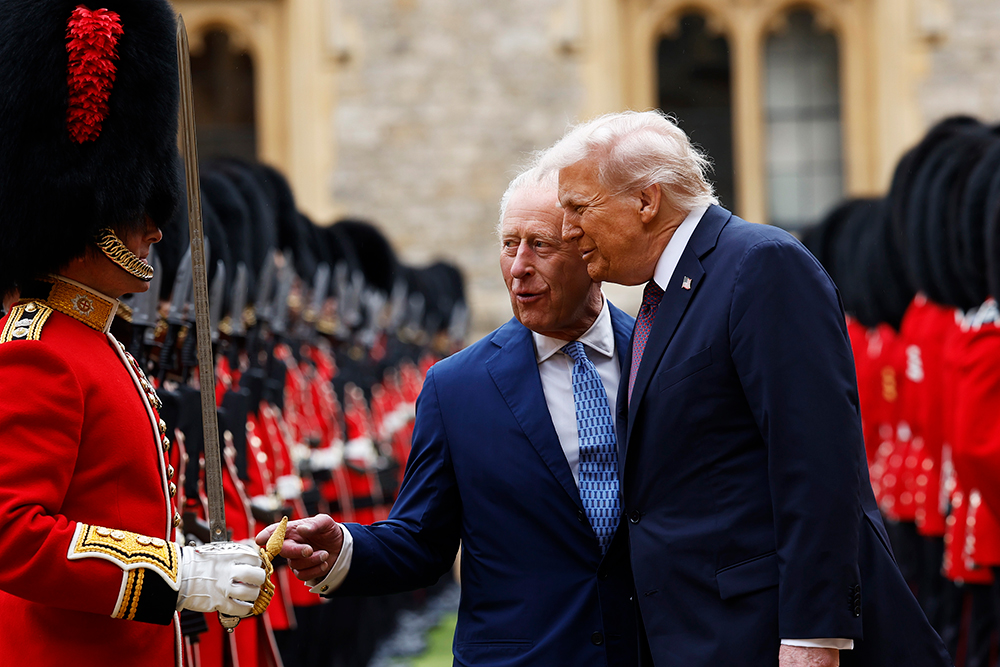
Few presidents and monarchs are more different than the current pair – the reality TV star and the super-fogey. The glitz of Trump Tower is very far away from Poundbury’s neoclassicism. Even if Trump’s state visit last September was thought a success, it didn’t go unnoticed when the King wore his Canadian medals a few days after America’s President had suggested he wanted its northern neighbour to become the 51st state. There is a suspicion that the King enjoys meeting Trump only slightly more than his own troublesome brother.
But George III’s descendant must ignore Davey’s posturing. The King is our greatest diplomatic asset. As Robert Hardman said last year: ‘The world would rather meet British royalty than anyone else we might park on a red carpet.’ There is no one else who can smooth relations and massage the President’s ego like the King.
After America’s independence, the new country was swift to re-establish good relations with the old. When John Adams first met George III as America’s new ambassador, he told his former monarch that he sought to restore ‘the old good nature and the old good humour between people’. While the two countries were separated by an ocean, Adams said, they were of ‘the same language, a similar religion, and kindred blood’. King George told Adams he was ‘the last to consent to the separation’, but the ‘first to meet the friendship of the United States as an independent power’.
Adams and the Founding Fathers struggled to construct a new state without a monarch. Alexander Hamilton understood that a monarch was a check on corruption within republics; in the Federalist Papers he exaggerated a king’s powers to make the more expansive presidency he sought seem modest by comparison. There was even idle talk that George Washington should be crowned. Americans have struggled to escape monarchy’s charms ever since. A direct line can be traced from the Constitutional Convention of 1787 to Trump’s love of the royal family, especially the late Queen.
There is no one else who can smooth relations and massage the President’s ego like the King
Charles III is a great improvement on George III when it comes to charming our American cousins. He first visited Washington as a 21-year-old in 1970, and has served tirelessly the amity of the English-speaking peoples, offering experience that no politician or diplomat could match. Charles has met, in all, ten US presidents.
The ‘Special Relationship’ is a much-abused phrase; British prime ministers often hunt for their Love Actually moment, winning a day’s plaudits by standing up to an over-mighty president. But through all the personal tiffs cooperation endures, from intelligence-sharing via Diego Garcia to the maintenance of the at-sea nuclear deterrent. When American politicians criticise the British government for restricting free speech, they are only lamenting our break from the English liberties they have adopted.
That ‘old good nature’ praised by John Adams has been proven again and again, from Omaha Beach to the mountains of Afghanistan. Rather than cancelling the King’s visit, we must extend that same hand of friendship George III proffered. And, should the President and the King run out of conversation, the pair can at least lament ever having heard the name of Jeffrey Epstein.
Tim Shipman, Adrian Wooldridge and Sophie Winkleman discuss whether the King could be Britain’s Trump card on the latest Edition podcast:





Comments