The Spectator

Letters: How to save red squirrels

Fire-fighting Sir: Your editorial raised the persistent problem of predicting major international disasters in a timely enough way to prepare (‘Eclipses and revolutions’, 29 April). The US academic Joseph Nye said that a good model for wars is to identify three types of cause: deep (the logs for a fire), intermediate (the kindling) and immediate (the sparks). The dilemma is that there are often so many crises on the brink of igniting that preparing early for dozens stretches many governments. Struan Macdonald Hayes, Kent Brain drain from Africa Sir: The majority of Sudanese doctors working in Britain will have been trained in Sudan at local government expense (Eclipses and revolutions’, 29 April).

Our app is better than ever

The new Spectator app has a fresh look and plenty of new features to help you make the most of our world-class writing and broadcasts. Get instant worldwide delivery of the weekly issue to your device from 4 a.m. on Thursdays. Or, get the latest analysis on the breaking news of the day in the Coffee House section. Make the most of your subscription – download the Spectator app today. App highlights: • A daily mixture of political commentary, cultural criticism and humour • Each issue of the weekly magazine published every Thursday at 4 a.m.

Why wasn’t the Foreign Office prepared for Sudan?

The fiasco in Khartoum is being widely interpreted as a tragic failure of intelligence. James Cleverly, the Foreign Secretary, is facing questions about how and why the government was caught unawares as Sudan descended into bloody chaos. There are bodies on the streets of Khartoum, foreigners have fled the city, and those who remain are braced for a resumption of war. A United Nations-brokered truce turned out to be illusory. It is tempting to think of diplomats as an unnecessary luxury in the 21st century, but they are vital The British military managed to evacuate about 100 diplomatic staff but most of the estimated 4,000 British nationals remain in a place that evokes the mayhem of the panicked evacuation of Kabul.

With Love to Mozart

It is the fear by which all fears are fed, The certainty one day you will lie dead. Such fear is groundless, some might call it rot: Consider, where death is there you are not. Truly, this should have no power to scare, Like you, it will be neither here nor there. Just wait, the harmless truth shall be revealed, You flourished as a flower of the field. You won’t be struggling for a breath of air, Or fretting in the dust, still half-aware. Fear not, there’s no foul limbo in-between The fact that you once were and now have been. There is one who evokes this comedy Precisely and entire, most perfectly Don’t speak of hell or everlasting bliss, I simply want to be where Mozart is.

Letters: what’s wrong with adoption?

The sins of the world Sir: Matthew Parris (‘Cross purposes’, 22 April) claims that Paul invented the Church’s teaching about redemption on the cross and that Christ was silent on the topic. This is simply not true. An obvious example is found in the gospel of Mark, chapter 10, verse 45: ‘For even the Son of Man did not come to be served, but to serve, and to give his life as a ransom for many.’ But it is Jesus’s words of institution at the Last Supper which provide the most clear explanation of what his death would achieve: ‘This is my body which is given for you… This cup is my blood of the new covenant poured out for you.’ Jesus could not have been clearer that his death was going to be a sacrifice for sins which he would make on behalf of his disciples.

We’ll miss Rupert Murdoch when he’s gone

The idea that Donald Trump was denied victory in the 2020 presidential election by conspirators determined to fiddle with the electoral system was never more than a fiction dreamed up by a frustrated losing candidate. At such times, the role of the media is crucial. If there were genuine evidence of vote-rigging then it should of course be investigated. But to amplify conspiracy theories for the sake of ratings could have grave consequences. The editorial decision to try to give legs to the stolen election claim is now costing Fox News dearly. This week the company reached a $788 million settlement with Dominion, a company which supplies vote-counting technology for US elections and had been accused of involvement in rigging the election.

Portrait of the week: Strikes, Scottish arrests and stabbings

Home Nurses in England belonging to the Royal College of Nursing union rejected the government’s pay offer and hurried to go on strike over the first May bank holiday and thereafter on chosen dates till Christmas. Members of Unison voted to accept the NHS pay offer. More than 196,000 hospital appointments were cancelled because of the junior doctors’ strike in England the week before. Strikes by public-sector workers contributed to the complete lack of growth in GDP in February, according to the Office for National Statistics. Humza Yousaf, the First Minister of Scotland, declined to suspend Nicola Sturgeon, his predecessor, from the Scottish National party as police investigated its finances.

Song (After Heine)

Who invented the clock, pray tell, time’s division, the ticking spell? An ice-cold man that hated song, who sat and thought the whole night long and listened to the starved mice brawl and beetles pacing in the wall. What invented the kiss? I’ll tell: a lovely mouth, you know full well, that kissed and did not think at all; it was in May, the wondrous call of bird and bloom adorning earth, the sun-god roaring golden mirth.

The pointlessness of renaming the Brecon Beacons

Putting out fires The Brecon Beacons National Park Authority said it was renaming the park because the word ‘beacon’ implies carbon emissions and ‘does not fit with the ethos’. — Many hills in Britain carry the name ‘beacon’ thanks to chains of fires which were lit up to warn of approaching invasion. In Devon alone, 39 beacon sites have been identified. Most famously, beacons were lit in July 1588 to warn of the approaching Spanish Armada after it was spotted off Land’s End, although there is no record of how many fires were lit nor how quickly it took the message to reach London. — Not that the name of the Brecon Beacons really appears to be changing at all.

Letters: The reincarnation of Anne Boleyn 

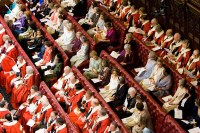
Pension point Sir: I have just read Kate Andrews’s article on junior doctors’ pay (‘Sick pay’, 15 April). While not wishing to get drawn into the rights or wrongs of their strike action, may I point out that in respect of the NHS pension scheme, for the sake of balance, the employee’s pension contribution also needs to be taken into account? The employer may well pay a 20 per cent contribution, but a junior doctor on a salary of either £29,000 or £37,000 (both figures quoted in the article) will pay 9.8 per cent of salary with a consequent reduction in take-home pay. John Etherington Wilsden, West Yorkshire Coach trip Sir: It was good to see mention of the Speaker’s state coach in your leading article (‘Reign or shine’, 15 April).

King Charles and a tale of two coronations

The United Kingdom is one of the last countries in the world to host lavish coronation ceremonies. Europe’s new kings and queens keep these events low-key, whereas the British monarchy continues to be marked by splendour and mass popular appeal. This time last year, there were 3,874 applications for road closures to mark street parties to celebrate Queen Elizabeth’s Platinum Jubilee. A coronation is, of course, far more historic. Yet with just three weeks to go, there have only been 274 street party registrations. In many ways, the disparity is understandable. Elizabeth II had built up huge personal affection over a lifetime’s service.

Portrait of the week: Doctors on strike, Labour on the attack and Tupperware in trouble

Home President Joe Biden of the United States visited Northern Ireland, shook hands with party leaders, talked with Rishi Sunak, the Prime Minister of the United Kingdom (though not about a trade agreement), and went on to the Republic of Ireland, for the 25th anniversary of the Good Friday Agreement. The accountancy firm Johnston Carmichael resigned as auditors to the Scottish National party. Its decision coincided with a police search of the SNP’s headquarters in Edinburgh following the arrest and release without charge of Peter Murrell, the party’s former chief executive and the husband of Nicola Sturgeon, who was the SNP leader and first minister.

Letters: The C of E has become too broad a church

Too broad a Church Sir: I am not implacably hostile to Justin Welby; I share Christian empathy with the Archbishop’s earnest struggles to attract a spiritually dead nation back to the Church of England as described by Dan Hitchens’s article (‘The lost shepherds’, 8 April). However I cannot agree with his strategy. A liberal church is doomed to failure because it’s selling something that we already have. I ask our bishops: what is the Church’s USP? What does it offer that we can’t get elsewhere? The Church used to stand apart as a bastion against a hostile world, but if all it does is follow along behind modern secular fads then it is admitting its own redundancy. If you permit everything, you stand for nothing.

The legacy of Nigel Lawson

Nigel Lawson was the most consequential chancellor in modern British history. He gave the world a case study in how to overturn a failed consensus. He was guided throughout his political career by the political principles articulated when he was editor of this magazine. His legacy is so rich that it offers a wide choice of lessons, three of which stand out for Rishi Sunak today. The first is one that the Prime Minister himself writes about in his article – the importance of preparing for battles. Lawson wanted lasting change and realised that radicalism is pointless without strategy. Tax can only ever be a reflection of the spending rate: to cut tax revenue without spending restraint will only ever lead to the restoration of high taxes.

Portrait of the week: Delays in Dover, decline in house prices and Donald Trump in the dock

Home Britain joined Australia, Japan and nine other countries in the Comprehensive and Progressive Agreement for Trans-Pacific Partnership, or the CPTPP. Kemi Badenoch, Business and Trade Secretary, said that projections of its contribution to the growth of the UK economy, of 0.08 per cent over a decade, didn’t tell the whole story. Teachers voted for more strikes; the Passport Office began five weeks of strikes. The Food Standards Agency investigated allegations that a meat supplier falsely labelled foreign pork as British and mixed rotting and fresh meat. In March, house prices were 3.1 per cent less than a year before, according to the Nationwide – the largest annual decline since July 2009. In March, the pound gained 3 per cent against the dollar.

Letters: The positive case for daycare

Major mistake Sir: Douglas Murray (‘Our poor deluded MPs’, 1 April) contends that John Major is widely regarded as ‘one of the worst prime ministers in living memory’. If so, that seems unfair. Although a greyish figure, Major had to operate with a narrow parliamentary majority and a fractious party. It is often forgotten that he was instrumental in establishing the foundations of peace in Northern Ireland, for which Tony Blair is perhaps given too much credit. Moreover, it is difficult to name any of Major’s successors who didn’t leave No. 10 without black marks on their record. Ranking PMs is something for history.