The Spectator

Screening the PM

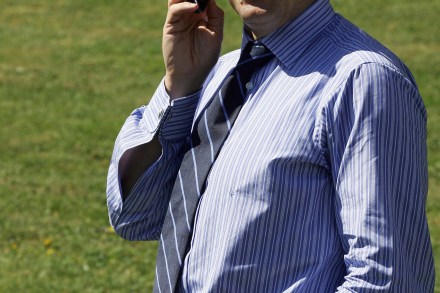
The Times has a cracking story this morning about how everyone in Whitehall is coping—or not—with Gordon Brown’s ferocious appetite for work. Apparently, “His weapon of choice is the mobile phone, which will ring from 6.30am, with the bright-eyed, perky Prime Minister demanding papers, discussing strategy and even asking for feedback.” The Times reports that it has got so bad that people are now not picking up when Brown calls. There’s lots of other great details in the piece; including how he kept Ruth Kelly, Ed Miliband, Hilary Benn at No. 10 until one in the morning while he waited to be satisfied that a moment of danger during the floods had passed. Do read the whole thing.

Brown’s Darfur triumph is also his test

Those who have exchanged fierce views on the invasion of Iraq have a fresh challenge this week: how to react to the UN resolution, tabled by Gordon Brown and Nicolas Sarkozy with support from George W. Bush, to send 19,000 peacekeeping troops to the Darfur region of western Sudan. This is one deployment of foreign troops, we trust, of which all but the most ardent pacifist or isolationist will approve. Over the past four years 200,000 Sudanese have keen killed in rebel fighting and a further two million turned into refugees. If this is not a humanitarian disaster on a scale which justifies international intervention, it would be difficult to conceive of one which did.

What Cameron can learn from Canada

The Conservative Home team are currently touring the Anglosphere and reporting back on the state of conservatism in these countries. This week’s report is on Canada under Stephen Harper (pictured) and makes for interesting reading considering the Tories current predicament. After all the Canadian Conservatives came back from a defeat far more crushing than 1997. To my mind, the key lesson the Tories can draw on from the Harper-led Conservative revival is his success in building internal coalitions on issues. This is something that the Cameron project has been bad at. For instance, lots of Tory members are inherently suspicious of all the talk of global warming.

Fighting words from Cameron, but he’s picking the wrong fight

  Some strikingly martial language from Cameron who is now promising to "give the government a bare knuckle fight over the NHS". What a shame that his strategy is to do this on behalf of the unions, rather than the patients. There is still time to rewrite his dismal NHS policy. Brown is dumping the Blair reform agenda: power to the patients, not the producers (or the "professionals" as the Tories now lovingly call them), should be Cameron's mantra. But this fighting talk is a welcome change of tone.

Have you seen this man?

Iain Dale has his monthly table of shadow cabinet media mentions up and as always it makes for interesting reading. Amazingly, Peter Ainsworth, the Tory environment spokesman, got a mere 57 mentions in July despite the 24/7 media coverage of the floods. Indeed, his Liberal Democrat opposite number Chris Huhne got more attention than Ainsworth as did 18 of his shadow cabinet colleagues. The numbers also show the need for the shadow cabinet as a whole to up its game. Currently, David Cameron gets more press than the 31 members others of it combined. While if Nick Clegg was a Tory he’d be eighth in the table. All of which raises the question of whether the shadow cabinet can continue to carry so many part-timers.

Guardian: Brown planning Spring ’08 poll

The Guardian has a story in today's edition suggesting that Gordon Brown has pencilled in spring 2008 as the time for an election. Apparently, campaign professionals are being sounded out about working for the campaign with polling day planned for sometime before May 1st. This date would have the advantage of short-circuiting the Cameron project without Brown risking a backlash from the country for calling an election just because he’s ahead in the polls that he might face if he went this autumn. What are your predictions for what the result of a spring ‘08 poll would be?

Very possibly the worst idea from a presidential candidate ever

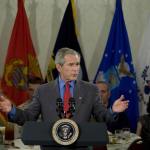
  Some dumb things are said during every presidential campaign but few statements in campaign history can be as reckless, irresponsible and downright idiotic as Republican Presidential contender Tom Tancredo’s proposal that the United States announce that in response to a nuclear terrorist attack it would nuke Mecca and Medina. Tancredo thinks that this would be an effective deterrent. But  it would actually play straight into the terrorist hands: not only would they have pulled off a spectacular on American soil, but the American response world then thrust the world into a full blown clash of civilisations. I know you can say that Tancredo is about as likely to win the Republican nomination as Gordon Brown is to wear that bomber jacket George W.

The challenge for Boris

There is both a must-read and a must-hear on the Boris for London front this morning. First the must-read, Matthew Parris's column in this week's magazine on what Boris needs to do to win. His thoughts on how Boris could prove that he’ll put city above party are particularly smart. While the must-hear is Ken talking about his likely challenger on The Today Programme. He conceded that Boris is the most formidable opponent that he’ll face in his political career but he also previewed his line of attack on him, declaring that Boris was to the right of Norman Tebbit. Red Ken is half-way through Boris’s entire oeuvre at the moment so expect his assault  to consist mainly of lines taken from Boris’s columns.

The revolution enters a new phase

Philip Gould's memo laying out what Gordon Brown needs to do to win an early election makes for fascinating reading. Especially notable is Gould’s belief that elections can’t be won on ‘schools n’ hospitals’ or ‘investment versus Tory cuts’ any more. He writes that: “There is no doubt that the political landscape is changing: Crime, terror, immigration and so on are now the dominant issues. Underpinning these concerns is a growing sense of the power of events beyond our control - globalised economies, international terror, community disintegration and so on....However, public services and the economy are still important, about equal and just below security.

Obama out-hawks Bush and Clinton on Pakistan

Barak Obama just delivered the most important speech of the 2008 campaign so far. Having stepped to Hillary’s left on the issue of meeting with Castro, Ahamdinejad, Chavez et al, he is now going to her right by pledging himself to military strikes on al Qaeda safe havens in Pakistan if Musharraf won’t deal with the problem himself. If, through positions such as this, Obama can establish himself as credible on national security he will have removed one of the major obstacles to him being elected president. Here's the key passage of his speech: “There are terrorists holed up in those mountains who murdered 3,000 Americans. They are plotting to strike again. It was a terrible mistake to fail to act when we had a chance to take out an al Qaeda leadership meeting in 2005.

A cheeky idea

The BBC are reporting that Ed Davey, Ming’s chief of staff, is floating the idea of his officemate Lembit Opik running for mayor of London. This strikes me as a rather desperate attempt by the Lib Dems to get someone with Boris or Ken level name recognition on the ballot. But there’s no denying that Opik’s presence would further liven up the contest.

List your pet hates

Over at Comment Central, Daniel Finkelstein is asking folks what impolite behaviour really gets under their skin in an attempt to draw up a definitive list. He starts us off with David Aaronvitch’s ten suggestions in The Times this morning and adds in a few of his own: people who bellow on their mobiles, make speeches when called on to ask a question, put you on email lists without asking and joke about other people’s weight. I’ll definitely second Daniel on the motion of people who fail to obey the chair’s injunction to ask a question--not speechify--at meetings and add in my current bug bears: people who try and get into a Tube carriage while others are still trying to leave and London cab drivers who ask you where you are going before picking you up.

Spice up their lives

The Spice Girls have set up a website allowing fans to vote for one more city to be included on their world tour. But I fear they might be in for a surprise. You can enter any city you want and, oh so predictably, the internet campaign to send them to Baghdad is already under way, which seems a little unfair on the Iraqis. Where would Coffee Housers vote to send the Spice Girls? Personally, I'd favour Stockholm as retaliation for sending us Abba or the Cheeky Girls hometown of Cluj-Napoca, Transylvania.

Brown to America: I love your country

One of the fascinating things about Brown’s trip to the United States is how while he has kept his relationship with President Bush workmanlike he has been effusive about America in general. Last night on NBC news he told the anchor Brian Williams: I love your country. I mean I'm, I'm a great supporter of everything that you've tried to do. And I look at the history of the United States and you've got people who came to this country, built a great country.If Blair had said this there would have been irritation in this country about his supposed sycophancy but Brown’s remarks seemed to have passed without comment. (Admittedly, they were rather overshadowed by the revelation that Brown and Blair are still in regular touch).

Just not cricket | 1 August 2007

Christopher Martin -Jenkins, The Times’s cricket correspondent and Test Match Special commentator, has an op-ed that is well worth reading on the excessively heated atmosphere during the Trent Bridge Test in this morning’s paper. The game was definitely not played within the spirit of the game. England’s scattering of jelly beans at the crease, apparently designed to distract the Indian batsmen, was pathetically juvenile. (It was a sweet irony that the pumped up victim of this prank, the Indian bowler Zaheer Khan, swung the game India’s way in England’s second innings.) While the beamer that Shantha Sreesanth bowled at Kevin Pietersen was downright dangerous. Let us hope that the last Test of the summer at the Oval is played in a better spirit.

The joy of the Bolshoi

A new swathe of Russians has hit town - dancing ones this time. The Bolshoi Ballet opened in swaggering style last night at the Coliseum with the full three-act version of Le Corsaire. Even paid-up balletomanes have often only seen the bravura duet from Act One. The whole thing was gloriously, unabashedly old-fashioned. The plot is negligible, everyone had at least four costume changes - the heroine sported a dazzling series of little hats, each one cocked at a fetchingly oriental angle - and a rousing finale was reached at 5 to 11 with a cracking thunderstorm and a shipwreck from which hero and heroine managed to extricate themselves with exquisite grace, landing on a rocky foreshore with their finery untouched by the elements. Bliss.

Tony’s last act or Gordon’s first triumph

Tony Blair will not take a bow for this one, and you can bet Gordon Brown won’t give him credit. But it looks like his plan for a peacekeeping operation in Darfur is finally going ahead – pretty much as the draft whose details were released on the day he stood down envisaged. It was a Blair initiative, but is already being spun as a “Brown coup”. An impression which, I feel sure, the Prime Minister will not rush to correct. But as someone said, there’s no end to what you can achieve if you don’t care who takes the credit.

Brown’s poverty of thought

I simply disagree with those who criticised Gordon Brown's Camp David performance in this morning’s press. He struck me as assured, and eloquent. But he has just let himself down in New York, banging on about his last-century approach to poverty reduction. He wants to give Africa the remedy he prescribes for Britain - borrowing a huge pot of cash, then resorting to hand-outs. Not for him the free trade recipe which has transformed Asia. Brown’s instincts lead him to see overseas aid as a government-to-government task, rather than a people-to-people task. The fact is, world poverty has never been lower thanks to the people-to-people miracle of global capitalism.