The Spectator

Letters | 28 November 2009

Not so special Sir: The only ‘disrespect’ Obama can really be accused of is a degree of indifference to the British delusion of a ‘special relationship’ with the USA (‘A special form of disrespect’, 21 November). One would have thought that after the con-trick of Lend-lease, the wholesale vacuuming-up of British nuclear and aviation technology, Roosevelt’s barely concealed desire to see the British empire dismantled and the Suez fiasco, scales might have dropped from post-Churchillian Britain’s eyes. Despite General McChrystal referring to two British Generals as ‘Jacko’ and ‘Lamby’, there is not and never has been a special relationship unless it suited Washington.

Portrait of the week | 28 November 2009

Floods swept Cumbria after 12.4 inches of rain fell in 24 hours (at Seathwaite), the most ever recorded in Britain. Main Street in Cockermouth was more than waist deep in water. Some 1,300 houses were affected, and insurance claims were expected to reach £100 million. PC Bill Baker died in the collapse of the Northside bridge at Workington, away from which he was directing traffic. Six bridges were washed away, and all 1,800 in the county were to be checked, with the Calva bridge at Workington being condemned, separating the town by a 20-mile drive. The floods arrived a day after the government announced in the Queen’s Speech that ‘legislation will be introduced to protect communities against flooding’. Mr Gordon Brown, the Prime Minister, visited the area.

Think-tank battle

The concept of a ‘Red Tory’ is not an easy one to grasp. T he concept of a ‘Red Tory’ is not an easy one to grasp. Is it someone who believes in huntin’, shootin’ and fishin’ for all, or is it an inversion of a champagne socialist: someone who preaches free markets from beneath a flat cap while sipping bitter in a boozer in Bolton? The phrase was invented by Philip Blond, a former lecturer who has attracted a million pounds to set up his own think-tank, ResPublica — launched this week with David Cameron in attendance. His particular beef is with monopolies, and their effect on community spirit. Much to the annoyance of Ken Clarke, the shadow business secretary, he advocates legislation to break up high-street shopping chains.

Troubled waters | 28 November 2009

Amid the wreckage of this week’s floods the most depressing comment came from a government scientist who called for a national register of bridges. If we had a register, he argued, the relevant authorities might in future be better able to predict which bridges are likely to go the same way as Workington’s two went this week. And this — as well as blaming climate change — is how the government machine avoids a glaringly obvious problem. Britain is not short of databases. On the contrary, the taxpayer is groaning under the weight of them. What the country is desperately short of, on the other hand, is decent roads, railways and bridges that will actually withstand the odd rainstorm.

The week that was | 27 November 2009

Here are some of the posts made at Spectator.co.uk over the past week. Fraser Nelson wonders if Britain's economy is turning Japanese. James Forsyth highlights the risk that a hung parliament poses to UK bond market, and makes the case for sending 40,000 troops to Afghanistan. Peter Hoskin spots Lord Mandelson making mischief, and urges caution over the rogue poll. David Blackburn says that President Obama has procrastinated his way to failure over Afghanistan, and asks if the Chilcot inquiry will be any different. Mark Bathgate cries out for the banks to be resolved. Lloyd Evans watches Clegg and Cameron spring a few surprises on Gordon Brown. Daniel Korski wonders who is to blame if the world is cooling. Martin Bright reveals the real broken Britain.

In this week’s Spectator | 26 November 2009

The latest issue of the Spectator is released today. If you are a subscriber you can view it here. If you have not subscribed, but would like to view this week’s content, you can subscribe online now. Six articles from the latest issue are available for free online to all website users: Prepare for a lost decade. Fraser Nelson and Mark Bathgate believe that zombie banks and high unemployment look set to curse our economy as they did Japan’s. A Conservative government could avoid disaster, but only if it is prepared to face the painful reality.   A century ago, leading leftwing thinkers such as George Bernard Shaw subscribed to the vile pseudo-science of eugenics.

CoffeeHousers’ Wall 23 November – 29 November

Welcome to the latest CoffeeHousers' Wall. For those who haven't come across the Wall before, it's a post we put up each Monday, on which - providing your writing isn't libellous, crammed with swearing, or offensive to common decency - you'll be able to say whatever you like in the comments section. There is no topic, so there's no need to stay 'on topic' - which means you'll be able to debate with each other more freely and extensively. There's also no constraint on the length of what you write - so, in effect, you can become Coffee House bloggers. Anything's fair game - from political stories in your local paper, to chat about the latest football results.

Just in case you missed them… | 23 November 2009

...here are some of the posts made on Spectator.co.uk over the weekend: James Forsyth welcomes David Cameron's emphasis on growth, and highlights an important member of the class of 2010. Peter Hoskin looks behind the closed doors of Brussels, and observes a fine line between love and hatred for Peter Mandelson. David Blackburn identifies where to start cutting, and wonders what should be included in a British Bill of Rights. Daniel Korski says it's good that EU job picks are undemocratic. Martin Bright hopes he's wrong about Labour's situation. Susan Hill looks at the divide between real life and virtual life. Rod Liddle wonders why it's unravelling for Dave. Alex Massie adminsters a dose of Sunday Evening Country. And Melanie Phillips spots a smoking iceberg.

Letters | 21 November 2009

Eliot’s anti-Semitism Sir: I yield to none in my love of T.S. Eliot’s work, and have even managed to defend to myself the iffy passages about Jews in his poetry. But the letters that Craig Raine quotes in his review (Books, 14 November) are so blatantly, even honestly, anti-Semitic that they leave no room for doubt; except, it seems, at Faber & Faber. Mr Raine’s attempts to argue the anti-Semitism away present a hilarious and painful spectacle. For example, Eliot writes that Jews are inclined to Bolshevism — a classic Nazi belief. Mr Raine asserts, desperately, that this is a tribute to Jewish iconoclasm. It isn’t; it’s racism. The question is, why does Mr Raine go through such contortions to protect his hero when the evidence is so plain?

Waste of the day

Having been reprimanded by the broadcasting regulator Ofcom for a clutch of on-air errors, this report is just the most recent evidence that the Corporation is now form-filling when it should be programme-making. At times it is as if the viewers are receiving a service that incorporates all that is undesirable: a costly administration unable to stop the broadcasting of abuse but successfully stifling genuine creativity. Programme-makers have already protested: Stephen Poliakoff has stated that the BBC is suffering a ‘crisis of confidence’, presided over by a clutch of ‘Kafkaesque committees’. Their dramatists have even been sent to learn about ‘goodies’ and ‘baddies’.

Speech failure

It is now 12 years since the Queen was first obliged to enter the Palace of Westminster and deliver a speech studded with the most awful New Labour clichés. Over the years, Her Majesty’s dismay during the state opening of parliament has become steadily more visible — and little wonder. As Labour ekes a fifth year out of this parliament, it is bowing out with perhaps the most fatuous and futile agenda of its 13 years in power. But one which, nonetheless, offers useful insights into why this government failed. It was, as a gleeful but unnamed minister said, ‘one of the most political Queen’s Speeches in history’ — this is not something to boast about. But to Gordon Brown, governing is an act of party political violence.

What makes them tick?

Seiko is collaborating with leaders and innovators in a variety of fields to celebrate the release of the Ananta Collection Luxury travel company Abercrombie & Kent annually moves nearly a quarter of a million people around the globe. So for president and chief operating officer Joss Kent, being organised is a given. With 62 offices in 33 countries, A&K is unique in having such a global on-the-ground network. ‘We are the only global company that is still in control of your experience, right down to the nitty-gritty of the detail,’ says Kent.

Christmas Books II | 21 November 2009

Ferdinand Mount Andrew Brown has spent a lot of his life writing about religion, not least for The Spectator. He has never written anything remotely like Fishing in Utopia (Granta, £8.99), but then nor has anyone else. The book tells the story of how the author fell in love with Sweden and everything Swedish, including his first wife, the fishing and the socialism. And when he falls out of love, it is not a straightforward disillusionment, but rather a rueful recognition of how hard it was for a country of dirt-poor farmers to emerge as an industrial nation without losing some of the idealism in the affluence. The descriptions of fishing are as enchanting as anything since Izaak Walton, but in its light and easy style the book is as profound as it is enchanting.

The week that was | 20 November 2009

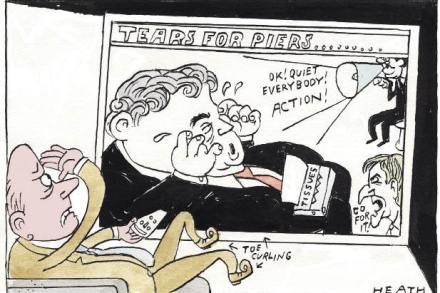
Here are some of the posts made at Spectator.co.uk over the past week. Fraser Nelson congratulates Michael Heath, and introduces Britain’s AWOL ally. James Forsyth praises Chris Grayling’s commitment to elected police commissioners, and finds an example of corruption that is shocking even by the standards of the Karzai government. Peter Hoskin says that Brown has misjudged the Afghan waiting game, and sees Ed Balls dump Gordon Brown into another lose lose situation. David Blackburn argues that Gordon Brown has been hoist by his own petard, and challenges the liberal centre to engage with the BNP. Mark Bathgate explains just quite how inexperienced this government is at economic management. Lloyd Evans reviews a paper thin Queen’s speech.

In this week’s Spectator | 19 November 2009

The latest issue of the Spectator is released today. If you are a subscriber you can view it here. If you have not subscribed, but would like to view this week’s content, you can subscribe online now. Five articles from the latest issue are available for free online to all website users: Con Coughlin believes that Barack Obama’s increasing disregard for Britain’s views is no way to treat an ally whose troops have fought side by side with America since September 11. Obama has become our absent ally; he is practising a very special form of disrespect.

CoffeeHousers’ Wall 16 November – 22 November

Welcome to the latest CoffeeHousers' Wall. For those who haven't come across the Wall before, it's a post we put up each Monday, on which - providing your writing isn't libellous, crammed with swearing, or offensive to common decency - you'll be able to say whatever you like in the comments section. There is no topic, so there's no need to stay 'on topic' - which means you'll be able to debate with each other more freely and extensively. There's also no constraint on the length of what you write - so, in effect, you can become Coffee House bloggers. Anything's fair game - from political stories in your local paper, to chat about the latest football results.
Just in case you missed them… | 16 November 2009

...here are some of the posts made at Spectator.co.uk over the weekend. Fraser Nelson praises Jeremy Hunt’s plan for the BBC, and answers your questions. James Forsyth sees the government commit another u-turn, and argues that Obama’s Afghan position is pennywise but strategically foolish. David Blackburn believes that the BNP remain a party of racists, and finds Gordon Brown at the heart of Labour’s emerging election strategy. Susan Hill says that teenagers living in rural areas are left with nothing to do and nowhere to go. Rod Liddle can’t understand how Britain has become the global capital of busybodies. And Alex Massie condemns a betrayal of justice and common sense.

Spelling it out

Sympathy for Gordon Brown is not a common emotion in Westminster, but this week only the coldest heart could fail to feel for the Prime Minister. It is mortifying to have misspelt the name of a fallen soldier, even if the mistake was minor. To have his misery played out in front of the national media, complete with a taped conversation of him being berated by the soldier’s mother, can only have been devastating. But the power of this sorry episode lies in the truths it represents. Jacqui Janes, whose Grenadier Guardsman son Jamie, 20, was killed last month, was richly entitled to berate the Prime Minister for the lack of equipment in Afghanistan. It was his decision to fight two wars on a peacetime military budget.

Can Cameron deliver?

There is something about ‘compassionate conservatism’ that infuriates the Labour party, as if the very phrase were a deceitful contradiction in terms. The notion sends Gordon Brown into apoplexy. He can handle the Tories talking about economic efficiency or immigration, but he regards concern for the poorest as a subject purely for Labour. And for too many of the last 20 years, it has been. As a result Labour has incubated, through its dysfunctional welfare state, the most expensive poverty in the world. From the beginning of David Cameron’s leadership, he has focused on this outrage.