The Spectator

CoffeeHousers’ Wall, 22 August – 28 August 2011

Welcome to the latest CoffeeHousers' Wall. For those who haven't come across the Wall before, it's a post we put up each Monday, on which — providing your writing isn't libellous, crammed with swearing, or offensive to common decency — you'll be able to say whatever you like in the comments section. There is no topic, so there's no need to stay 'on topic', which means you'll be able to debate with each other more freely and extensively. There's also no constraint on the length of what you write — so, in effect, you can become Coffee House bloggers. Anything's fair game, from political stories in your local paper, to chat about the latest football results.

Just in case you missed them… | 22 August 2011

…here are some of the posts made at Spectator.co.uk over the weekend. Fraser Nelson says the far right should be allowed to ‘perish in the sunlight’, and ponders the end of Gaddafi. James Forsyth applauds a burst of common sense from Eric Pickles, and says that Europe is likely to become a key issue in the autumn. David Blackburn examines the Starkey affair, and notes that the row over human rights has far reaching consequences. Martin Bright calls for action on youth unemployment. And the Arts Blog gets to grips with the final instalment of Chris Mullin’s diaries.

Letters | 20 August 2011

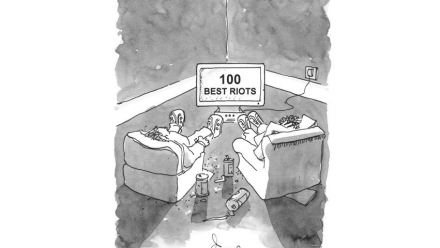
Violent by nature Sir: Amongst the sociological why-oh-why-ery trying to explain the motivation of the rioters, the simplest explanation has been overlooked: human nature is utterly violent and wicked. Conservatism — the heir of Christianity in this respect — realises this. Recent work on violence in hunter-gatherer societies has demolished sociological explanations of violence: it is not society that makes people violent but our nature, evolved over the last 100,000 years. Forty per cent of Rousseau’s ‘noble savages’ in primitive hunter-gatherer societies die at the hands of another. We are all descended from successful rapists.

Barometer | 20 August 2011

Bishops and rioters From the Scarman report to ‘Faith in the City’, no British riot is complete without politicians and churchmen weighing in with the answers. It was no different in the 13th century. In 1272 the townsmen of Norwich rioted after the prior to the city’s monastery refused to allow the arrest of monastic servants charged with murder. The cathedral was burned down. In response, the bishop excommunicated the townsfolk, but two years later the Pope was asked to pass judgment. He deferred to Edward I, who besides ordering the townsmen to pay 3,000 marks towards rebuilding the cathedral, produced an agreement with a phrase worthy of a primary school headmistress: ‘That all parties should be real friends.