Robert Thompson
• Democracy in Zambia Sir: There are undoubtedly dubious countries in Africa but Daniel Kalder (‘Mr Blair goes to Kazakhstan’, 5 November) is wide of the mark in including Zambia among them. It may not be perfect but its record in terms of human rights and relative freedom from corruption is one of the best on the continent. Zambian presidents since independence have respected the will of the majority when their time was up. The recent election that led to a change of government is a shining example of the country’s political maturity, one which Mr Blair might usefully point to in his conversations with his more authoritarian clients.
Another worldSix cosmonauts have completed an experiment in which they were isolated inside a container for 520 days to simulate a voyage to Mars. A similar experiment, the Lunar-Mars Life Support Test Project between 1995-97 isolated crews for 91 days at a time. These were some of the findings: — Without natural daylight, the astronauts found themselves gravitating towards days of 28 to 30 hours, of which they would work nearly 20. — After emerging from the chamber it took hours for astronauts’ eyes to recover vision at distances greater than six metres. — Many reported having trouble adjusting to the variable noise levels outside the chamber, the noise inside being constant. — Several reported feelings of mild depression after leaving the chamber.
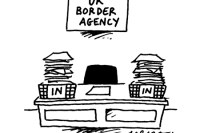
HomeTheresa May, the Home Secretary, blamed Brodie Clark, the head of the UK Border and Immigration Agency’s ‘border force’, for ‘relaxation of border controls without ministerial sanction’. Mr Clark left the agency, declaring that what Mrs May had said in parliament was wrong. An online petition urging ministers to reduce immigration gained more than 100,000 signatures, making it eligible for a Commons debate. The Duke and Duchess of Cambridge are to live in the apartment at Kensington palace once occupied by Princess Margaret. A road-cleaning crew found a pot of gold jewellery in a drain in Slough.
No job in government has its path so strewn with banana skins as that of Home Secretary. A missing criminal, slippery detainee or foreign terrorist can end a ministerial career. And with tens of thousands of people going in and out of the country daily it can happen at any moment. The Home Office has become the department where political careers go to die. There is a reason for this. As John Reid famously said of the Home Office’s immigration operation, it is quite simply ‘not fit for purpose’. Five years on from that bleak assessment, the situation has not improved. A case this summer highlighted the problem.

A further selection of our reviewers’ favourite reading in 2011 Richard Davenport-HinesAmidst the din, slogans and panic of modern publishing, my cherished books are tender, calm and achieve a surpassing eloquence by dint of tightly controlled reticence. Anthony Thwaite’s Late Poems (Enitharmon, £10) are written by a man of 80. Each of them is word-perfect: some recall dead parents; others foreshadow Thwaite’s death; and throughout there is the clear, crisp wisdom, pensive sadness and absence of confessional self-pity that show a mastery of language and feeling. Amos Oz’s Scenes from Village Life (Chatto, £12.99) is set in an Israeli pioneer village which is being chi-chied with boutique wineries as jackals circle in the surrounding countryside.
Here are some of the posts made on Spectator.co.uk over the past week: Fraser Nelson says that we ought to remember the living too, and questions whether Britain really is a safe haven. James Forsyth asks why Chris Huhne is still shunning shale, and observes the Italian domino effect. Peter Hoskin reports on the eurozone's cash-flow problems, and wonders where David Cameron now stands on the 50p tax. Daniel Korski sets out the new German Question. Jonathan Jones gives his take on that Rick Perry gaffe. Nick Cohen argues that history is moving against Alex Salmond and his bid for independence. Rod Liddle reckons that Theresa May's a goner. Alex Massie watches George Osborne slay the Tobin tax.
Welcome to the latest CoffeeHousers' Wall. For those who haven't come across the Wall before, it's a post we put up each Monday, on which — providing your writing isn't libellous, crammed with swearing, or offensive to common decency — you'll be able to say whatever you like in the comments section. There is no topic, so there's no need to stay 'on topic', which means you'll be able to debate with each other more freely and extensively. There's also no constraint on the length of what you write — so, in effect, you can become Coffee House bloggers. Anything's fair game, from political stories in your local paper, to chat about the latest football results.
…here are some of the posts made at Spectator.co.uk over the weekend. Fraser Nelson says Ruth Davidson "could have been designed by a committee of A-lister fantasists". James Forsyth says the Union needs a champion to take on Alex Salmond. Matt Cavanagh gives his take on the latest immigration revelations. Rod Liddle asks how you lose 124,000 people. Daniel Korski says Labour haven't figured out a position on the EU either. Alec Ash reports of shocking protests in Tibet. Nigel Jones describes the unique Bonfire celebrations in Lewes. On the Arts Blog, Patrick O'Flynn shares some of The Jam's hidden gems. And Michael Fallon answers the Book Blog's literary questions.