1-2
From our US edition
A woman’s workSir: I enjoyed Andrew M. Brown’s article on the rise of the ‘Dalis’ (28 January). As the working wife of a man who earns more than I do, I drew comfort from the fact that more and more women are becoming the main breadwinners. At the same time, it is irritating to think of all those useless men sitting about dreaming while their wives slave away from home. Perhaps we will all eventually reach the same conclusion as our more militant sisters — we don’t really need men at all.
From our US edition
Bonus cultureSome have called for an end to a ‘bonus culture’ in banks and big firms. But bonus culture has been around a long time… — Around the year ad 70, Roman legionnaires received bonuses of 25 denarii to supplement their salaries of 225 denarii. — Bonuses were recorded by 14th-century Florentine banks, with one employee of the Peruzzi Company receiving 40 lire to supplement a salary of five times that sum. — In 1965 India passed the Payment of Bonus Act, which entitled employees to a bonus of 8.33 per cent of their salary, and at least 100 rupees, providing they worked for more than 30 days in a year. Who’s unbalanced?Nicolas Sarkozy says ‘Britain has no industry any more’.

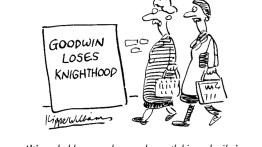
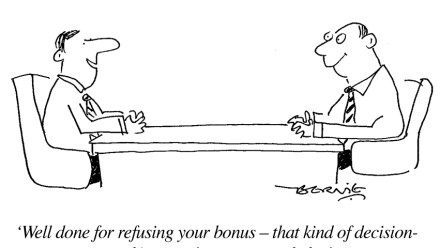
HomeFred Goodwin, the former chief executive of the Royal Bank of Scotland, was stripped of his knighthood by the Forfeiture Committee, which said he had ‘brought the honours system into disrepute’. Stephen Hester, the chief executive of the Royal Bank of Scotland, turned down a £963,000 shares-only bonus payment in the face of ‘enormous political pressure’. The Institute for Fiscal Studies said that the government was borrowing £2.9 billion less this year than expected and that there might be room for tax cuts in the budget next month. A man in Bournemouth found blue spheres of jelly an inch across on his lawn after a hailstorm.
When George Osborne became Chancellor, he took charge of a very large zombie bank with a medium-sized government attached to it. The Royal Bank of Scotland was nationalised in 2008 with assets of £2.2 trillion, almost four times state annual spending. The difference between RBS being run well or run badly could be counted in billions. The man who would make that difference was Stephen Hester, a top-flight banker who in a moment of madness had accepted the contract from Alistair Darling’s Treasury and got to work. He would not have known how his new masters would turn on him, demanding that he refuse his bonus of nearly £1 million. Hester’s bonus was almost twice as large last year — but then, fewer people cared.
Here are some posts made on Spectator.co.uk during the past week: Fraser Nelson champions John Sentamu as the next Archbishop of Canterbury, and examines Labour’s chances in the 2015 election. James Forysth contemplates what Chris Huhne’s resignation means, and reminds us of the coalition's political purpose over Fred Goodwin. Peter Hoskin has a six-point guide to the IFS’ Green Budget, and disregards Miliband's Eurospecticsm. Jonathan Jones highlights the importance of the Scottish referendum question, and reveals the tuition fee effect. Sebastian Payne looks into the politics of the Falklands standoff. Peter Robins asks how dangerous cycling really is.
...here are some posts made on Spectator.co.uk over the weekend: Fraser Nelson finds the prospect of party political police commissioners depressing, and doubts that 51 per cent of Scots really back independence. James Forsyth notes that Douglas Alexander understands Labour's problem, and comments on the party's attempt to seize on Stephen Hester's bonus. Peter Hoskin breaks down Labour's new line on the benefits cap, and reports on the government's problems over Hester's bonus. Daniel Korski reports on the worsening situation in Syria. On the Book Blog, Gloria de Piero reveals her love of books about recent US politics, and her respect for Das Kapital.