Bishop 2
Too busy for terrorism Sir: The Islamisation of countries surrounding Israel may not necessarily constitute an increased threat to the Jewish state (‘Israel under siege’, 24 November). The reluctance of Hezbollah to open a second front in Israel’s north in the past weeks may be due to the recent economic recovery of south Lebanon following massive infrastructure destruction extending up to south Beirut in the 2006 war with Israel, largely funded by Iran. Similar economic growth and prosperity in the West Bank may well be responsible for the virtual absence of any recent anti-Israel violence. (A recent television report on West Bank high schools showed many kids wearing orthodontic braces — a sure contra-indication to becoming a suicide bomber.
Local elections in Catalonia, which could lead to an independence referendum, put the region in a race with Scotland to be the world’s next new nation. Some other contenders: NEW CALEDONIA A collectivity of France governed by a high commissioner and a 54-seat territorial congress. Rejected independence in a referendum in 1987 but will hold another one in 2015. MTHWAKAZI A kingdom until the late 19th century, now part of Zimbabwe. A MTHWAKAZI independence party was founded earlier this year. CABINDA Former Portuguese Congo, now a province of Angola. Detached from the rest of Angola by strip of the Congo. BIAFRA Breakaway republic from Nigeria which existed between 1967 and 1970 before being reabsorbed.
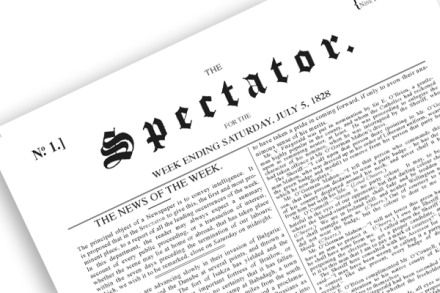
Anyone picking up a newspaper in recent days will have noticed that the press has been writing a lot about itself. Lord Justice Leveson’s inquiry into press practices and ethics has created anxiety at a time when newspapers were already haemorrhaging sales and influence. David Cameron’s government’s response to the report is nervously awaited, and a group of 42 Tory MPs is urging him to seize a ‘once-in-a-generation’ chance to regulate the press. They threaten to rebel if he doesn’t. The Prime Minister will be vilified whatever he decides to do. As the oldest continuously published weekly in the English language, The Spectator has seen this all before. The technology changes, but the principles do not.
Home Rotherham Borough Council took away three children from foster parents because they belonged to the UK Independence Party. ‘If the party mantra is, for example, ending the active promotion of multiculturalism I have to think about that,’ said Joyce Thacker, Rotherham’s Strategic Director of Children and Young People’s Services. Rochdale Council said that 12 of its workers were being investigated following the conviction last May of nine men who ran a child sex ring. Greater Manchester Police said that boys ‘were victims of physical and sexual abuse’ by the late Sir Cyril Smith, the MP for Rochdale, in the 1960s. Boris Johnson was mistaken for Boris Becker in Delhi on a tour promoting London business.


Fresh from the jungle, Nadine Dorries is the Spectator's diarist for this week. As well as observing that each of her 11 fellow contestants on I'm a Celebrity: Get Me Out of Here! was 'probably more right wing than I am', she also explains why she thought it was acceptable for a 'working class woman to take a few parliamentary days off' to go on the show, writing: Many MPs take jollies from the House of Commons, but in seven years I have never spent a day away from my Westminster duties. This is why I thought I would be allowed to devote a few days of my holiday to a reality TV show. As far as I could see, the Conservative party is intensely relaxed about such absences. Some of its MPs have full-time careers in the City, others run family businesses or write books.
Anyone picking up a newspaper in recent days will have noticed that the press has been writing a lot about itself. Lord Justice Leveson’s inquiry into press practices and ethics has created anxiety at a time when newspapers were already haemorrhaging sales and influence. David Cameron’s government’s response to the report is nervously awaited, and a group of 42 Tory MPs is urging him to seize a ‘once-in-a-generation’ chance to regulate the press. They threaten to rebel if he doesn’t. The Prime Minister will be vilified whatever he decides to do. As the oldest continuously published weekly in the English language, The Spectator has seen this all before. The technology changes, but the principles do not.