Bronze
The Duke of Cambridge deserves credit for bringing his influence to bear on the growing tragedy of the elephant, whose population is being decimated by poaching. But his advisers should have been quicker to dissuade him from one aspect of his campaign: the threat to dispose of his grandmother’s ivory collection. That Africa’s elephant population is in peril from poachers is not in doubt. Of a total of 400,000 living in the wild, around 50,000 were illegally killed last year, way beyond the numbers which the population could naturally withstand. The future is looking bleak, too, for wild rhino, 1,000 of which were poached in Africa last year out of an estimated total of 25,000.
Caution over wind Sir: While the broadcast media have assailed their audiences with simplistic yet blanket coverage of the floods crisis, it behoves Christopher Booker to provide a long overdue critical perspective of the Environmental Agency (‘Sunk!’, 15 February). The two main tenets of his article have been ignored by most, if not all, other journalists. With something approaching delicious irony we are then treated in the same issue to a self-serving missive from the Renewables UK boxwallah Jennifer Weber (Letters, 15 February).
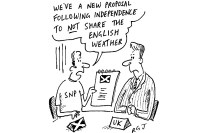
Home It would be ‘extremely difficult, if not impossible’ for an independent Scotland to join the European Union, José Manuel Barroso, the president of the European Commission, said on British television. Alex Salmond, the leader of the Scottish National Party, said that if an independent Scotland was not allowed to use the pound, it would cost the rest of the United Kingdom £500 million in transaction costs per year, and Scotland would refuse its share of the national debt. Mark Carney, the governor of the Bank of England, warned that uncertainty produced by a referendum on EU membership would mean that businesses held off from making investment. The Unite union called off a strike at the Faslane and Coulport naval bases in the Clyde.