The Spectator

The Spectator at war: A warless world

From ‘Dreams of a Warless World’, The Spectator, 19 December 1914: In truth, there is only one way to stop war, and that is for some one Great Power first to disarm the whole world, and then to see to it that no one shall again take up arms. Universal tyranny may create universal peace. Nothing else will. We know, of course, all that can be said about that tyrant being an International Committee, but such an International Committee must be run by somebody, and it would soon become merely a tyrant under an alias. A superimposed peace and true freedom cannot keep house together.

The Spectator at war: A Scandinavian league

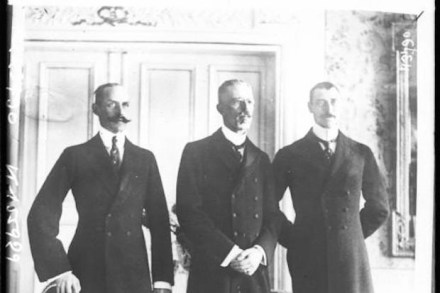
From A Scandinavian League, The Spectator, 19 December 1914: THE meeting of the three Scandinavian Kings at Malmo is an event of more than momentary importance. According to the official statement, this meeting was arranged in order that the three Kings might confer upon the neutrality of their respective countries, especially in connexion with the interference with trade which results from the war. That such a Conference should take place on such a subject is eminently reasonable, and will certainly be welcomed. in this country, as it appears to have been throughout Scandinavia. As regards the interference with trade, of which all the three Scandinavian countries are reasonably complaining, our own view as a belligerent necessarily differs somewhat from their view as neutrals.

The Spectator at war: Coastal retreats

From News of the Week, The Spectator, 19 December 1914: A SMALL squadron of German cruisers made an attack on Hartlepool, Whitby, and Scarborough on Wednesday morning. It seems that the squadron consisted of at least three battle cruisers and two armoured cruisers. Hartlepool and Scarborough were shelled simultaneously for about half an hour shortly after eight o'clock. The bombardment of Whitby began at nine o'clock, and it is possible that one or more of the ships which took part in it had come from Scarborough, which is only fifteen miles distant. As soon as the presence of the German ships was reported a British patrolling squadron tried to cut them off. They then retired at full speed and succeeded in escaping in the mist.

Jeremy Clarke’s heartbreak and A.L. Kennedy’s dislike of dates

A.L. Kennedy Novelist I dislike dates. It’s either a yes, or a no. Why date? Sadly, I am both bad at reading the signals which indicate the outbreak of a date and attractive to people who are bad at signals. This means that I end up — often in coffee shops — with a variety of men who suddenly exhibit enthusiasms I cannot return. Among these gentlemen would be the portly chap in Day-Glo cycle shorts, the man who brought an ugly plant with him, the man who cried, the man who talked unendingly about the rows he used to have with his last girlfriend, the man who sat next to me, miserably unable to speak at all, and the man who got crawling-drunk and then confessed something, mumbly, before hiding in his hotel room for a day.

The Spectator at war: An Englishman’s home

From The Spare Bedroom, The Spectator, 12 December 1914: OUR national individuality has been threatened, with the result that all English institutions are at this moment specially dear to the Englishman. We are prepared to defend them from first to last—from the system of government to the spare bedroom. Indeed, though we may jestingly call the spare bedroom the least among our typically English institutions, it counts for a good deal in our national life. It has been instrumental in the development of the middle-class Englishman, and be, after all, is the typical Englishman. Among the bourgeoisies of Europe the English- man alone can have a friend to stay. He regards the power to dispense hospitality as a necessary part of his dignity.

Matthew Parris and Dan Snow reveal their strangest dates

Matthew Parris Spectator and Times columnist One evening in 1995 some friends brought a friend to dinner at my flat. His name was Julian, and he seemed rather bright. As it happened, the Nigerian ecological campaigner and fighter for rights of the Ogoni people, Ken Saro-Wiwa, was in prison having been convicted on trumped-up charges of incitement to murder. His case had become an international cause célèbre. His conviction carried the death penalty; and he was widely believed to face death by hanging. I was in full ‘old African hand’ mode, and announced to the table that I knew the ‘African mindset’ too well to believe Saro-Wiwa would actually be executed, now that the eyes of the world were on Nigeria.

Melissa Kite and Celia Walden recount their most disastrous dates

Celia Walden Journalist and novelist It was supposed to be an interview, not a date. But Piers seemed to have other ideas. The Ivy dinner crowd was particularly amusing that day: Baroness Thatcher to our left, Louis Walsh with a group of X Factor ingénues to our right. In the corner, Salman Rushdie was seducing some improbably beautiful girl. Piers spent most of our lunch foghorning out greetings and taunts across the restaurant. I remember thinking that I’d never met anyone quite so loud. Over sticky toffee pudding Piers casually informed me that I was the chosen one. When I dropped him an email the following morning to thank him for lunch, I felt it only fair to add as a postscript: ‘So that you know, it’s never, ever going to happen.

The Spectator at war: Modern warfare

From The New German Artillery, The Spectator, 12 December 1914: We shall have to wait a long time, we surmise, till the merits or demerits of the various new weapons are proved.Perhaps before judgment is delivered other new weapons will be introduced. The data are still very imperfect. We cannot say yet, for instance, whether the old-fashioned grenade will enjoy a revival in future wars owing to the fact that the out- flanking of one huge conscript array by another similar army is in many circumstances impossible. and that therefore the trenches of the two armies approach within a few yards of one another on a parallel front. At this moment, at all events, the rival armies in Flanders can easily throw hand-grenades across the narrow gap which separates them.

The Spectator at war: The picture of guilt

From The Crowning Proof, The Spectator, 12 December 1914: THE crowning proof that German intrigue and cynicism caused the war was provided in the remarkable statement which Signor Giolitti, the ex-Prime Minister, made in the Italian Chamber last Saturday. He said:- "On August 9th, 1913, the Marquis Di San Giuliano, then Foreign Minister, sent me the following telegram: Austria has communicated to us and to Germany her intention of acting against Serbia, and defines such action as defensive, hoping to establish in regard to the Triple Alliance a casus foederis, which I regard as inapplicable.

James Runcie’s date didn’t turn fruity, despite him tasting of ‘erotic raspberries’

James Runcie Author of The Grantchester Mysteries I met Lucy at a dinner party in the early 1980s. By the main course we were holding hands under the table. She told me she was about to go travelling in China. By the time we reached the pudding I told her that I would wait, and after a bit of late-night kissing (in which I was told that I tasted of ‘erotic raspberries’) she went home. She phoned before she left. ‘When we sleep together it will be like a wedding night,’ she said. Then she added that her stepfather wanted to meet me. Even I thought this was a bit speedy, but I went to see him all the same. We talked about politics, the miners’ strike and the Cold War.