The Spectator

Cameron’s reaction to the Charlie Hebdo attacks has been depressingly predictable

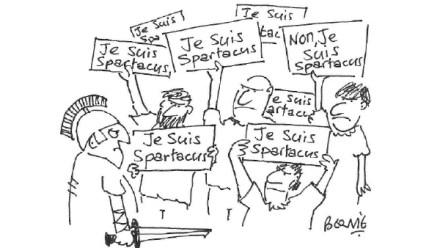
Last Sunday, David Cameron marched through Paris in solidarity, so it seemed, with those who stand up for free speech. Anyone who thought he meant it must now be crying out, ‘Je suis un right Charlie!’ Hardly had the march finished than the Prime Minister had rediscovered his other side: the one which reacts to terror by threatening yet more surveillance, more state control. He has promised to revive, in the Conservative manifesto, the ‘-snooper’s charter’ which would allow the state to retain indefinitely information about every email we ever send, every telephone call we ever make. Not only that. He added a further measure: he wants to ban all kinds of encrypted communications which the security -forces struggle to decipher.

The Spectator at war: Senior service

From ‘The Windfalls of Soldiering’, The Spectator, 16 January 1915: This war is unlike all our previous wars, in that it was known from the very beginning that a vast number of men would be required. Thus it was plain at once that the only speedy way of reaching the front for the civilian of military age was by enlistment. But for the man over military age who has never had any military training, yet burns to do something active, the windfalls of soldiering still seem to be just possible. No doubt the vast majority of the older men would find it impossible to leave the country, or give their services for the whole war, even if they had the opportunity, but they can be drilled in Volunteer Training Corps.

The Spectator at war: Commercial interference

From ‘The British Reply and American Comments’, The Spectator, 16 January 1915: We have not the slightest desire to punish American commerce or any neutral commerce. Our whole object is to destroy our enemies, and it is only so far as American commerce interferes with that object that we interfere with American commerce. That the interference may have to be greater if the Germans continue to violate the rules of humanity and civilization ought to be sufficiently obvious to any outside critic.

The Spectator at war: Taking cover

From ‘News of the Week’, The Spectator, 16 January 1915: Friday's Times contains on its "leader" page an appeal to our soldiers by Sir William Osier in regard to inoculation against typhoid. He tells the soldiers in simple but stirring language that it is their bounden duty to keep themselves in as perfect a state of health as possible, and reminds them that their worst foes are those of their own camp—the foes of disease. He recalls the fact that in South Africa the bacilli of disease killed twice as many men as did the bullets of the Boers. He next goes on to point out how inoculation safeguards men from the terrible dangers of enteric, and how alight is the indisposition caused by inoculation.

The Spectator at war: Supportive opposition

From ‘Lord Curzon's Speech’, The Spectator, 9 January 1915: We are glad to record, though in no way surprised to find, that Lord Curzon takes a very serious and very clearly defined view of the duties of the Opposition during a period of national crisis. He recognized that part of these duties in war time can never, as in peace, be the effort to substitute one set of politicians for another in the work of government. On the contrary, in war the support of the King's Government in all the measures which they may think necessary for ensuring the safety of the country becomes the essential duty of the Opposition. But while this is so, it is in no way to be desired that the Opposition should forgo its function, may, obligation, of criticism.

The Spectator at war: Belgian jobs for Belgian workers

From News of the Week, The Spectator, 9 January 1915: A Commission, under the chairmanship of Sir Ernest Hatch, has been appointed by the Government to advise and help local Refugee Committees in establishing workshops for Belgian refugees. In the recent Report of the Belgian Refugees Committee it was pointed out that the refugees were divided into three groups: (1) Those trained in industries in which there happens to be a shortage of British labour, such as the armament, woollen, agricultural, and motor industries. (2) Those trained in industries in which there is no shortage: tailors, dressmakers, printers, ironmongers, fancy goods makers, and carpenters. (3) Those who have had a professional training.

The Spectator at war: Keep cool and be British

From News of the Week, The Spectator, 9 January 1914: It is with deep regret that we record the loss of this battleship, which was sunk in the Channel by a submarine on the morning of Friday week. The ‘Formidable’ was a vessel of 15,000 tons, and was completed in 1901. She carried a company of between seven hundred and eight hundred officers and men. The disaster happened in very heavy weather, and only two hundred and one lives were saved. The ship was struck about two o'clock, and remained afloat till after three o'clock. Four boats were launched under terribly difficult conditions, due not only to the heavy seas, but to the list of the shop. One of these boats, a barge, capsized, and several men were thrown out.