The Spectator

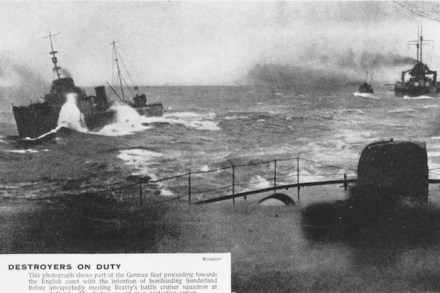
The Spectator at war: Light boats

From 'News of the Week', The Spectator, 10 July 1915: IN the western theatre of the war there has been a great deal of talk about renewed German activity on a huge scale, of imperative orders by the Kaiser to take Calais without delay, of vast movements of troops, and of huge guns intended when Calais is taken to bombard Dover and cover the invasion of England by aluminium boats. What special virtue there is in aluminium for this purpose does not appear. We can understand that aluminium was a very proper metal out of which to construct boats meant to be dragged across the Syrian Desert in order to facilitate the passage of the Suez Canal.
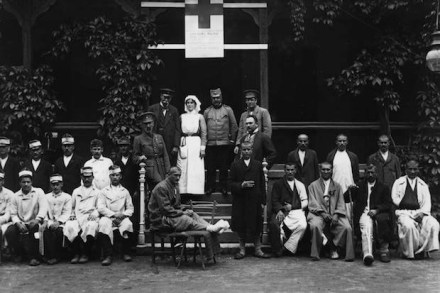
The Spectator at war: A breath of fresh air

From ‘The Open-Air Hospital at Cambridge’, The Spectator, 3 July 1915: We are all familiar with the open-air treatment of various diseases, and particularly of tuberculosis, but no such startling lesson on the value of open air for wounds, and one may say for practically all diseases, has been given to us before. Even diseases like pneumonia and bronchitis, which by intelligent doctors are still commonly sheltered from any rigours of temperature, have followed an extraordinarily prosperous course in the open-air wards at Cambridge. Of course in winter the wards were bitterly cold. That did not matter much to patients who had plenty of blankets and hot-water bottles. The real sufferers were the nurses.

The Spectator at war: Russian retreat

From ‘News of the Week’, The Spectator, 3 July 1915: During the week the Russians have been falling back in Poland and Galicia, and the Germans have been thrusting forward. The papers speak, indeed, of two million Germans invading Russia under Marshal von Mackensen. The Russian retreat, however, whether to the east or to the north, has been perfectly orderly, and the Germans have not made any material advance towards their main object, which, of course, is to destroy the Russian field armies. Indeed, the incidental fighting has in many places been favourable to the Russians.

The Spectator at war: A struggle in Bohemia

From ‘John Hus’, The Spectator, 3 July 1915: Here and there we have indications that this titanic struggle has not led the Czechs to renounce their hatred of all that is German. The misfortune of Bohemia has ever been her geographical position. As an outpost of the Slav races only the mountain ranges with which she is surrounded have saved her from being overrun by the conquering Teutons. But her strong, natural frontiers would have been ineffective against "peaceful penetration" had it not been for the intense race-consciousness of the country. For a thousand years the Teuton has struggled in different ways to dominate the land, to capture her Church, her schools, her freedom, and her soul; and for a thousand years the Czech has continued the unequal resistance.

Letters | 2 July 2015

How to fix Detroit Sir: When I last flew over my native Detroit five years ago, vast tracts of it still resembled Machu Picchu. From the ground, it was little better; in what had been a prosperous Italian-American neighbourhood when I lived there in 1964, there were only five houses left standing. Stephen Bayley (Arts, 27 June) marvels that ‘You could buy an entire house for $10,000’ — but in truth the taxes needed to support Detroit’s notoriously corrupt governments are so high that you can’t give them away unless they are in one of the few islands colonised by the middle classes. Indeed, the city filed for bankruptcy in 2013, with debts estimated at around $20 billion. I have no problem with gentrification, and I’ve done a fair bit of it myself.

Barometer | 2 July 2015

Bank job Should we buy shares in companies which print banknotes in expectation of one getting to print millions of drachma notes? — In May, according to the ECB, there were a total of 17.6bn euro notes in circulation. Given that Greece accounts for approximately 2.5% of the GDP of the eurozone, 441m of these were Greek, and might need replacing with drachma notes in the event the country leaves the euro. — However, there is already a good business in printing replacement euro notes. In May, 2.76bn notes were taken out of circulation and 2.88bn new ones were put into circulation.