The Spectator

The Spectator at war: A war within a war

From ‘Sir Ian Hamilton's Despatch’, The Spectator, 10 July 1915: THE despatch from Sir Ian Hamilton which was published in the papers of Wednesday leaves the reader in no doubt that the Dardanelles campaign is one of the most difficult operations of war ever undertaken by an army. We have tried, and are still trying, to take by assault positions which may be compared with Gibraltar, the fortified walls of Heligoland, the ancient Roman Capitol, or any other famous fortified place of which the very name stands for impregnability.

The Spectator at war: Mass movement

From ‘The Impulse of the Phalanx’, The Spectator, 10 July 1915: A mass of men, large enough to be beyond the control of any immediate words of command, is a difficult thing to stop when once it has been set in motion. It acquires a momentum of its own. The wills of individuals become submerged in the will, or what may pass for the will, of the mass. They respond to an impulse which nobody could precisely trace or define. In a very rough manner one sees the process at work when a crowd comes out of a public building.

The Spectator at war: Light boats

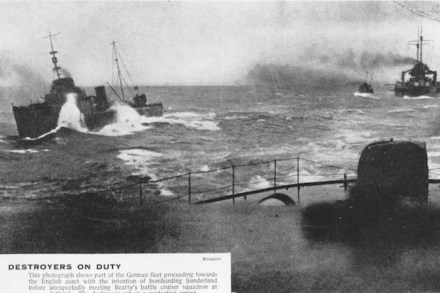
From 'News of the Week', The Spectator, 10 July 1915: IN the western theatre of the war there has been a great deal of talk about renewed German activity on a huge scale, of imperative orders by the Kaiser to take Calais without delay, of vast movements of troops, and of huge guns intended when Calais is taken to bombard Dover and cover the invasion of England by aluminium boats. What special virtue there is in aluminium for this purpose does not appear. We can understand that aluminium was a very proper metal out of which to construct boats meant to be dragged across the Syrian Desert in order to facilitate the passage of the Suez Canal.

The Spectator at war: A breath of fresh air

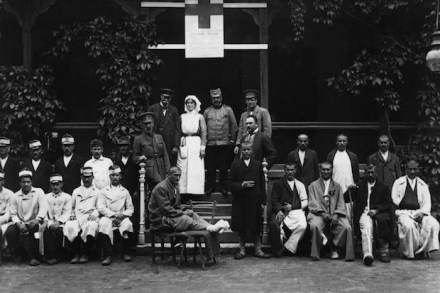
From ‘The Open-Air Hospital at Cambridge’, The Spectator, 3 July 1915: We are all familiar with the open-air treatment of various diseases, and particularly of tuberculosis, but no such startling lesson on the value of open air for wounds, and one may say for practically all diseases, has been given to us before. Even diseases like pneumonia and bronchitis, which by intelligent doctors are still commonly sheltered from any rigours of temperature, have followed an extraordinarily prosperous course in the open-air wards at Cambridge. Of course in winter the wards were bitterly cold. That did not matter much to patients who had plenty of blankets and hot-water bottles. The real sufferers were the nurses.

The Spectator at war: Russian retreat

From ‘News of the Week’, The Spectator, 3 July 1915: During the week the Russians have been falling back in Poland and Galicia, and the Germans have been thrusting forward. The papers speak, indeed, of two million Germans invading Russia under Marshal von Mackensen. The Russian retreat, however, whether to the east or to the north, has been perfectly orderly, and the Germans have not made any material advance towards their main object, which, of course, is to destroy the Russian field armies. Indeed, the incidental fighting has in many places been favourable to the Russians.

The Spectator at war: A struggle in Bohemia

From ‘John Hus’, The Spectator, 3 July 1915: Here and there we have indications that this titanic struggle has not led the Czechs to renounce their hatred of all that is German. The misfortune of Bohemia has ever been her geographical position. As an outpost of the Slav races only the mountain ranges with which she is surrounded have saved her from being overrun by the conquering Teutons. But her strong, natural frontiers would have been ineffective against "peaceful penetration" had it not been for the intense race-consciousness of the country. For a thousand years the Teuton has struggled in different ways to dominate the land, to capture her Church, her schools, her freedom, and her soul; and for a thousand years the Czech has continued the unequal resistance.