2324: In the frame | 14 September 2017
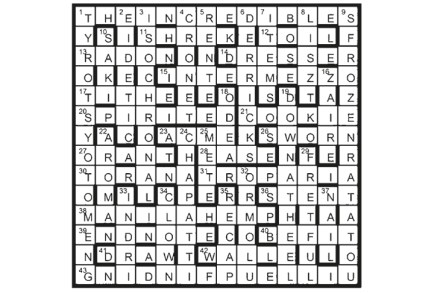
11, 42 and perimeter entries are titles of COMPUTER-ANIMATED FILMS. First prize B. Midgley, Ettington, Stratford-upon-Avon Runners-up Arabella Grandage, Bradenham, Bucks; D.G.
11, 42 and perimeter entries are titles of COMPUTER-ANIMATED FILMS. First prize B. Midgley, Ettington, Stratford-upon-Avon Runners-up Arabella Grandage, Bradenham, Bucks; D.G.
For Church of England vicars who worry less about what they will preach on Sunday than whether there will be any parishioners to listen to them, the latest findings of the British Social Attitudes Survey will make grim reading. For years the number of people professing religious belief in Britain has hovered around the 50 per cent mark. Now it seems to have dived decisively, plunging from 52 per cent to 47 per cent in just a year. According to a survey we are no longer a Christian country, but then neither — for all the squeals over sharia law — are we becoming much of a Muslim country, or indeed any other religion. Just 6 per cent of us profess a faith other than Christianity, down from 8 per cent last year. Our established national church is declining fastest of all.
The future of Lord’s Sir: Roger Alton (Sport, 2 September) has hit the spot and no doubt touched a nerve or two at the MCC. The club thinks it has been fair to all members in giving them a say in the future development of Lord’s, but it has sent out in an email to members a video which presents only the case for the committee’s preferred masterplan. Every respected speaker on that video, including my former captains Mike Brearley and Mike Gatting, are ‘pro’ the masterplan. Although some objections to it are raised, not one speaker is featured to endorse the aesthetic and financial benefits of the alternative Rifkind-Morley plan — which would have a completely different effect on the Nursery End of the ground.
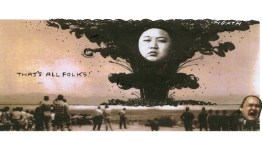
More or less a million One in 79 Britons is now a millionaire thanks to property price rises. The word is first recorded in 1821, when £1 million was worth £100 million now. More modern-day values of millionaire: £24 million: 1956, when Cole Porter’s song ‘Who Wants to Be a Millionaire?’. featured in the film High Society. £20 million: 1962, when the Glaswegian song ‘Ma Maw’s a Millionaire’ was recorded. £7.8 million: 1975, when Dr Hook released their song ‘The Millionaire’. £1.7 million: 1998, when Who Wants to Be a Millionaire? began on British television. Bigger bangs A North Korean nuclear test was estimated as the equivalent of 50,000 tonnes of TNT. How does that compare historically?
For Church of England vicars who worry less about what they will preach on Sunday than whether there will be any parishioners to listen to them, the latest findings of the British Social Attitudes Survey will make grim reading. For years the number of people professing religious belief in Britain has hovered around the 50 per cent mark. Now it seems to have dived decisively, plunging from 52 per cent to 47 per cent in just a year. According to a survey we are no longer a Christian country, but then neither — for all the squeals over sharia law — are we becoming much of a Muslim country, or indeed any other religion. Just 6 per cent of us profess a faith other than Christianity, down from 8 per cent last year. Our established national church is declining fastest of all.
Home On being asked if she meant to lead the Conservatives into the next election, due in 2022, Theresa May, the Prime Minister, said: ‘Yes. I’m in this for the long term.’ Echoing Peter Mandelson’s remark in 2001, she said: ‘I’m not a quitter.’ Research by Conservative Home found that 52 per cent of Conservative party members wanted her gone before 2022. A memo from Lynton Crosby sent in April, before Mrs May called an early election, turned up in the Mail on Sunday: ‘Clearly a lot of risk involved with holding an early election, and there is a real need to nail down the “why” for doing so now.’ The Duchess of Cambridge announced that she was expecting her third child.
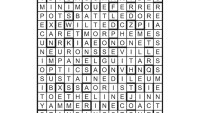
A Ambition, A Aorist, B Battledore, C Caret, C Cashed, C Coact, C Coalman, C Cuttoes, D Dioxan, D Disaccharides, D Drop, E Eerie, F Ferrer, G Goering, G Guitars, H Heteros, I Ileum, I Impanel, I Impecuniosity, I Interrupts, J Jinn, K Kraits, L Lanolin, M Melanesian, M Minim, M Morphemes, N Neurons, N Nonets, O Optics, P Pots, Q Quince, R Reassessments, R Re-echo, S Seville, S Standing stone, S Sustained, T Toe the line, U U-boat, U Undines, V Vivisect, W Wilted, X Xema, Y Yammer, Z Zenith. First prize Andrew Vernalls, Thame, Oxon Runners-up Andreas Fabian, Dunsden, South Oxon; and A.
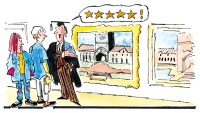
Walhampton School The ethos at this prep school on the edge of Hampshire’s New Forest is very much one of living life to the full; history lessons involve re-enactments of the Battle of Hastings on horseback or the Battle of Trafalgar on a lake. Every year pupils go to ‘camp’ for a week at the end of the summer term; activities include day trips to RNLI stations, visits to local historical sites and a week on the Isle of Mull. Horse riding is also part of the curriculum, with a stable-full of ponies available for lessons. Walhampton describes itself as encompassing the ‘Swallows and Amazons spirit’, and aside from its fantastic location, it’s easy to see why.

New drive to promote ‘British values’ in schools The recently appointed Ofsted chief inspector, Amanda Spielman, has vowed to press ahead with the ‘active promotion of fundamental British values’ in schools. Speaking to an audience at Wellington College, Ms Spielman said that the terror attacks in London and Manchester had brought into ‘stark relief’ the scale of the threat posed by extremism in Britain. It was essential that the country’s children were equipped with the ‘knowledge and resilience’ required to confront the violent rhetoric peddled by those who ‘put hatred in their hearts and poison in their minds’, she said.
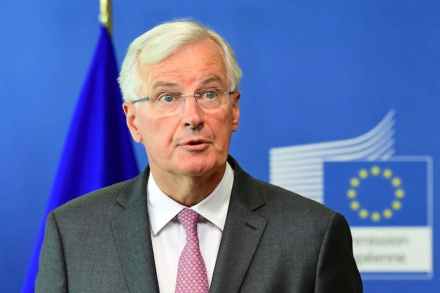
There is a growing perception that Britain is floundering in its EU negotiations, with a professional team from Brussels running rings around our bumbling amateurs. It is an idea that is being put about by the EU’s chief negotiator, Michel Barnier, who this week appealed for Britain to begin ‘negotiating seriously’. As he has found out, the strange dynamic of British public debate at present means that EU spin is repeated uncritically by those hostile to Brexit. It can seem, at times, as if we are in the grip of hysteria normally seen during the final days of an election campaign. This is not to say that the British side has been faultless. The government has struggled to articulate the clear case for Brexit that we heard during the Leave campaign.
Campus censoriousness Sir: I am so grateful to Madeleine Kearns for having the courage to speak out about her experiences at university when others, including myself, remain silent (‘Unsafe spaces’, 26 August) . I have done the reverse of Madeleine in that I, a young American woman, moved from New York City to the UK for graduate school. One of the main factors in this decision to continue my education here is because I feel I have more academic and intellectual freedom. The idea of a balanced argument at my undergraduate university was ‘neoliberal’ versus ‘radically liberal’. We spoke of the importance of diversity, but political diversity was never considered.
Ethnic ethics Actor Ed Skrein withdrew from a cartoon film after protests that he had the wrong ethnic background to play a Japanese-American. Some famous performances which, on the same principle, could be regarded as unacceptable: — Laurence Olivier blacked up to play the lead role in the 1965 film of Othello. — Andrew Sachs, son of a German Jew, played Manuel the Spanish waiter in Fawlty Towers in 1975 and 1979. — Eddie Redmayne, who is not disabled, played Stephen Hawking in the 2014 film The Theory of Everything. — Lin-Manuel Miranda, who is of Puerto Rican descent, played founding father Alexander Hamilton in the Broadway musical Hamilton, which he also wrote.

There is a growing perception that Britain is floundering in its EU negotiations, with a professional team from Brussels running rings around our bumbling amateurs. It is an idea that is being put about by the EU’s chief negotiator, Michel Barnier, who this week appealed for Britain to begin ‘negotiating seriously’. As he has found out, the strange dynamic of British public debate at present means that EU spin is repeated uncritically by those hostile to Brexit. It can seem, at times, as if we are in the grip of hysteria normally seen during the final days of an election campaign. This is not to say that the British side has been faultless. The government has struggled to articulate the clear case for Brexit that we heard during the Leave campaign.
Home Sir Keir Starmer, the shadow Brexit secretary, announced a change in Labour’s policy by saying that he wanted Britain to stay in the single market and customs union during a transition period after Brexit, which could be ‘as short as possible but as long as necessary’. The French government denied that senior French diplomats had said they wanted to see Brexit talks make progress by proceeding to questions of trade. ‘We need you to take positions on all separation issues,’ said Michel Barnier, the European Union’s chief negotiator. British sources denounced M. Barnier’s ‘inconsistent, ill- judged and ill-considered comments’.

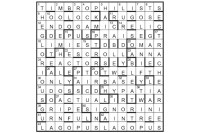
The event was THE GLORIOUS TWELFTH (1D/29) (12 August, opening day of the grouse-shooting season). Remaining unclued lights bring to mind ‘grouse’: LAGOPUS LAGOPUS SCOTICUS (43/19: scientific name); RUGOSE and ROGUES (11 and 3: anagrams); GRIPE and BLEAT (39 and 25: synonyms).
In defence of General Lee Sir: In your leader ‘America’s identity crisis’ (19 August) you state that ‘When General Lee emerged as a leader of that rebellion [the secession of the Southern states], we said that he had no cause that stood up to scrutiny.’ The irony is that Lee did not disagree with that view. Unlike Jefferson Davis and other Confederate leaders, he was opposed to secession and believed that the Union should be kept intact. Nor was he an enthusiast for slavery. A slave owner by proxy, he appears to have loathed the experience. In 1856 he wrote to his wife saying that ‘In this enlightened age, there are few I believe, but what will acknowledge, that slavery as an institution, is a moral & political evil in any Country.

George Tomlinson, the post-war education secretary, declared that politicians should leave exams to the teachers because ‘the minister knows nowt about curriculum’. Today, however, the curriculum seems to be in a state of permanent revolution. The new GCSEs, for example, are marked on a nine-point scale: a grade of 7 or above indicates what used to be an ‘A’. For every five students who hit the 7 threshold, only one will get 9, the top mark. How employers are meant to understand this is another question. The GCSE overhaul is the latest of a series of reforms, started by Michael Gove seven years ago, which are intended to ‘restore confidence’ after years of grade inflation. During the Labour years, ministers denied that exams were getting easier.