The Spectator

Letters | 16 May 2019

Labour’s fence-sitting Sir: James Forsyth writes that Mrs May and Mr Corbyn are ‘not, in fact, that far apart’ (‘May’s compromising position’, 11 May). To many, the Labour left is simply playing its very old game of sitting on the fence over the EU. The electorate have spotted it, and Labour paid for it in the local elections. Some of us are old enough to remember Harold Macmillan’s withering mockery of the Labour attitude to the then Common Market in the early 1960s. It recalls the words of the old song: ‘She didn’t say yes and she didn’t say no; she didn’t say stay and she didn’t say go!’ The reason for Labour’s contorted behaviour was the same then as now.
Mind the gap | 16 May 2019

This week the Institute for Fiscal Studies announced a five-year study into inequality in Britain, to be led by the economist Sir Angus Deaton, a Scottish academic who recently won the Nobel prize for economics. It is to be welcomed, because it will widen the scope of a debate that has been too narrow for too long. Britain’s problems with inequality stem not from an unfair distribution of income but from patchy provision of public services, which are often far better in wealthier areas than in poorer ones. As the IFS makes clear in a report to launch its initiative, income inequality in Britain is not rising — how-ever much the Labour party would like to tell us it is.

to 2405: Satanic

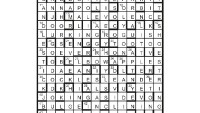
DEVILS at 33D (its ‘essence’ is ‘EVIL’) is linked with ‘Malevolence’ (13) and ‘Roguish’ (19) and Devil’s CANDLESTICK (1), ON HORSEBACK (3), LIVERY (7), DOOR (14), SHOESTRINGS (17), ELBOW (27), APPLES (29) and ISLAND (32).   First prize F.A.

Letters | 9 May 2019

Scrutinising charities Sir: Toby Young was right to raise questions about War on Want’s links to the Stop Trump campaign (4 May). The public rightly hold charities to high standards of behaviour, and charities are required to follow clear rules around political activity. We will be scrutinising the charity’s activities, and the issues raised by Toby Young, closely as part of an ongoing case into the charity. Similarly, we have examined concerns about the activities of a range of charitable thinktanks, and last year issued a regulatory alert to all charitable thinktanks on the register, including to warn them about unacceptable political activity.

Monarchy matters

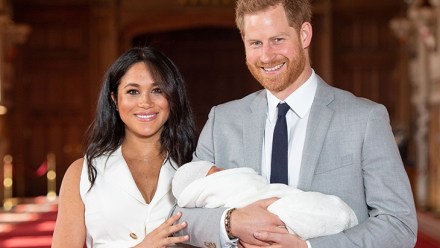
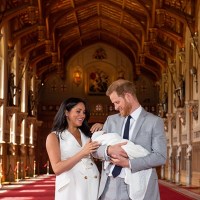
Strictly in terms of its implications for the succession, the arrival of the Duke and Duchess of Sussex’s son this week was not the most important of royal births. The boy has been born seventh in line to the throne, but that position can be expected to fall rapidly once the Cambridge children begin to marry. He is not born to be king, and may never even be granted the title of prince. Nevertheless, the birth has attracted wide attention and celebration, inspiring front-page headlines on foreign newspapers and eliciting interest in Britain from types of people who don’t normally care about royal events. Partly this is down to the new baby’s parentage.

Portrait of the Week – 9 May 2019

Home John McDonnell, the shadow chancellor, blamed Theresa May, the Prime Minister, for leaking details of talks between the government and Labour over Brexit. He said she had ‘blown the confidentiality’ of the talks and ‘jeopardised the negotiations’. He was annoyed that the Sunday Times had said she would agree to a customs union, something predicted four days earlier by the Daily Telegraph. Rory Stewart, the new International Development Secretary, said the Conservatives had to accept the ‘short-term pain’ of a Brexit compromise with Labour. David Lidington, May’s right-hand man, admitted that the failure to reach a Brexit agreement meant that the EU elections on 23 May ‘do have to take place’.

to 2404: 1+2 = 3+4

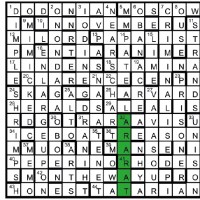
The first and second letters of the unclued lights are the same as the third and fourth ones. All the solutions are words or one phrase eight letters long. ARARAT at 32 Down matches the pattern but is only six-letters in length and had to be highlighted.   First prize D.

How to fight Bolshevism

From 10 May 1919: The heart of the country is always for moderation. Nothing could show this more plainly than the recent by-elections. It was felt that the Prime Minister had been given too clean a sheet of paper to write his policy on, and that it would be good for him to feel that the country had criticism to offer, and was, moreover, able to put on the curb. But this balancing process was not, and never is, a violent swoop towards pulling down everything that exists. There was certainly nothing revolutionary in it.

Full transcript: Douglas Murray in conversation with Roger Scruton

What does it mean to be a conservative? Last night, The Spectator brought together Douglas Murray and Roger Scruton to discuss that question. Here is the full transcript of their conversation: Douglas Murray: Some months ago, The Spectator said to me that they would like me to do an event and who would I like to do it with. And I said I'm very used to doing events with my enemies and spend rather too much time with them and would like to spend the evening with a friend. And they said: anyone in particular? And I said first choice, Roger Scruton. And a lot of things have happened since we agreed to get together with you all. Sir Roger and I have known each other for almost 20 years now.

Barometer | 2 May 2019

Great shakes Shale gas commissioner Natascha Engel resigned in protest at what she called ‘absurd’ restrictions on fracking — in particular rules which state that fracking operations must cease. Has anyone ever been harmed by a tremor at magnitude 0.5? — The Richter scale was devised by seismologist Charles F. Richter in 1935. It is a logarithmic scale, each ascending number marking an increase of approximately 31 times the amount of released energy. — The largest recorded earthquake, in Chile in 1960, measured 9.5. A tremor less than 4.0 is unlikely to cause damage and one of 2.0 or below unlikely even to be felt. — A tremor of 1.

Portrait of the week | 2 May 2019

Home Of those who voted Conservative in 2017, 53 per cent intend to vote for the Brexit party in the EU elections on 23 May, according to a YouGov poll. Brandon Lewis, the Conservative party chairman, said: ‘As a government, our first priority is not to have to fight the EU elections,’ adding that there was still time to cancel them if parliament approved the Brexit withdrawal agreement reached by Theresa May, the Prime Minister. Labour’s National Executive Committee agreed party policy should be to hold a referendum (with a question yet to be decided) if it could not get changes to the government’s deal or precipitate a general election. The Conservatives said they always expected to do badly in this week’s local elections.

How to lose elections

When a political party is in trouble, we see infighting, leak inquiries, resignations, mass loss of council seats, dismissals and botched attempts to depose the leader. But when a party implodes, something different happens: it loses the ability to defend or explain itself. An imploding party can and will lose any argument, no matter how strong its track record. The Tories entered this terminal stage under John Major after the disastrous local elections of 1995, which were followed by their landslide defeat of 1997. With the party now having had its worst set of election since 1995, it looks very much like they might be entering it again.

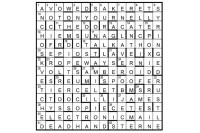
to 2403: Hexad

The second and fourth letters of six unclued lights gave abbreviations of the states forming New England: ACATER (13) Connecticut, ERNIE (24) Rhode Island, AMBEROID (27) Maine, ANCHOS (1D) New Hampshire, KVETCHED (22) Vermont and SMEAR (34) Massachusetts. NAG/LEND (17/36) is an anagram of ENGLAND suggesting ‘New England’.   First prize Mike Conway, Grantham, Lincs Runners-up John Sparrow, Padbury, Bucks; G.H.

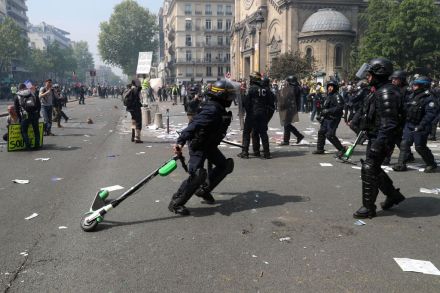
In pictures: May Day protests in Paris turn violent

Hundreds of people have been arrested after violent May Day clashes in the centre of Paris. Tens of thousands of demonstrators took to the streets of the French capital to mark the event. Stone-throwing protestors clashed with police, as officers – more than 7,000 of whom were deployed – responded with tear gas. Gilets jaunes, who have held anti-government protests weekly since November, teamed up with May Day marchers.