The Spectator

It’s time for ministers to stop hiding behind unpublished ‘scientific advice’

From the outset of the Covid-19 crisis, the government was determined that scientists would play a central and highly visible role. The Prime Minister set the tone in his first daily press briefing, when he addressed the nation flanked by the chief medical officer and the chief scientific adviser. The message was clear: this was a government that cherished, not rejected, experts. They were not going to be kept in a back room, but would be there to explain the reasoning behind all policy-making. But this new relationship between government and scientific establishment risks going sour. Professor Neil Ferguson of Imperial College advised the government that Covid-19, if left unconfronted, could take 500,000 lives: almost as many as are killed each year by all other causes put together.

2455: Shadow boxing solution

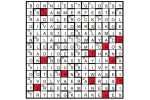
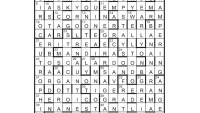
The unclued lights are the four Labour MPs who stood for election as Labour’s leader to succeed Jeremy Corbyn: 11, 18/12, 28/16 and 36/41. The red squares reveal ANGELA RAYNER, the deputy leader. First prize Sara MacIntosh, Darlington, Co.

Covid-19 update: Cancer deaths, A&E and the lockdown effect

The Spectator brings you the latest insight, news and research from the front line. Sign up here to receive this briefing daily by email, and stay abreast of developments both at home and abroad. News and analysis  Slogan update. After ‘Stay alert’ comes: ‘Keep our distance, wash our hands, think of others and play our part. All together.’Delays to cancer surgery will lead to almost 5,000 deaths, according to the Institute of Cancer Research. Analysis from Fraser Nelson below.The UK has sold government bonds with a negative interest rate for the first time ever: £3.75 billion worth, maturing in July 2023 with an average yield of -0.003%.Cambridge University said it will switch to online lectures in the next academic year.

Covid-19 update: How many furloughed jobs will come back?

The Spectator brings you the latest insight, news and research from the front line. Sign up here to receive this briefing daily by email, and stay abreast of developments both at home and abroad. News and analysis  The number of people claiming unemployment benefits in the UK rose to 2.1 million in April in the biggest jump since records began in 1971.One in three private sector workers now has some of their wages paid for by the government.The official number of UK coronavirus deaths is now more than 44,000. The number of care home deaths is down 31% on the previous week, according to ONS data.Primary school pupils in Reception, Year 1 and Year 6 may return to school from 1 June.

Covid-19 update: Measuring the damage of lockdown school closures

The Spectator brings you the latest insight, news and research from the front line. Sign up here to receive this briefing daily by email, and stay abreast of developments both at home and abroad. News and analysis Children from better-off families spend 30% more time on home learning than those from poorer families, according to new research from the Institute for Fiscal Studies.Missing a third of a year of school could cut pupils’ lifetime earnings by 4%, a German study says. More below.More than 500,000 people have accessed a suicide prevention course over the past three weeks, according to a suicide prevention charity.Trains in England are running at increased frequency and stations have put in place crowd control measures.

Covid-19 update: Boris Johnson declares war on obesity to tackle the virus

The Spectator brings you the latest insight, news and research from the front line. Sign up here to receive this briefing daily by email, and stay abreast of developments both at home and abroad. News and analysis Boris Johnson has declared war on fat as an increasing body of research suggests a link between obesity and Covid-19 deaths. James Forsyth has the details below.Some 20% of Londoners are thought to have caught Covid-19 and now less than 24 people a day in the capital are being infected with the virus, a Cambridge model predicts. This chimes with testing data below.The model also suggests that one in five children and one in nine adults – 6.5 million in total – are understood to have contracted the virus.

Covid-19 update: Will antibody tests be a gamechanger?

The Spectator brings you the latest insight, news and research from the front line. Sign up here to receive this briefing daily by email, and stay abreast of developments both at home and abroad. News and analysis  The UK has approved a new antibody test for detecting Covid-19. Details below.It could take ‘many months’ to restart NHS services, according to experts from three leading think tanks. The news comes as A&E attendance fell to its lowest level on record.A study from the University of Manchester has claimed that 29% of the UK population may have already had Covid-19 by the end of April.Plans for the NHS Covid-19 tracing app have been leaked after officials put the documents online by mistake. Details below.

Portrait of the week: Europe’s lockdowns ease, England stays alert and Broadway stays shut

Home The government changed its slogan from ‘Stay home, protect the NHS, save lives’ to ‘Stay alert, control the virus, save lives’. Authorities in Scotland, Wales and Northern Ireland refused to adopt it. The day after a 13-minute televised speech to the nation by Boris Johnson, the Prime Minister, the government published a 50-page Recovery Strategy. A 14-day quarantine would bind anyone entering the country (with exceptions, such as people from France). Everyone should continue to work from home if possible, but workplaces ‘should be open’, apart from those required to be closed.

What would a perfectly socially-distanced UK look like?

Safety first The government was criticised for its new coronavirus slogan, ‘Stay alert’. What are the most common safety slogans in use in workplaces?— ‘Safety is our number one priority’— ‘Safety is no accident’— ‘Take five and stay alive’— ‘The key to safety is in your hands’— ‘No safety, know pain’The word ‘alert’ doesn’t appear until number ten: ‘Stay alert, don’t get hurt’.Source: safetyrisk.

Letters: It’s not so easy to boycott Chinese goods

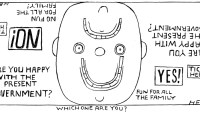
Jobs for all Sir: Charles Bazlington championed Universal Basic Income in last week’s magazine (Letters, 9 May). It is welcome to see innovative ideas being discussed at a time of unprecedented economic crisis. Might I suggest that if we wish to empower citizens, not just pay them, we instead look to provide employment via a National Job Guarantee? A guaranteed job at the living wage backed by the state and administered by national and local government as well as the charity and private sectors. This crisis has proved that people need not only money but purpose, camaraderie with colleagues, and the pride of a ‘job done well’; they want to provide for their families and contribute to society. We have plenty of work that needs doing.

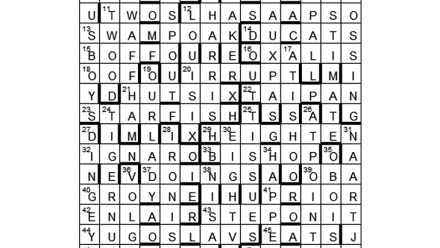
2454: 17 Across Solution

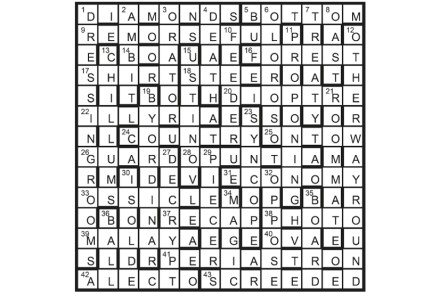
The thirteen unclued lights are all breads, hence the puzzle’s real title at 17A. First prize Nicholas Grogan, Purley, SurreyRunners-up Clare Reynolds, London SE24; Mrs E.

Covid-19 update: A £516 billion deficit?

The Spectator brings you the latest insight, news and research from the front line. Sign up here to receive this briefing daily by email, and stay abreast of developments both at home and abroad. News and analysis A leaked Treasury report warns the UK could face a 1970s-style ‘sovereign debt crisis’ unless the Chancellor introduces new taxes, freezes public sector wages and ends the pensions triple lock. Details below.The UK economy contracted by 2% in Q1, the biggest drop since the financial crash.Self-employed workers can now apply for an income support grant of up to £7,500.Covid-19 hospital admissions are falling more slowly in the north of England than the rest of the country.

Full Text: Prime Minister’s ‘roadmap’ to ease lockdown

Here is the full transcript of the Prime Minister's address to the nation: 'It is now almost two months since the people of this country began to put up with restrictions on their freedom – your freedom – of a kind that we have never seen before in peace or war. And you have shown the good sense to support those rules overwhelmingly. You have put up with all the hardships of that programme of social distancing. Because you understand that as things stand, and as the experience of every other country has shown, it’s the only way to defeat the coronavirus – the most vicious threat this country has faced in my lifetime. And though the death toll has been tragic, and the suffering immense. And though we grieve for all those we have lost.

Covid-19 update: Is lockdown working?

The Spectator brings you the latest insight, news and research from the front line. Sign up here to receive this briefing daily by email, and stay abreast of developments both at home and abroad. News and analysis  Britain will remain in lockdown until June at the earliest, according to theTimes. Meanwhile, No. 10 has been dampening hopes of a significant easing by Boris Johnson on Sunday.Germany has seen its Covid-19 cases rise the most in a week, as it prepares to reopen hotels, restaurants and non-essential shops.A leaked Whitehall report warned three years ago of the serious impact of a pandemic on care homes. Matt Hancock has responded: ‘Everything that was recommended was done.

Track and trace should not be our only exit strategy

The concept of the state tracking our every movement is anathema to this magazine and, we assume, to its liberal former editor now resident in Downing Street. Nevertheless, such is the impasse over coronavirus that it is right the government should attempt to exit lockdown via the application of a voluntary ‘track and trace’ on mobile phones, trials of which began on the Isle of Wight this week. Track and trace appears to have worked for Asia so, given what’s at stake, it’s reasonable to try it here. South Korea, Taiwan, Vietnam — the countries which employed tracking and tracing from an early date — appear to have dealt with Covid-19 the most effectively, minimising the impact on their economics and societies.

Portrait of the week: Neil Ferguson quits, Rory Stewart drops out and Boris names his baby

Home The government put its mind to the puzzle of how to get people back to work. Draft advice was for office workers to avoid sharing staplers and to face the wall in lifts. An Ipsos Mori poll found that 61 per cent of people would feel not very comfortable about using public transport. Boris Johnson, the Prime Minister, appeared at a daily coronavirus press conference and said: ‘We have come through the peak, or rather we have come under what could have been a vast peak, as though we have been going through some huge Alpine tunnel, and we can now see the sunlight and the pasture ahead of us.’ Professor Neil Ferguson resigned from the government’s Sage scientific advisory body after accepting visits to his house by a woman friend.

How many books are in the average home?

Admitting defeat 8 May is celebrated as VE Day, but it is also a date which marks a significant English military defeat. It was the day in 1429 when the Earl of Salisbury’s forces were driven from Orleans by Joan of Arc, an event which provoked an English retreat from the Loire Valley and marked a turning point in the Hundred Years’ War. The event is marked in Orleans with an annual Fête de Jeanne d’Arc, featuring a parade through the city led by ‘Joan’. Upwardly mobile Residents on the Isle of Wight were urged to install an app on their phones which is being used in a pilot scheme for tracking contacts of people who have been diagnosed with coronavirus. How many people own a smartphone, by age group?

2453: All Right? Solution

Unclued lights were characters in the musical Oklahoma!, 2/20, 4A, 10, 22, 24, 30, 35/15D. They are AUNT ELLER, WILL PARKER, LAUREY WILLIAMS, ALI HAKIM, CURLY MCLAIN, JUD FRY, and ADO ANNIE.