Susanna Gross

Bridge | 20 June 2013

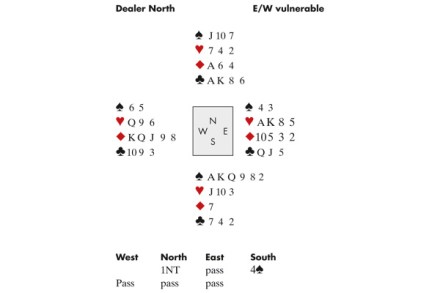
There have been a lot of frantically close finishes in the big English tournaments recently. In the semi-final of the Gold Cup, the de Botton team edged the Norwegian Tøndel team by just one IMP (and went on to win the event). The Crockford’s Cup was even closer. Nick Irens and his team lost the final on a tie-break to the Hackett team (Paul Hackett, Tom Hanlon, Peter Lester, Hugh McGann and Ian Panto). That must have been particularly painful: I’d have been up all night agonising over every little missed trick. For the victors, however, these close run-ins provide an opportunity to luxuriate in the memory of each hand that played a crucial role.
Bridge | 6 June 2013

David Cameron must long ago have stopped signing off texts to friends with ‘LOL’. In internet slang, of course, it means ‘laughing out loud’, not ‘lots of love’ as he’d thought. Yes, we all scoffed when the story emerged — but how many of the scoffers know that in bridge, LOL means something else entirely: it stands for ‘Little Old Lady’. True: the term is sexist, ageist, and all the rest of it. But if we’re honest, we can all picture the type of elderly lady who whiles away her afternoons playing bridge and is, as they say, easy game. On the other hand, be careful of judging by appearances: bridge famously keeps the brain sharp, and there are plenty of dangerously astute octogenarians out there.

Bridge | 23 May 2013

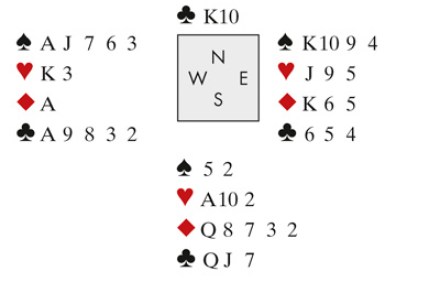
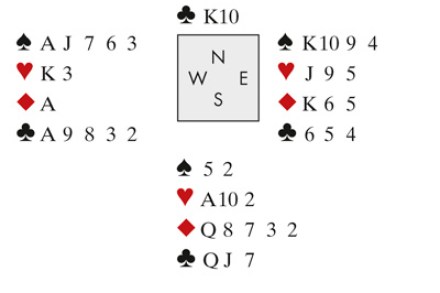
Before deciding how to tackle a hand, experts don’t just weigh up the odds; they also size up the opponents. That’s why, whenever I present the likes of Zia Mahmood or Andrew Robson with a declarer problem, the first question they ask is: ‘Who am I playing?’ Needless to say, weak opponents are far less likely to have ducked a trick or played a false-card. And so it was that when I gave the star England player David Gold this declarer problem, which had come up the previous evening, he wanted to know: ‘How good is my right-hand opponent, and how good is my left?’ The ♠10 is led. You play low. East wins with the ♠K and returns a spade to dummy’s ♠A.

Bridge | 9 May 2013

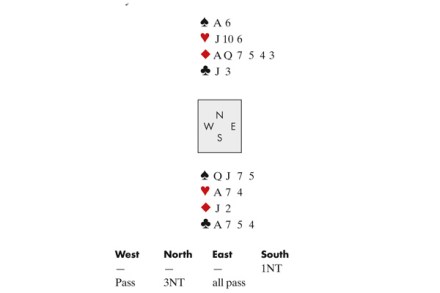
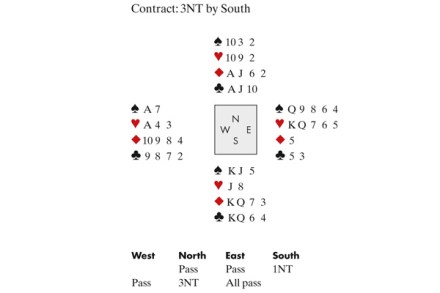
Most of us play bridge with slight tunnel vision; we focus on our own cards, and those in dummy. Experts manage to split their screen, as it were, and see all four hands at the same time. I was reminded of this the other day, when playing with Barry Myers in the London pairs. I went two off in 3NT and felt I should have done better, but couldn’t work out how. Barry shook his head impatiently. ‘One off was lay-down,’ he said. ‘You knew exactly what everybody held.’ (Remember, the difference between one and two off in pairs scoring is huge.) As so often in bridge, I was flattered and insulted at the same time. Obviously, I’d played like a klutz, but at least Barry thought it was a blip of concentration rather than a sign of my limited ability.

Bridge | 25 April 2013

Does life feel a bit flat? Are you bored and listless? Then take up bridge! During the recent Lady Milne (the women’s home internationals) in Edinburgh, these are just some of the emotions I experienced: euphoria, frustration, elation, shame, exhaustion, self-loathing, pride, fear. The one thing I didn’t feel, not even for a second, was boredom. It helped that our England team was leading throughout. And that I was lucky enough to be playing with Sally Brock, probably the best woman player in the country. Our teammates were Jane Moore and Gillian Fawcett — I wish they were my teammates more often — and Lizzie Godfrey and Pauline Cohen, who were both on superb form; and by the way, this was Pauline’s first cap, aged 69.

Bridge | 28 March 2013

Why is bridge quite so exciting? One of the reasons, surely, is that it involves a power struggle, with each player wanting to assert their supremacy; the very word ‘trump’ derives from ‘triumph’. Call me competitive — but my view is confirmed even more starkly in the writings of the Austrian psychoanalyst Alfred Adler (a contemporary of Freud). ‘Bridge players are usually suffering from an inferiority complex,’ he wrote, ‘and find in the game an easy way to satisfy their striving for superiority.’ Bridge, he went on, is ‘a great invention ...it offers an opportunity to conquer others.’ Even more satisfying than conquering others is enlisting their help in doing so: making them fall on their own swords.

Bridge | 14 March 2013

A friend asked me recently whether there are any rules against ‘unethical hesitations’ in bridge: one of his opponents had paused before following low in a suit; as a result, my friend had assumed he held the ace, and put up dummy’s king ...whereupon the other opponent won the trick. It’s a murky area: a pronounced hesitation, for no good reason, is clearly unethical. But many hesitations are ambiguous, or hard to prove. In my view, if you accidentally fumble for even a moment, you should declare that you have ‘nothing to think about’. One of my favourite stories about unethical behaviour concerns the late American player Alvin Roth (who invented weak twos and the unusual no trump). ‘Al’ couldn’t abide any form of cheating.

Bridge | 28 February 2013

Like most children, I was often told: ‘Count the pennies and the pounds will look after themselves.’ I was strangely transfixed by the idea — as though, through some strange alchemy, coins could turn into notes all by themselves if you just waited long enough. But I never did; I couldn’t resist spending my pocket money on penny chews every Saturday. In adulthood, however, I often find myself thinking how useful the saying is in relation to bridge, reconfigured as: look after the part-scores and the games will look after themselves. Like many players, I struggle to stay focused when playing in low-level contracts: I’m far more interested in games and slams. But how many matches have been won by the smallest of margins?

Bridge | 14 February 2013

I feel that we in the bridge community (is there one? Am I in it?) haven’t made enough of a song-and-dance about Andrew Robson being awarded an OBE in the Queen’s new year’s honours list. It’s been nearly 20 years since a bridge player was honoured in this way (the last was Nicola Smith in 1995), and it’s richly deserved: Andrew has done more than anyone in this country to promote the game. In fact, his club in Parson’s Green is the only place I feel completely confident in sending people who want to learn. Bridge players can be a pretty rude and intimidating lot, but Andrew has instilled a zero tolerance policy: no bad behaviour at all.

Bridge | 31 January 2013

Once you’ve made a fool of yourself in public often enough, you pretty much stop minding. At least, that’s my experience of playing bridge on Vugraph (which is broadcast online, for all to watch). These days, all major national and international tournaments are shown online, so there’s no getting away from it; but you quickly learn that every player — even the best — makes blunders under pressure. That’s my excuse, anyway — in case you saw any of the action from the England women’s bridge trials last weekend.

Bridge | 17 January 2013

I’m writing this on Monday morning and wow, what a weekend that was. The great and the good of the bridge world flocked to TGRs for its 4th Annual Auction Pairs. It’s the first time I’ve played in the event — and I felt like I’d died and gone to bridge heaven. Everywhere I looked there was a colossus of the game: Romania’s Bogdan Marina, France’s Paul Chemla, Icelanders Adalsteinn Jorgensen and Bjarni Einarsson, Zia Mahmood, Andrew Robson (or Lord Robbo as we call him since his New Year OBE for services to bridge)... In total, there were 70 pairs, and we were auctioned off for between £300 and £3,500, generating a huge cash pool.

Bridge | 3 January 2013

It’s hard to explain to non-bridge players how much the game means to some of us. It’s not just a pastime; it’s a grand passion. Janet de Botton summed it up well when someone asked her if she really loved the game. ‘I don’t love it,’ she replied, ‘I’m in love with it.’ Ask any bridge fanatic: it seduces us, it consumes us, it makes our pulses quicken. In fact, it’s better than romantic love because the excitement never wanes. As another friend put it: ‘I’ve often thought about bridge during sex, but I’ve never thought about sex during bridge.

Bridge | 12 December 2012

At a dinner party recently, I was asked whether men and women are equally good at bridge. Not at the very highest level, I replied. If you were to name the top 300 players in the world, only one or two — at most — would be women. When I was asked why, I replied that I thought it was possible that our minds work slightly differently. There was an uncomfortable pause. Then the man sitting on my left — a successful writer — asked whether I wrote my bridge column for the Telegraph; when I said it was for The Spectator, he gave a patronisingly knowing nod (it obviously came to much the same thing). Clearly, his assumption was that I had to be ‘right-wing’ to hold such a view. What nonsense.

Bridge | 29 November 2012

Ever heard of the ‘gum-wrapper coup’? My guess is not — as far as I’m aware, only one person has ever pulled it off, and that was about 80 years ago. I came across it while reading a book about the ‘father of contract bridge’, Ely Culbertson. Ely was a brilliant player but chronically impatient. He found it hard to sit still: whenever he was dummy he would lay down his hand as quickly as possible so he could get up and pace the room. On one occasion, the opponent on lead, David Burnstine, purposely dropped a chewing-gum wrapper on the table; quick as a flash, Ely laid down his cards — and Bernstine was able to have a good look at them before deciding what to lead.

Bridge | 15 November 2012

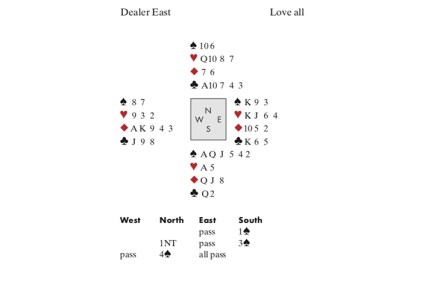
Time and again in bridge, when tackling problematic contracts, I miss simple solutions which, it turns out, were staring me in the face. It’s some consolation to know that this sort of temporary blindness is a fairly common condition: bridge clubs are full of people slapping their heads and groaning as they see — too late — how they should have played a hand. That’s just one of the things that separates the mere mortals from the pros: they have full vision, at all times. Anyway, a friend showed me this deal from a local teams event. The contract was the same at both tables — as was the lead of the ♠8 (second highest from a rubbish holding). Would you have had the same blind spot as one of the declarers?

Bridge | 1 November 2012

In this country, Andrew Robson and bridge are practically synonymous: he’s the best known, and probably the best, player we have. His love for the game goes to the very core of him. During our recent bridge week at Stuart Wheeler’s house in Tangier, I asked Andrew about his near-fatal accident in 2001. While walking alone on Scafell Pike in the Lake District (England’s highest mountain), he slipped on ice and fell some 120ft, shattering every limb in his body except his left arm. He landed on a scree slope, which saved his life. Andrew told me that as he was lying there, he became aware of an extraordinary lucidity: he remembers thinking that if he were to play bridge right now, he’d play better than he ever had before, or ever would again.

Bridge | 18 October 2012

I’ve just come back from Tessa and Stuart Wheeler’s stunning house, Dar Sinclair, in Tangier. It’s a lovely time of year to go: the sun was shining, the sea was warm, the souk was beckoning. But this was Stuart’s annual bridge week — so naturally we hardly stepped outdoors. The bridge gang included Andrew Robson (the ‘resident pro’), his partner Alexander Allfrey, and several seasoned Portland players like Patrick Lawrence, Bernard Teltcher and Giles Hargreaves. We discussed and analysed hands non-stop, even during meals, on car journeys and at the airport. What poor Tessa and her two non-bridge-playing guests made of us, I hate to think; but she assures me she’s used to it. The cards produced plenty of drama.

Bridge | 3 October 2012

The sad truth is, the length of time you’ve been playing bridge is no indication of how good you are. When I had my first lesson, aged 27, I’d already been playing with friends every week for five or six years. I quickly found out that almost everything we were doing was wrong. I was worse than a beginner: I came with a set of habits that had to be un-taught. I was reminded of this when I came across an article by the novelist Alexander McCall Smith in an American newspaper. He and his wife are bridge addicts. A few years ago they went on a cruise which offered bridge classes. His wife, a ‘much stronger’ player than him, chose the intermediate class — but soon realised she was out of her depth; she belonged with the ‘novices’.

Bridge | 19 September 2012

You’ve won a national championship by the narrowest of margins. You’re too elated to sleep: you’re going over the hands in your head, when suddenly — argh! — you realise you scored one board incorrectly. If you come clean, your score will drop. What do you do? This is exactly what happened to the American player Debbie Freeman, winner of the Mixed Teams in the recent North American Bridge Championships. What did Debbie do? She informed the tournament director the next day, dropping her team out of first place and into second. This sort of good sportsmanship is not unusual at the top level in bridge. Zia Mahmood and Michael Rosenburg, for instance, have always taken great pains to play fair.

Bridge | 6 September 2012

Here’s a bridge tip you won’t read about in any book — one which the world-class pro Gunnar Hallberg gave me the other evening during a game of social bridge. You’re declarer, and a suit is led. Let’s say dummy has a holding like 8643 in the suit, and you can see at once that it doesn’t matter at all which card you play. Instead of routinely playing low, very pointedly ask for a ridiculous, random card — say, the six. ‘The six?’ partner is bound to say, looking confused. ‘The six,’ you repeat, with conviction.