Susanna Gross

Bridge | 12 February 2015

Before returning to Australia about a decade ago, Michael Courtney spent several years playing high-stake rubber bridge in London. Those of us who occasionally kibitzed him will never forget his sheer brilliance at the table. Michael has the pleasingly shambolic look of a mad professor, and his imagination seems to operate in a different dimension: he always has his eye on the deceptive card, the one to throw his opponents off the scent. In the intervening years, he’s clearly lost none of his prowess: his team has just won the Australian trials.
Bridge | 29 January 2015

If you and your partner ever want to improve your bidding system, I can’t recommend Phil King highly enough as a bridge coach. Catherine Seale and I booked him for a few sessions in preparation for last weekend’s Lady Milne trials, and although we didn’t qualify (my mistakes are too embarrassing to mention), we both benefitted hugely from his wonderfully methodical and lucid way of explaining how certain conventions work in practice. Phil has prepared pamphlets covering every aspect of bidding (slams, defence, competitive auctions etc.), full of real-life deals played by experts, so you and your partner can see how you fare by comparison. It’s pretty eye-opening to find just how many hands there are that leave you stumped.

Bridge | 15 January 2015

This may sound odd, given its male-only membership, but the Portland is one of my favourite bridge clubs. I’m one of many women who are invited there regularly (in fact, I can claim to be the first woman to have played at its new premises in London’s St James’s Square), and we’re always welcomed with tremendous friendliness — not to mention gourmet dinners and far too much wine. I was last there in December for the club’s inaugural auction pairs, the brainchild of its new chairman Chris Kemp.

Bridge | 1 January 2015

It’s surprising how many perfectly good bridge players lack confidence when it comes to squeeze plays. They seem to think a squeeze is some sort of dark art which experts alone can master — a view no doubt reinforced by all that technical jargon about ‘rectifying the count’ and ‘isolating the menace’. But the truth is that many squeezes are within any reasonable player’s grasp — in fact, even beginners have a chance of executing one simply by playing off all their winners and hoping for the best.

Bridge | 4 December 2014

I witnessed utter carnage at the bridge table the other week. I was watching the European Champions Cup online when a brilliantly imaginative bid by one of France’s top players, Philippe Cronier, backfired horribly (always fun to see disaster befall a professional). When the dust had settled, Cronier had gone for one of the largest penalties I’ve ever seen — 4300. The problem came with a misunderstanding of what a ‘redouble’ by Cronier meant. He intended it to be an ‘SOS’, asking his partner to rescue him from the spot he was in. His partner — who will remain anonymous — saw it as a display of confidence. It’s a misunderstanding which happens fairly often: is a redouble a fearless battle-cry or a desperate plea for help?

Bridge | 20 November 2014

It’s one of the burning political issues of the day: why don’t more MPs play bridge? Two weeks ago, the 40th annual bridge match between the House of Lords and the House of Commons took place, and while the captain of the Lords, Baroness Henig, had no problem getting seven fellow peers to make up her team, the captain of the Commons — Bob Blackman MP — couldn’t find any volunteers at all, and had to enlist ex-MPs such as Michael Mates and Robin Squire. I think it’s time the Prime Minister intervened. I happen to know that he loves the game: about 20 years ago I played in a regular foursome with him, along with Neil Mendoza and Dominic Loehnis.

Bridge | 6 November 2014

To get good results at bridge, it’s not enough to play well — your opponents need to play badly; and if they won’t oblige, you’ll need to help them along. Some players do this the unethical way: they try to intimidate their opponents with officious behaviour, or else create a whirlwind of jollity designed to shatter their concentration. One player I know — I’m tempted to name him but I won’t — always manages to make the sort of cutting remark that leaves his victim unable to dwell on anything for the next hour. He once walked behind me before a match was about to start and paused to say, ‘Ooh, you’ve got a small bald patch.

Bridge | 23 October 2014

Forget the 5-2 diet. To lose weight the easy way, why not take up competitive bridge? I’ve just come back from the Autumn Congress, held over three days at the Holiday Inn in Peterborough. Despite devouring double helpings of banoffee pie from the hotel buffet each night, to my astonishment I’ve come back two pounds lighter. I can only put this down to the calorie-burning mental workout involved, plus the adrenalin of playing with David Gold, who never misses a single mistake I make. And then, of course, there’s the sheer excitement of trying to win. Well, we didn’t win: or at least, only the consolation final of the Sunday teams event. The A-final was won by my co-columnist Janet de Botton, who just keeps going from triumph to triumph.

Bridge | 9 October 2014

Has Zia Mahmood cried wolf one too many times? He’s still the undisputed master of the ‘psyche’ — he has an uncanny ability to know exactly how and when to make deceptive bids without running into large penalties like the rest of us. But he’s done it so often that many players are wary of him: he’s famously not a man to be trusted. Given this, Zia really needs to pick his victims with care. At the recent Cavendish Tournament in Monaco, he tried it on against the cheeky-faced Irish player Tom Hanlon (who, with Hugh McGann, has possibly the longeststanding bridge partnership in the world: 40 years). But the Irish have a nose for when someone is taking the mickey — doesn’t that very phrase originate from Ireland?

Bridge | 25 September 2014

There aren’t many instantly recognisable stars in the bridge world, but Andrew Robson is definitely one — as he was made only too aware on a flight to Tangier recently when a group of Club Med passengers in the surrounding seats got very excited and made him discuss bridge for hours. Andrew goes to Tangier every year for Stuart Wheeler’s Bridge Week, to which I’m also lucky enough to be invited. The Wheelers’ house has stunning views and Tangier itself is teeming with exotic life —  but to be honest, none of us has much desire to step outside when non-stop bridge is on offer. The guests are mainly Portland Club players, and the stakes are pretty high —  but even with money involved, the emphasis is on fun.

Bridge | 11 September 2014

Unlike poker, there’s not much money to be made from bridge tournaments (consider yourself lucky if you win £40 in vouchers). There is one event, however, where big bucks — actually, euros — are at stake. The invitation-only Cavendish Pairs attracts top players from all over the world; they are auctioned off (they can buy back a percentage of themselves if they’re outbid) and a huge pot is raised. The 52 pairs taking part in this year’s Cavendish, held last week in Monaco, raised €618,000. The biggest draws were Geir Helgemo and Tor Helness (€47,000), Fulvio Fantoni and Claudio Nunes (€44,000), Andrew Robson and Tony Forrester (€33,000), and Krzystof Buras and Gregorz Narkiewicz (€22,000).

Bridge | 28 August 2014

I was talking to the brilliant 27-year old Israeli player Alon Birman at the recent Brighton Congress, when suddenly there was a loud crash: a pane of glass had fallen to the floor. No one was hurt, and as everyone carried on chatting, Alon quipped: ‘It’s obvious none of you live in Israel.’ Alon is quite a star: aside from his dashing good looks, he is part of the Israeli team that stormed to victory at last month’s European Teams Championships. But life for Israel’s top players isn’t easy. Last year, its women’s team withdrew from the Venice Cup, held in Indonesia — my understanding is that the Indonesian organisers stonewalled their efforts to ensure adequate security was provided.

Bridge | 14 August 2014

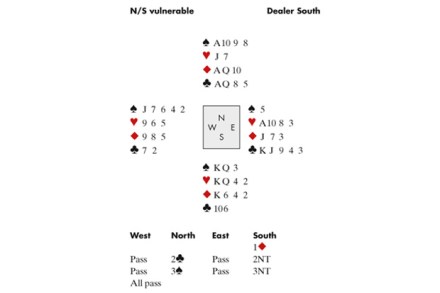
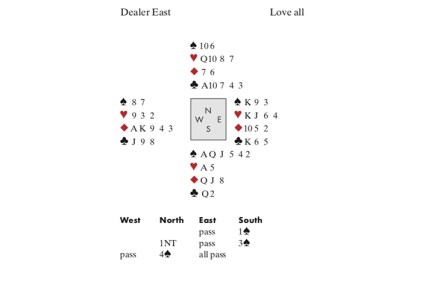
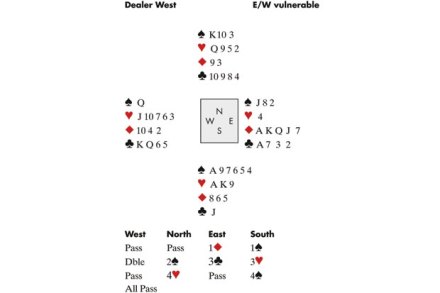
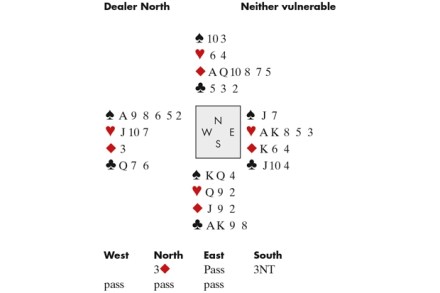
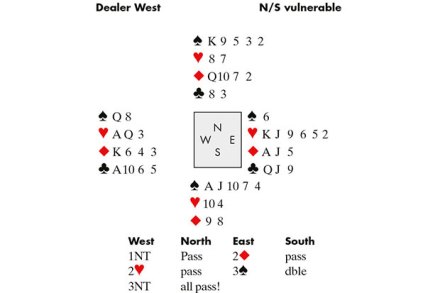
Some bridge hands are so sad that they make you want to cry. At least, that’s how my friend Lou Hobhouse put it when she phoned to tell me about her disastrous duplicate game the previous evening. I should explain that Lou is a bridge teacher in Somerset; she’s hugely popular with her students and sometimes agrees to partner them at her local club. So there she was, playing at Langport Bridge Club with a newish student, and things were going well — indeed, they looked set to win. Then came the last board (illustrated). Lou could have bid 3♠ over 3♥ but decided to set hearts as trumps by cue-bidding diamonds. West led the ♣K. Lou won and surveyed the hand. Clearly, if the ♥Q fell in one or two rounds, 13 tricks were in the bag.

Bridge | 31 July 2014

The brilliant American bridge writer and former world champion Eddie Kantar once overheard two wives in his bridge class arguing about which of their husbands was the worse player. The first wife said, ‘Look, there’s no contest. Last night, my husband was in 7NT with 11 top tricks, and dummy had the ♥AQ with the ♥K onside, so a finesse would have worked. But he managed to wind up in dummy at Trick 11 and, with two cards left, led the ♥Q from ♥AQ!’ The second wife simply shrugged and said: ‘What’s so terrible about that? Against my husband, that play works.’ I was reminded of this exchange last week when, playing against a husband-wife pair, the wife erupted at her husband for failing to duck a trick.

Bridge | 17 July 2014

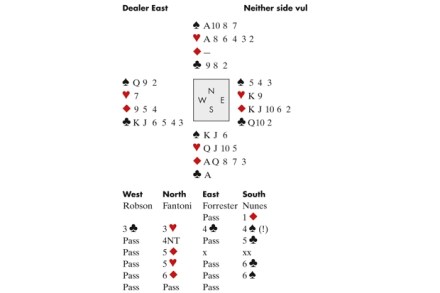
The recent Open European Championship was won by Israel — but right up to the end, Monaco and England were snapping at their heels (they won silver and bronze respectively). I suspect Monaco’s Fulvio Fantoni and Claudio Nunes are still having nightmares about the hand-of-horror that cost them gold (though it cheered me up no end — I’m always shamefully exultant when giants of the game show they too can utterly humiliate themselves). They were playing against England’s Tony Forrester and Andrew Robson: A right old balls-up. Nunes obviously thought Fantoni’s 3♥ was a transfer to spades, Fantoni thought Nunes’s 4♠ was natural — and off they went. Forrester’s diamond double asked partner not to lead the suit.

Bridge | 3 July 2014

Our Golden Oldies have brought home the Gold! Many congratulations to the England players who have won the Seniors Teams European Championships in Croatia. I’m particularly pleased for my friend Simon Cochemé, their non-playing captain. Simon is relatively new to captaincy, but has long been one of the funniest bridge journalists around. I’ve hugely enjoyed his daily blogs. The night before their victory, he wrote: ‘I am pleased to report that the team retired to bed early. Or so I hope. Maybe I should have resorted to the tactics employed by the NPC of the famous Italian Blue Team; not only did he see the players to their rooms, he then made them give him their trousers so that they couldn’t sneak out to a nightclub.

Bridge | 19 June 2014

It takes a lot for me to give up on a ‘double-dummy’ bridge problem — i.e. one in which you are shown all four hands and told game or slam is possible but have to work out how. I tell myself to imagine that I’m locked in a cell and won’t be released until I get the answer: surely if I think long and hard enough, it will come to me. But solving bridge puzzles is not just a matter of thought power. Equally important is whether or not you’ve seen the type of problem involved before. It’s rather like trying to solve a cryptic crossword puzzle: even the most intelligent person won’t know how to go about it if they’re unfamiliar with the way cryptic clues work.

Bridge | 5 June 2014

Have you ever been told by an expert that a bid you’ve made is foolish, badly judged or plain wrong? And although you may not agree, you tell yourself that you really ought to submit to their superior judgment? Before you do, my advice is: get a second opinion, and maybe even a third. When it comes to tricky bids, you’d be amazed how much disagreement there is among pros — and amazed, too, at how stubbornly each insists that their decision alone is the right one. If you want to see bridge egos clashing in this way, you need only turn to the regular section in the excellent online monthly Bridge Magazine in which a panel of experts is given various hands to bid; there are always at least three differing views on each one.

Bridge | 22 May 2014

There’s no point in soft-soaping it: however long you’ve been playing bridge, however well you think you play, if you’ve never had regular lessons, or played with experts, sorry, but you probably aren’t much good. Bridge is an endlessly complex, multi-layered game, and there’s no way of improving without enlisting help. That’s not to say there’s anything wrong with ‘kitchen-bridge’ — but if no one ever notices your mistakes, it’s easy to be deluded. Hiring a top-class player is not only about improving your game, though: it’s just such fun to play with someone better than yourself. And it has become a lot easier thanks to a new agency — ProBridge —  set up by Sally Brock, Simon Cope and Ben Green.

Bridge | 8 May 2014

The more I watch top-class players bid their hands, the more I abide by the philosophy: points, schmoints! Obviously, we all evaluate our hands to a certain extent — indeed, a large extent — according to how many points we hold. From our very earliest days as players we are taught this rule of thumb: that we and our partners need a combined holding of 25 points for game and at least 30 for slam. But many of the social players I know are completely in thrall to this way of evaluating their hands: they base all their decisions about whether to enter the auction, or raise their partner, or bid on to game, and so on, purely according to what their mental pocket calculator tells them.