Susanna Gross

Bridge | 24 April 2014

It’s no coincidence that many card players excel at both bridge and poker. The poker legend Gus Hansen plays a mean game of bridge and regularly turns up at tournaments. The American bridge star Steve Weinstein is also a poker pro who goes by the name of ‘Thorladen’. The attributes needed for both games are remarkably similar: a knowledge of probability, an ability to ‘read’ people, an outstanding memory, the confidence to bluff, the ruthlessness to go for blood...But I’m pleased to report that Weinstein believes what I’ve long suspected: that bridge is the  more skilful and difficult game. ‘You can’t be a prodigy in bridge like you can in poker,’ he maintains. ‘It takes years to become anywhere near a master.
Bridge | 10 April 2014

The news that two German doctors have been found guilty of cheating at the world bridge championships in Bali last year — by dint of some well-timed coughs — has made headlines around the world. In fact, no one on the international bridge scene is too surprised: Michael Elinescu (61) and Entscho Wladow (71) have had a reputation for cheating for some time. I played against them at the European championships in 2011, and have never forgotten my partner David Gold whispering in my ear: ‘It’s the German doctors, hold your cards up!’ I must say, they seemed very pleasant to me — and I can’t bring myself to feel any real sense of outrage. In truth, I think the episode has done wonders for the image of the game.

Bridge | 27 March 2014

You’ve probably read about the English Bridge Union’s attempt to get bridge reclassified as a sport rather than a game — meaning that its members would no longer have to pay VAT on entry fees for competitions. Last month, a tax tribunal rejected the move on the grounds that ‘a sport normally connotes a game with an athletic element’. You may think this sounds reasonable enough, but, as my six-year-old daughter would say, it not fair! Many other European countries, including France, Holland and Poland, classify bridge as a sport — as does the International Olympic Committee. And HMRC recognises games like darts, billiards and croquet as sports — hardly ‘athletic’ activities — so why not bridge?

Bridge | 13 March 2014

The Night of the Stars charity bridge event, held in West London a couple of weeks ago, was every bit as fun as I’d hoped: 53 stars of the game mingled with — well, let us be known as the eclipses — for an evening’s duplicate. My partner wasn’t one of the official stars, but he’s without doubt one in the rising — young Tom ‘Mini’ Paske, aged 23. We did pretty well, finishing eighth out of 112 pairs. And he’s a gentleman to boot: when we were going through some of the hands afterwards, he pointed to one and said, ‘We did well here.’ ‘But that was entirely you — you were declarer!’ I exclaimed. ‘Ah, but you gave me the perfect dummy,’ he replied.

Bridge | 27 February 2014

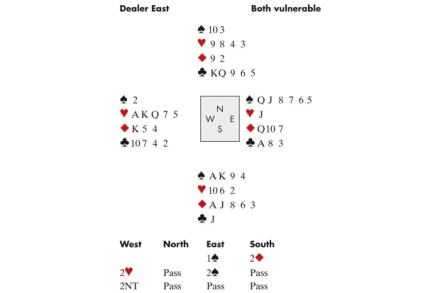
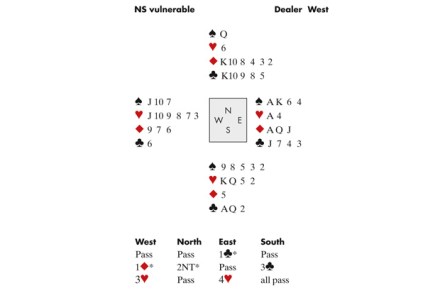
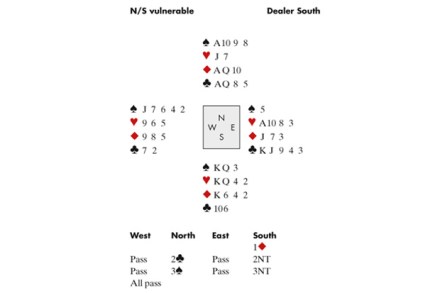
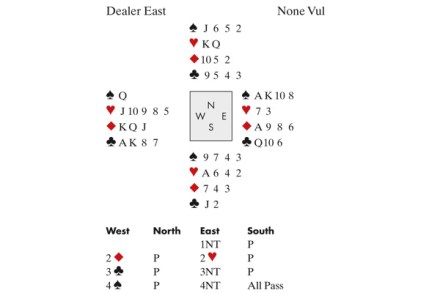
To any player with even the smallest sadistic streak, squeezing your opponents is hugely satisfying. But there’s something even more enjoyable: pseudo-squeezing them. With a genuine squeeze, you make them squirm, but they can console themselves afterwards that there was nothing they could have done. That’s no fun. With a pseudo-squeeze, you get to see them squirm and kick themselves when they realise they’ve been duped. On this recent deal, the UK star Gopal Venkatesh was hoodwinked by Bulgaria’s Valio Kovachev: [*2♠ was a game try; 2NT a relay; 3♣ asked for help in clubs] Venkatesh (West) led the ♥9.  Even with the ♥K onside, Kovachev had only nine tricks: two spades, five hearts, a diamond and a club.

Bridge | 13 February 2014

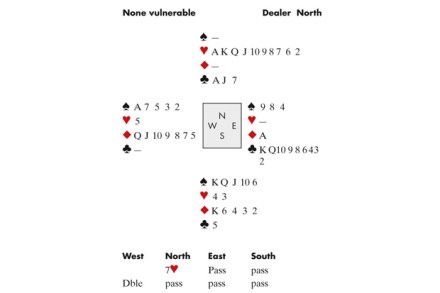
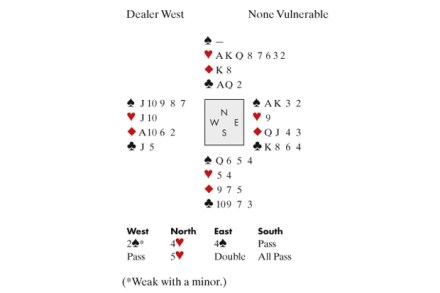
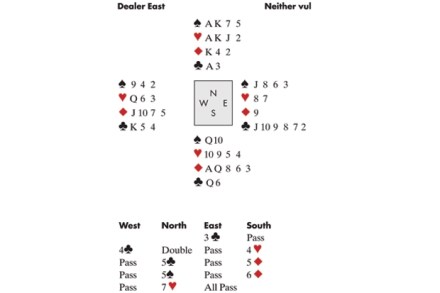
A couple of Sundays ago, in London, Zia Mahmood and Demetri Marchessini held the first ever ‘Goulash Individual’ tournament. ‘Goulash’ deals involve wild distributions of suits — and the day was bizarre and fun in equal measure. Several superstars flew in to play, including 86-year-old Benito Garozzo, 13 times world champion, and 28-year-old Marion Michielsen, arguably today’s best female player. Everyone partnered everyone for two boards; on this deal, my great pal Neil Mendoza got to play with Zia — but not altogether successfully:   North’s spectacular opening was passed round to Zia (West), who made a ‘Lightner’ double, asking for a ruff.

Bridge | 30 January 2014

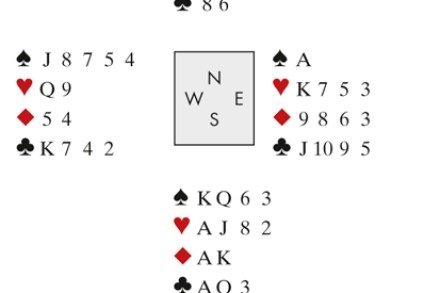
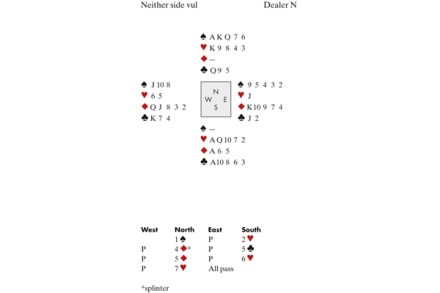
I always find it impossible to sleep when I’ve played poorly, and last night just one sleeping pill was never going to be enough. Alas, I needed two to stop me agonising over my many mistakes during the weekend’s Lady Milne trials (for the women’s home internationals). Sally Brock and I didn’t manage to qualify, which,  given Sally’s brilliance, tells you just how badly I played. However, let me describe one interesting hand for which Sally insists on taking half the blame, even though I propelled us to the wrong contract: (3♣ = 5 card stayman; 3♠ = agrees hearts; 4NT = RKCB). Sally had limited her hand by opening 2NT, so it was crazy of me to bid the grand, despite her 5NT bid confirming we held all the key cards.

Bridge | 16 January 2014

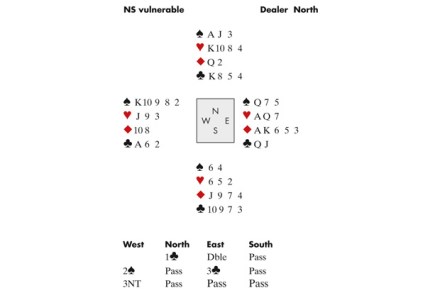
Do you ever watch the greats playing bridge? And if you do, are you sometimes baffled, because instead of playing the obvious card, they do something that seems to be completely random? Of course, it never is random — it’s just that they are operating on a different plane from the rest of us. Not only is their awareness deeper and their technique better, but they never lose sight of the psychological aspect of the game. They are always trying to see things from their opponents’ points of view, to entice them to defend in a way that will bring about their own defeat. As John Lennon once said, you have to be a bastard to make it to the top. This hand comes from the recent final of a US Championship. Zia Mahmood was South: West led a spade.

Bridge | 3 January 2014

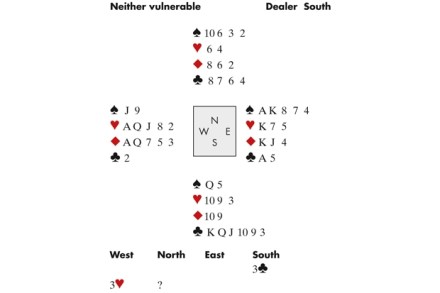
What is the purpose of bidding? It’s how partners describe their hands to each other in order to reach the best contract. At least, that would be my answer — but I can already envisage the experts chuckling at my naivety. As any pro knows, describing your hand is just part of the story: almost as important is the ability to misdescribe it. When your side has been dealt poor cards, often the best course of action is to sabotage your opponents’ attempt to communicate. Bidding becomes a tool with which to fool, bully, confuse or harass them — and that’s all part of the beauty of the game.

Bridge | 5 December 2013

One of the most dramatic events of the Spanish American War was the sinking of the cargo ship Merrimac. Early in 1898, a bold plan was hatched by the US navy to rig the Merrimac with explosives, sail it into the narrow channel leading into Santiago harbour, then blow it up — thereby blocking the Spanish fleet within the harbour. As it was basically a suicide mission, the skeleton crew of just eight men were all volunteers. In the end, the mission failed: the Merrimac’s steering gear was damaged by enemy fire and, despite sinking, the vessel failed to block the channel. Although they were captured, the crew did at least survive — and after a prisoner swap the following month, they returned home as heroes.

Bridge | 21 November 2013

Everyone over a certain age can remember the sense of shock that comes when policemen start looking like mere boys. Now I’m in my mid-forties, I get that kind of jolt quite frequently. It seems incredible to me that so many ‘authority’ figures in my life — my boss, my doctor, my lawyer, and so on — are younger than me. But never have I felt this more keenly than I did last week, when I found myself sitting opposite an extremely talented bridge player whom I’d booked to play in a duplicate game. Meet my new teacher: Tom ‘Mini’ Paske, aged 23. Mini — so called because he has an older bridge-playing brother — is a rising star of the game.

Bridge | 7 November 2013

Bridge is a great leveller: at some point, it makes fools of us all. As a result, it’s probably best to steer clear of any definitive pronouncements — ‘I couldn’t make the hand’, or ‘there was no way to beat it’ — as there’s almost always someone who can prove you wrong. Even experts end up being out-thought on a regular basis. The one really safe way of avoiding embarrassment is to be like Socrates, who declared: ‘All I know is that I know nothing.’ Of course, it’s impossible advice to follow: I’m forever blurting things out which turn out to be rubbish. Just the other week, I was watching the Bermuda Bowl on BBO, and saw Tony Forrester bid to a slam. ‘Oh no — too high, you are going dooown!

Bridge | 24 October 2013

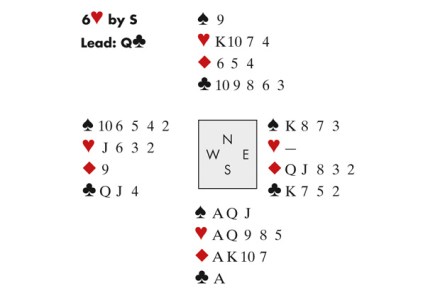
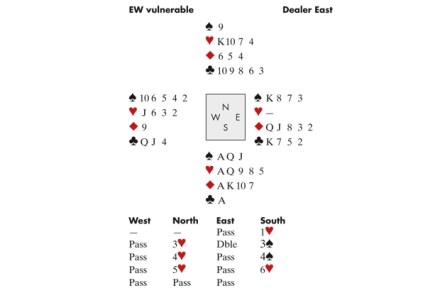
It’s difficult for non-players to imagine the extent to which bridge hands can torment us. I’ve spent hours this week mulling over a fiendishly complicated slam, endlessly jotting down diagrams on bits of paper and snapping at my children whenever they interrupted my train of thought. I described it last time — it was played by Fulvio Fantoni and won Declarer Play of the Year. When I showed it to the manager of TGRs, Artur Malinowski, he spotted a superior line. See what you think: East had passed and then made a take-out double (vul), strongly suggesting a void in hearts. Fantoni won the ♣ lead and played a low heart to dummy’s ♥7. He then ran the ♣10, discarding a diamond. West won and played a heart to dummy’s ♥10.

Bridge | 10 October 2013

The 2013 IBPA (International Bridge Press Association) Awards have just been published — and it’s no great surprise to see the name of the multi-world champion Fulvio Fantoni (formerly of Italy, now of Monaco) scooping ‘Declarer Play of the Year’. Cover up the EW hands and see whether you find the same solution (I certainly didn’t): (1♥: forcing, 3♥: weak, 3♠: cue, 4♠: cue, 5♥: 1 key card.) West led the ♣Q. East’s double at the 3-level, vulnerable, as a passed hand, spoke volumes: Fantoni correctly placed him with a heart void, the black kings, and probably both diamond honors. After a long pause, Fantoni played a low heart to dummy’s ♥7!

Bridge | 26 September 2013

This week I’m tackling one of the great unmentionable subjects of bridge: the fact that players so seldom go to the loo when they need to. We sit for long hours ignoring our bladders rather than risk missing a moment of the action. I’ve always assumed this was bad not just for the kidneys but also the concentration. However, relief — or perhaps I should say reassurance — is at hand. According to Professor Noreena Hertz’s new book, Eyes Wide Open: How To Make Smart Decisions in a Confusing World, the need to pee actually enhances your judgement. She cites an experiment where participants were asked whether they wanted $16 tomorrow or $30 in a month — those who needed to pee were far more likely to take the shrewder, long-term option.

Bridge | 12 September 2013

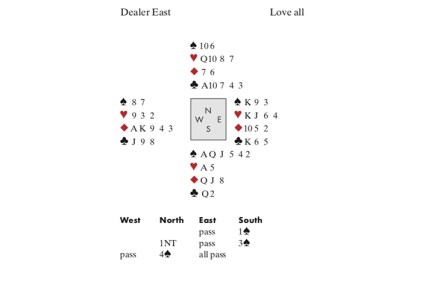
In any sport, a sense of elation is a dangerous thing. When a player does something good, he can’t afford to enjoy the moment: however dazzling the goal he’s scored or the ace he’s served, he can’t relax until the match is over. And so it is in bridge. It’s hard advice to follow: I’ve often lapsed into a smug reverie mid-hand upon doing something clever — and the next thing I know, everything’s fallen apart. Last week, Artur Malinowski, manager of TGRs, showed this hand he’d played to a couple of experts at the club, concealing the East-West cards: South’s double promised four spades. West led the ♥J. East won and played back the ♥7, ruffed. West switched to a trump. What now?

Bridge | 15 August 2013

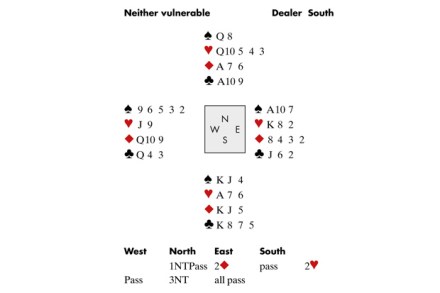
I’m on the train back from the Brighton Congress, where I’ve been playing in the Swiss Pairs, and I’m still kicking myself over the very last deal of the tournament. There are few things more satisfying in bridge — well, in life actually — than squeezing an opponent, and I squandered a perfect opportunity. It was only a matter of an overtrick — but in match-pointed pairs, one extra trick can net you the jackpot. Take a look at the South hand below: would you have been alert to the fact that the seemingly innocuous two of hearts could be used to devastating effect? Playing strong no-trump and 2-over-1 game forcing, my partner and I bid to 3NT. West led the ♥9. I played dummy’s ♥J.

Bridge | 1 August 2013

I haven’t played rubber bridge for a few years now (the demands of young children), but recently I’ve been hearing the siren call again — and decided to pop into my old haunt TGRs. I wanted to watch for a while, rather than play (I’m too rusty), and what great timing it turned out to be. The club’s manager, the brilliant Artur Malinowski, had just landed in a grand slam:   West led a trump. Artur (South) drew trumps in two rounds. If spades break 4-4, then one spade ruff will provide four discards for the losing clubs. Artur saw an additional chance. He cashed three top spades: West discarded first the ♠8, and then the ♠J and ♠10.

Bridge | 18 July 2013

There was a particularly juicy deal during the recent European Open Mixed Teams in Ostend, which led to many pairs bidding and making a grand slam. My teammates, however, were prevented from reaching even a small slam when the Swedish player Peter Fredin made a devilish psychic bid against them. After two passes to him, he opened a strong no trump with no points. Talk about putting a spanner in the works! I was so impressed by his psych that I texted Zia Mahmood to tell him about it. ‘Yes, I was watching on BBO [Bridge base Online],’ he replied. ‘Good bid by Fredin — but I think I’d have opened 2NT.’ That’s the thing about experts: they have no fear, and know exactly when and how to bluff. And not just in the bidding.

Bridge | 4 July 2013

Zia Mahmood has never been the most punctual man — but I wonder whether he’ll ever be late for a bridge tournament again? He and his partner Jan Jansma were favourites to win the European Open Pairs in Ostend last week. In the final, they were neck-and-neck with the German player Sabine Auken and her partner (in life as well as bridge) Roy Welland. In the end, Auken-Welland won by just 0.9 per cent — or 3.35 IMPS (international match points). Only later did I find out that Zia had been fined 4 IMPS for turning up a few minutes late that morning. When I rang to commiserate, he said he’d been buying cough medicine, but was delighted for Auken and Welland. So am I: it’s the first time a woman has won the European Open Pairs.