Stephen Bayley

Stephen Bayley is an honorary fellow of the RIBA, a trustee of the Royal Fine Arts Commission Trust and the co-founder of London’s design museum.

High wire act

From our UK edition

‘Mid-century modern’ is the useful term popularised by Cara Greenberg’s 1984 book of that title. The United States, the civilisation that turned PR and branding into art forms, wanted homegrown creative heroes. In design there were Charles Eames and George Nelson with their homey hopsack suits and wash’n’wear shirts, their sensible Wasp homilies: a counterattack against imported — and often baffling — exotics from the Bauhaus. It was the same in fine art. Jackson Pollock (Jack the Dripper) was a roughneck from cowboy country in Wyoming who became a darling of the media, not least because of his readily reportable deplorable behaviour.

Vital signs

From our UK edition

Exhibit A. It is 1958 and you are barrelling down a dual carriageway; the 70 mph limit is still eight years away. The road signs are nearly illegible. You miss your turning, over-correct, hit a tree and die. The following year, graphic designer Margaret Calvert is driving her Porsche 356c along the newly built M1. The motorway signs are hers. It is information design of a high order, possibly even life-saving. The clarity and intelligence of Calvert’s British road signs remain unmatched nearly 60 years later. And the font she created became the NHS, and later rail and airport, standard. Exhibit B. The French are worried about nuclear waste. Given the half-life of radio-active detritus, warning signs must be legible in 100,000 years when written language may be redundant.

Building block | 8 June 2017

From our UK edition

Liverpool is the New York of Europe. The business district looks like old Wall Street: a miniature Lower Manhattan on the Mersey. It’s a city of scale, drama, melodrama, tragedy and comedy. Not to mention rich and poor. And often all these effects are simultaneous. No other British city has a similarly contrary architectural character: superb, shabby, romantic, melancholy, proud and mean. You cannot be in Liverpool and not be affected by its buildings. I grew up there and long before I knew what ‘design’ meant, Liverpool had taught me to see — as well as to feel the deadly weight of history. It’s an architectural education. But Liverpool has not treated its architects well.

The bridge of size

From our UK edition

Before Brooklyn exceeded it in cool, Manhattanites spoke dismissively of BNTs. These were the Bridge ‘n’ Tunnel folk, the out-of-towners who needed civil engineering to help them reach social nirvana. The ambitious critic Norman Podhoretz, a master of self-invention, was one such. His notorious Making It (1967) begins: ‘One of the longest journeys in the world is... from Brooklyn to Manhattan.’ But since 1883 the journey over the East River has only been 5,989 feet, although physical distance was not the measure that pained Podhoretz. That’s the total length of Washington Roebling’s Brooklyn Bridge, the first connection between the outer boroughs and the elite ‘New York’.

Dome truths

From our UK edition

It was 50 years ago today, Sergeant Pepper taught the band to play. The result was a popular masterpiece. Thirty years later, a less accomplished, tone-deaf group of individuals collaborated on the Millennium Dome, and the result was an expensive, sniggerable calamity. For a while, I was one of them. Of course, it was not really a ‘Dome’ at all, since a dome is a sophisticated self-supporting masonry structure and this was just a big, stupid, hemispherical fabric tent. But ‘Millennium Tent’ did not have rhetorical resonance sufficient to burnish the already very bright and shiny egos of its perpetrators during the Blair Dawn. In any organisation, lots of stuff goes wrong a lot of the time, as Murphy’s Law states.

The mysteries of colour

From our UK edition

When Australia imposed generic packaging in its war on cigarettes, there was consumer research into the most deterrent colour. Pantone 448 was chosen, a sort of sludgy green-brown. When it was described as ‘olive’, Oz’s federation of olive growers formally complained. Certainly, colours move us. Interior designers know that yellow makes people angry, while in the US Naval Correctional Center in Seattle, what’s known as Baker-Miller Pink (after the officers who created it) has been found to pacify stroppy recidivists. Additionally, as Diana Vreeland averred, pink is the navy blue of India. Racing drivers think green unlucky, even if it is the British national colour in motorsport. We sometimes see red and that means we are angry, but red is also the colour of love.

Paradise lost | 9 March 2017

From our UK edition

The American dream was a consumerist idyll: all of life was to be packaged, stylised, affordable and improvable. Three bedrooms, two-point-five children, two cars and one mortgage. The sense was first caught by Alexis de Tocqueville in Democracy in America (1835–40), where he talks about a people more excited by success than fearful of failure. We all know when the dream died: on 9 November 2016. People in Brooklyn were crying. In Manhattan they couldn’t breathe. A national angst had been revealed: the land of plenty had become the land of the plenty cross. But when did the dream start?

Ideal homes

From our UK edition

Artists, poets and philosophers have not paid much attention to Milton Keynes ...although comedians have. This urban experiment has been mocked by lazy satirists who find ambition derisory and concrete cows hilarious. Milton Keynes is 50 this year and it has an honourable place in the history of that ancient chimera, the Ideal City. It was conceived in a decade when the improving influence of the ‘white heat of technology’ could be cited without irony (or embarrassment). In those days, technology involved calorific value, not cold, invisible bytes. The name sounds like an ad-man’s invention. But until 23 January 1967, when the new city was designated, Milton Keynes was an old, quiet Buckinghamshire village near Bletchley, one of 15 that were absorbed into the whole.

What Donald Trump’s taste tells us about him

From our UK edition

Elsie de Wolfe was the pioneer interior designer whose motto was ‘plenty of optimism and white paint’. She banished brown Victoriana from America. And her work on Henry Clay Frick’s private apartments introduced new American money to old French furniture. If only she were with us today. For his first television interview as president-elect, Donald Trump appeared, imperiously, sitting on a golden throne in the style of Louis Quinze. My vision may well have been blurred by circumstances beyond, but I think there were period-incorrect wall and ceiling paintings on classical-allegorical themes in the background. All of this on cantilevered decks behind mirrored glass about 200 metres above Fifth Avenue.

Roving the world

From our UK edition

In these books, two handsome and popular telly adventurers consider, from viewpoints that are sometimes overly autobiographical, the culture of internal combustion in two of its most distinctive forms. Ben Fogle is obsessed by Land Rovers while Richard Hammond is fascinated by motorbikes. Fogle came to notice in 2000 when he survived a harrowing year in front of the cameras on Taransay for the reality show Castaway. Here he says he found a rusting Series II Land Rover. This is odd because their bodies are made of aluminium, which corrodes in a different way. Hammond, the cute pixie of the Top Gear trio, made his own career move when, again in front of cameras, he crashed a dragster in 2006. Bravado in its different forms is a part of each account.

Making America crass again

From our UK edition

Elsie de Wolfe was the pioneer interior designer whose motto was ‘plenty of optimism and white paint’. She banished brown Victoriana from America. And her work on Henry Clay Frick’s private apartments introduced new American money to old French furniture. If only she were with us today. For his first television interview as president-elect, Donald Trump appeared, imperiously, sitting on a golden throne in the style of Louis Quinze. My vision may well have been blurred by circumstances beyond, but I think there were period-incorrect wall and ceiling paintings on classical-allegorical themes in the background. All of this on cantilevered decks behind mirrored glass about 200 metres above Fifth Avenue.

Spectator Books of the Year: Stephen Bayley on the enigma of Kenneth Clark

From our UK edition

I told James Stourton that the world didn’t need to know anything more about Lord Clark of Trivialisation. And I was wrong. His meticulous and elegant book, Kenneth Clark: Life, Art and Criticism (Collins, £30) perfectly captures the contradictions of ‘K’, an Olympian snob, but a true democrat who was thrillingly honest and also hard on himself. Britain’s best writer on art since Ruskin now has the biography he deserves. Before he took his life with his own hand, the Infinite Jest author had used that same hand to play tennis at the US equivalent of county standard.

Contours of the mind

From our UK edition

In Australia, I have been told, the female pubic area is sometimes known as a ‘mapatasi’ because its triangular shape resembles a map of Tasmania. And since we are discussing cartography and the nether regions, it is wonderful to find in the British Library’s new exhibition, Maps and the 20th Century, that Countess Mountbatten wore knickers made out of second world war airmen’s silk escape maps. Maps certainly colonise our imaginations in many different ways. The allies in Iraq had a ‘road map’ rather than a strategy. So much of personal value can be lost in the creases and folds of our own ‘mental maps’.

Nicholas Serota

From our UK edition

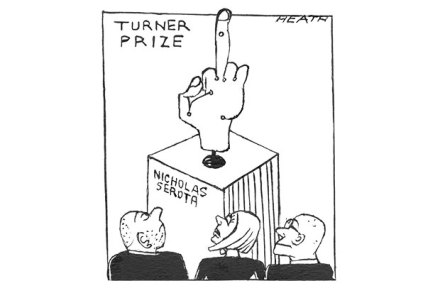
In this week of toadying obsequies after the (rather late) retirement of Sir Nicholas Serota from his imperial throne at Tate, an alternative narrative (briefly) enters the minds of the mischievous. Alone, aloof, fastidious, austere, he is sitting, suited darkly, in his office surveying, with a basilisk stare, the spreadsheets and data-sets his cowering elfin helpmeets have presented him. They step backwards towards the door bowing, afraid to meet his eyes, as he shoots freezing glances towards them. His lips soon purse in cool satisfaction. He is maybe even stroking a furry white cat. Or perhaps a PVC balloon pussy by Jeff Koons. The numbers on his spreadsheets are all about attendances. And they are big numbers.

Belly of an architect

From our UK edition

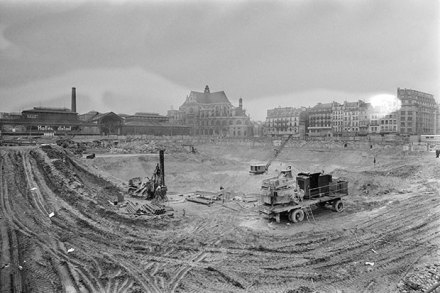
Depending on your point de vue, Haussmann’s imperial scheme for Paris created townscape of thrilling regularity or boring uniformity. Whatever; against a backdrop of serene haute-bourgeois perfection, intrusions have always been controversial. Eiffel’s tower of 1889 was attacked by the intellos of the day. Maupassant, Gounod and Dumas fils thought it a hideous construction of riveted tin. Le Corbusier’s unrealised 1925 Plan Voisin, replacing monuments with motorways, was designed as a shock to the system. And the 1973 Tour Montparnasse, central Paris’s only tall building, is, by general agreement, brainless. The Centre Pompidou of 1977 was a test for taste while the 1989 Bastille Opera is grossly ham-fisted, the last and worst of les grands projets.

Estate agent

From our UK edition

A big misunderstanding about art is that it excites serene meditation and transcendent bliss. But anyone who has worked in a public museum or a commercial gallery knows that this is untrue. The moral climate of the contemporary art world would embarrass the Borgias. Art excites peculation, speculation, back-stabbing, front-stabbing and avarice while fuelling nasty spats about attribution and ownership between heirs, relatives, executors and collectors. Nowhere is this more comically apparent than in the matter of artists’ estates. Once a private concern of family and lawyers, the ‘artist’s estate’ is becoming recognised as a tangible and valuable entity that needs professional management just like any other financial asset.

Peggy Guggenheim

From our UK edition

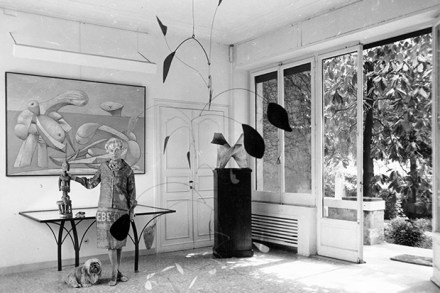
She had come a very long way from the shtetl, but Marguerite ‘Peggy’ Guggenheim was still the poor relation of her fabulously wealthy family. Although these things are, of course, relative. It was her uncle Solomon, enriched by mining, who first made the family’s name. Peggy’s father sank with the Titanic in 1912. Eventually Solomon’s museum, a Frank Lloyd Wright design as magnificent as it was absurd, became a New York landmark. Peggy never much cared for it, so she built her own elsewhere. Guggenheim was no one’s idea of a great beauty, but possessed enough lust, fortune and ambition to compensate. She moved to France just as traffic on the New York–Paris axis was becoming the standard model of the history of modern art.

The original and the copyist

From our UK edition

Architecture is sometimes described as the second oldest profession, but often — in both theory and practice — it competes with the first. In his splendiferous office in Manhattan’s Seagram Building, Philip Johnson confirmed this when he told me, ‘Remember, son, I’m a whore.’ True to his vocation, this was a line he had often indiscriminately used. Architects need to have big personalities because their responsibilities are so huge. Frank Lloyd Wright said that surgeons can bury their mistakes, but architects have to live with them. And so do the rest of us. Few of us have ever met a reticent, self-deprecating architect.

Requiem for a designer dream

From our UK edition

Threnody. Dirge. Lament. Epitaph. Elegy. Wake. There are so many English terms to describe the passing of people and things that you wonder if introspection about demise might be a national characteristic. All these words are on my (doggedly cheerful) mind as staff have moved out of London’s Design Museum, securing the last open door with a padlock on 30 June and leaving inside cavernous spaces with rusting memories of designer people and designer things. So what was the old Design Museum? It arose from a conversation between Terence Conran and me in 1978. He was the proprietor of Habitat, whose decent, modern merchandise revolutionised popular taste, and I was the author of a book about design he had just discovered.

The faceless man in the bowler hat

From our UK edition

Surrealism was, at least initially, as much about writing as painting. A plaque on the Hotel des Grands Hommes in Paris’s Place du Pantheon records that the oneiric movement began in 1919 when André Breton and Philippe Soupault invented ‘l’ecriture automatique’ at numéro 17. Automatic writing, with consciousness suspended, was supposed to open a conduit to an internal dreamworld. René Magritte (1898–1967) became one of the most famous Surrealist painters, but he wrote throughout his life: detective stories, manifestoes, criticism, essays, prose-poems, lectures, surreal bric-a-brac. His Ecrits Complets was published by Flammarion in 1979 and ran to 764 pages.