Stanley Johnson

Miliband’s net zero madness & meet Reform UK’s new poster boy

39 min listen

This week: Miliband’s empty energy promises. Ed Miliband has written a public letter confirming that Labour plans to decarbonise the electricity system by 2030. The problem with this, though, is that he doesn’t have the first idea about how to do it. The grid doesn’t have the capacity to transmit the required energy, Ross Clark writes, and Miliband’s claim that wind is ‘nine times cheaper’ than fossil fuels is based upon false assumptions. What is more, disclosed plans about ‘GB Energy’ reveal that Miliband’s pet project isn’t really a company at all – but an investment scheme. This empty vessel will funnel taxpayer money into the hands of private companies rather than produce any energy itself.

Rolling in it: the return of Tory sleaze

43 min listen

Katy Balls, The Spectator’s political editor, writes about the return of Tory sleaze. She’s joined by Jill Rutter, a senior fellow at the Institute for Government, to discuss the problems piling up for Rishi Sunak and the Tories. (00:50) Also this week, security expert Mark Galeotti writes about why Europe has been reluctant to give Ukraine tanks. Journalist Owen Matthews and Ben Hodges, former commanding general of the United States Army (Europe), join the podcast. (18:44) And finally, Gus Carter, The Spectator’s deputy features editor, writes in this week’s magazine about bison being reintroduced into the UK. He joins the podcast with the environmentalist Stanley Johnson. (33:40) Hosted by William Moore. Produced by Oscar Edmondson.

How a marine reserve could make Pitcairn the crown jewel of the South Pacific

Last week, while the Mayor of London (pop. 7.8 million) was visiting China, the Deputy Mayor of Pitcairn (pop. 50) was visiting London.  I met Simon Young for afternoon tea in a riverside restaurant near the Tower of London.  Both he, and a fellow member of the Pitcairn Council, Mrs Melva Evans, had travelled thousands of miles to Britain with one specific purpose: to persuade the Government to designate a vast area around the Pitcairn Islands as a marine reserve. Most of us, I suppose, know the Pitcairn Islands as the place where the mutineers from the Bounty settled, with their Tahitian companions, in 1790.  The majority of the current population are their direct descendants.

Peloponnese: Return ticket

I first visited the Peloponnese in the spring of 1959, at the beginning of my gap year. I was 18. Having been accepted for university as a classicist, I decided I might as well combine business and pleasure by visiting the great sites of the Mycenaean era before going on to my studies. It was mind-blowing. Olympia, Argos, Tiryns, Mycenae! I went from place to place with the Oxford edition of Homer’s Odyssey weighing down my rucksack, and  each day brought a new revelation.  But I had to leave out the great Palace of Nestor near Pylos on that first peregrination through the Peloponnese. The buses didn’t seem to go that way. And a year wasn’t long enough to do and see everything.

An Old Shirburnian remembers

 I went to Sherborne in January 1954. The first view I had of my housemaster was at the TC ­inspection parade held on the first day of every term. TC stood for tinea cruris or ‘crotch-worm’, an ­infection which boys were thought to be prone to during the holidays. Col H.F.W. ‘Hughie’ Holmes moved down the line of boys, inspecting for tell-tale pustules, as they cupped their hands over their private parts. When he reached me, he straightened up. ‘Ah, you must be Johnson!’ he barked. ‘Welcome to Lyon House!’ I was lucky enough to win a £150 scholarship to ­Sherborne. £150 was a great deal of money in those days. It represented half the annual fee.

For the love of cod

Years — actually decades — ago, a gentleman from the British civil service, interviewing me as a potential candidate for a job in the European Commission, explained that ‘all the important decisions in Brussels are prepared by the chefs’. As he spoke, I had a vision of men in tall white hats stirring dishes on a large stove in the middle of the Berlaymont. ‘Chefs?’ I queried. The man quickly explained that he meant the ‘chefs de cabinet’, the Commissioners’ aides, who basically ran the show while the great men had long lunches at expensive Brussels restaurants.

HMS Albion to the rescue

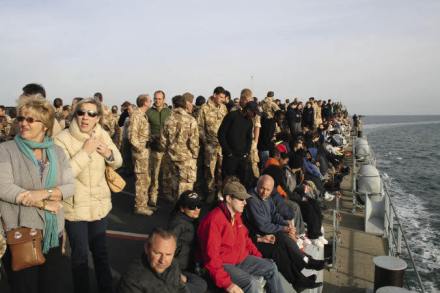
Stanley Johnson was a volcano victim — stranded in Spain with thousands of other British holidaymakers. Fortunately, the Royal Navy was on hand to bring him home in style Last week was quite extraordinary. My wife Jenny and I landed at Madrid airport on Monday afternoon, having flown overnight from Ecuador. We should have had an onward connection to London that afternoon, but because of the spreading cloud of volcanic ash, there were no flights. Next morning I was scheduled to take an early flight from Gatwick to the far north of Scotland to speak on behalf of my good friend, Alastair Graham, who is seeking to win the Caithness, Sutherland and Easter Ross constituency for the Conservatives.

The hard choices that face the Father of the Mayor

Stanley Johnson is adjusting to his new constitutional position in the life of London: not least deciding which clubs to avoid at lunchtime in order to dodge Boris’s journalist foes Last July, soon after Boris had announced he would be a candidate for the post of mayor of London, the editor of The Spectator very kindly invited me to give my reaction in the columns of this magazine. In the article I wrote then, I described the circumstances of Boris’s arrival in this world, in a hospital on New York’s East Side, around 70th Street. I recalled that, as a modern man, I was perfectly ready to be present at the birth but that unfortunately I missed it, having slipped outside for a moment to buy a pizza.

Grace under fire

To reach Sir Christopher Ondaatje’s Glenthorne estate you have to drive down a three-mile track which drops 1,000 feet to the only piece of flat land between Porlock and Lynmouth. Here, in 1831, the Reverend Walter S. Halliday built a substantial house, hemmed in behind by the towering Devon cliffs but enjoying an uninterrupted view over the Bristol Channel to the Welsh mountains. Halliday plays an important role in The Glenthorne Cat. Working in his library one wintry evening, Ondaatje looked up to find the reverend gentleman sitting in a nearby chair wrapped in scarf and nightgown.

Forty years on from Tet: how the US won Vietnam

For the last few days they have been putting the flags and bunting up in the streets of Hanoi and Ho Chi Minh City in preparation for the nationwide celebrations which will mark the Lunar New Year or Tet. Forty years ago, on the night of 30–31 January 1968, the Liberation Army, as it is now known here, launched its famous Tet offensive with a series of co-ordinated surprise attacks on a wide range of targets south of the 17th parallel. In and around Saigon, mortars pounded the US airbase at Tan Son Nhut, as well as the US embassy, the Presidential Palace, the General Staff Headquarters of the South Vietnamese Army and the Navy Command. In the United States, the Tet offensive had a devastating impact on public opinion.

Some like it cold

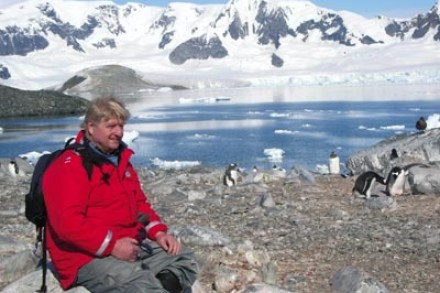
I first went to Antarctica in the (Antarctic) summer of 1984 on board the John Biscoe, a research and supply ship belonging to the British Antarctic Survey (BAS). Over a period of several weeks we visited various BAS stations on the Antarctic peninsula, including a small station known as Faraday at which vital measurements of the Earth’s ozone layer were being conducted. I remember climbing up into the loft with my fellow-passenger and now good friend Adrian Berry, science correspondent for the Daily Telegraph, past piles of cornflake packets, Bovril jars and tins of Horlicks which were stored for convenience in the roof, to see the Dobson’s photo-spectrometer at work.

Winter wonderland

At the beginning of 1984 — more than 23 years ago — I was lucky enough to be invited by the British Antarctic Survey (BAS) to join its research and supply vessel, the John Biscoe, on a six-week trip to Antarctica. At the beginning of 1984 — more than 23 years ago — I was lucky enough to be invited by the British Antarctic Survey (BAS) to join its research and supply vessel, the John Biscoe, on a six-week trip to Antarctica. On that occasion, we left Punta Arenas in Tierra del Fuego, Chile’s most southerly port, and crossed the dreaded Drake Passage below Cape Horn, to visit BAS bases on the Antarctic Peninsula, as well as the South Orkney Islands, South Georgia and the Falklands.

Some advice for Boris from a proud father

Stanley Johnson says that his son is no buffoon, that his ability to make people laugh doesn’t mean he’s a lightweight, and that he should not get bogged down in ‘consultation’ Boris was born in New York on 19 June 1964. I missed the birth since I had slipped outside for a moment to buy a pizza. When I first saw him he was bundled up in the hospital nursery with only the soles of his feet showing. These were completely black. This puzzled me. Had his mother, I wondered, somehow managed to give birth to the wrong baby? I later discovered that in New York, for reasons of security, newborn babies’ feet are dipped in black ink and an imprint taken for the record.