Sergey Radchenko

Sergey Radchenko

Sergey Radchenko is the Wilson E. Schmidt Distinguished Professor at the Johns Hopkins School of Advanced International Studies. He is the author of the newly published To Run the World: the Kremlin’s Cold War Bid for Global Power (Cambridge University Press, 2024).

What will Putin do next?

If you were Putin, what would you do? Predicting your adversary’s future moves requires putting yourself in his shoes. As Russia’s misadventure in Ukraine nears its first grim anniversary, we should ask ourselves how Putin sees the world, indeed – how we would see the world and what policy we would pursue if faced with a range of unpalatable options. Option one. He could declare the war lost and withdraw. If I were Putin, I would not choose this option. Why? There is grave danger in admitting defeat. Russia was built on the myth of infallibility. While the hope of victory stays alive, the people will follow the Tsar. But no sooner will he back down then they will turn away from him because the Kremlin is no place for losers.

Putin’s war has exacted a terrible toll on Ukraine

Putin badly miscalculated. The Russian army terribly underperformed. Kyiv has shown unexpected resilience in the face of what experts thought was far superior Russian firepower. This, we’re told, is the story of Russia’s invasion of Ukraine, and all of it is true. Vladimir Putin’s talk of a ‘dirty bomb’ is evidence of how badly the war is going for him. Russia has been taught a bitter lesson, one that other trigger-happy, self-proclaimed great powers would be wise to heed. But one part has been missed. For all of Russia’s difficulties, it is in a far better shape than Ukraine. Fighting has left Ukraine in ruin.

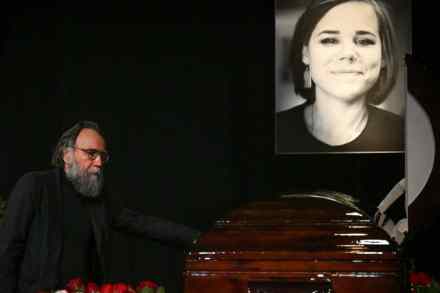
Daria Dugina has become a martyr for Putin

There was something menacing yet vaguely absurd about the Tuesday memorial service held to commemorate the life and fascist times of the prominent ultra-nationalist Daria Dugina, the daughter of the Kremlin propagandist Aleksandr. The 29 year old Daria Dugina, who died in a car explosion on August 20, was put on display in an open coffin, with guards wearing black and red armbands by her side. The sombre attendees filed past.

The West is watching the war in Ukraine like it’s sport

Every time I hear a politician speak of Munich, I suspect that something is amiss. Last week, President Zelensky accused former US Secretary of State Henry Kissinger of living in the ‘deep past’, and demanding that ‘a part of Ukraine be given to Russia’. ‘It seems that Mr. Kissinger has 1938 on the calendar instead of 2022’, Zelensky said. He wasn’t alone: figures from the Dutch Prime Minister Mark Rutte to the former chess champion Garry Kasparov put themselves on the record timidly or violently disagreeing with Kissinger. I wasn’t at Davos, but I learned of Kissinger’s revelations through Twitter.

Is Kissinger right about Ukraine?

32 min listen

Freddy Gray speaks to Sergey Radchenko a Cold War historian and Wilson E. Schmidt Distinguished Professor at the Henry A. Kissinger Center for Global Affairs, Johns Hopkins School of Advanced International Studies, and visiting professor at Cardiff University. They discuss a recent speech by Henry Kissinger who believes that Ukraine should made territorial concessions to Russia – is he right?

Why Russia needs to be humiliated in Ukraine

As Putin’s war against Ukraine drags on, Russia now faces the very real prospect of defeat. There are still difficult weeks and months ahead for Ukraine, and you cannot wholly discount the possibility of a dangerous escalation still in the war. But Putin has failed to attain his initial aims (the capture of Kyiv) and now looks likely to fall short of his secondary and much more modest aim of capturing Donbas. The war has turned into a protracted affair. That in itself is a defeat for the Russians. Russia’s humiliation in Ukraine has untold benefits, not least for Russia itself. We have heard it said for years that Russia must be indulged and humoured because, if not, it will resent having lost its great power status.

The Western Front

45 min listen

In this week’s episode: Has Putin’s invasion of Ukraine exposed the West’s weakness - or its strength?For this week, Sergey Radchenko, a Cold War historian writes about the draconian anti-war measures that Putin has imposed in Russia. He joins the podcast along with Dr Jade Glynn, a specialist in Russian memory and foreign policy at the Monterey Initiative in Russian Studies. (01:00)Also this week: has Russia’s invasion of Ukraine highlighted the hubris of the West? While Western countries unite in a chorus of criticism against Russia’s invasion of Ukraine. Rod Liddle writes that the invasion only highlights the impotence of the West. He is joined by James Forsyth, The Spectator’s political editor.

Putin has revived the cruelty of the Soviet regime

Among the many Russians who have protested against the war in Ukraine was 26-year-old Muscovite Aleksandra Kaluzhskikh, who was arrested earlier this month. She managed to record her interrogation while she was being beaten and sexually humiliated by police shouting expletives. ‘Look at the schmuck,’ one of her interrogators said, as Kaluzhskikh sighed and sobbed. ‘A marginal. What, you think they’ll do something to us for this [beating her]? Putin told us: kill them… That’s it! Putin is on our side. You are enemies of Russia. You are enemies of the people. I can kill you, and that’s it. And that’ll do it. They’ll give us a bonus for it.’ As I listened to this appalling 11-minute recording, I thought of precedents.