Sergey Maidukov

Sergey Maidukov is a Ukrainian writer and journalist. He is the author of Life On The Run

Ukrainians are paying a heavy price for Donald Trump’s indifference

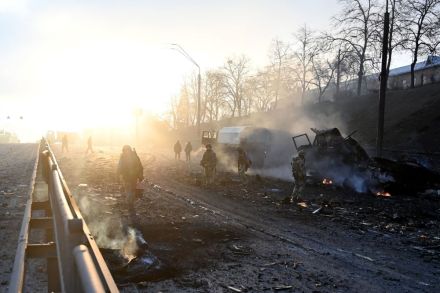
On the night of Monday, June 9, Russia carried out a combined strike on the territory of Ukraine, launching ballistic and cruise missiles, as well as attack drones. The first to fly, as always, were the so-called Shaheds, invaded into the country from various directions. Not long ago, American leadership meant something We in Kyiv anxiously awaited the continuation, remembering that in a recent telephone conversation with Donald Trump, Vladimir Putin had warned he would have to respond to Ukraine's major drone attack on Russian airbases. We also understood that the US president preferred not to interfere, portraying the bloody war as a conflict between "two young children fighting like crazy" in a park.

Who doesn’t stand to benefit from the war in Ukraine?

On the night of 26 May, Kyiv came under another large-scale Russian drone and missile attack, with explosions and machine gun fire rattling the city. I lay on the floor of my narrow hallway, listening to the furious cacophony outside the window. Two thin walls stood between me and the war, hardly an invitation to philosophical reflection. Nevertheless, I tried, because it helped me banish the more disturbing thoughts. We Ukrainians now rely on smartphone apps to warn us of incoming Russian drones and missile launches. They don’t tell you which building will be hit or where the wreckage of a downed Shahed might fall. This deprives you of sleep. Your mind churns with scrambled thoughts instead of dreams. If you can catch the truly important ones, they can be useful.

How Zelensky is calling Putin’s bluff

As the war between Russia and Ukraine continues on the battlefield, global leaders are waging their own campaigns through diplomacy, pressure and strategic manoeuvring. Just days ago, leaders from the UK, Germany, France and Poland arrived in Kyiv to urge Vladimir Putin to accept a 30-day, unconditional ceasefire. The message was clear: if Moscow refuses, Western allies will increase sanctions and ramp up military aid to Ukraine. Buoyed by this unified show of support, Volodymyr Zelensky called the ceasefire ‘the first step in truly ending any war’. But by morning, the Kremlin had issued a statement that ignored the ceasefire entirely. Instead, Putin proposed resuming direct peace talks with Ukraine in Istanbul on 14 May – without preconditions.

Has war healed Ukraine’s great divide?

The phrase divide et impera has echoed through history, its power as relevant today as it was in ancient Rome. Divide and conquer; rule through division. Rulers, then and now, have wielded this principle like a double-edged sword – deepening rifts to maintain control, ensuring that wounds never fully heal. At best, they turn into scars, waiting to be torn open again at the slightest provocation. War is a terrible thing. And yet, even a tragedy of this scale has taught us something In my own country, Ukraine, I’ve witnessed the devastating impact of this strategy for many years. While Western Ukrainians once called for the Donbas to be fenced off with barbed wire, people in the East labeled them neo-Nazis and Banderites. At times, political tensions led to “Orange Revolutions.

Could Ukraine descend into civil war?

US President Donald Trump has announced that peace talks with Putin are set to begin ‘immediately’. While Ukrainian President Volodymyr Zelensky says that he has not yet seen a ready US plan for ending the war, it seems that we are moving towards the final stages of the conflict. At some point the guns will fall silent, and the leaders of Ukraine and Russia will sign a peace agreement. But what happens then? Opinions vary, and not everyone is optimistic about how the war will wrap up. In a recent interview with the Financial Times, Polish President Andrzej Duda warned that the war’s end could trigger a surge in international organised crime, first flooding into Poland and then spreading across Europe and the US.