Seb Kennedy

Seb Kennedy is the founding editor of Energy Flux, an independent newsletter about the energy transition.

Putin could come to regret his gas game with Europe

Russian president Vladimir Putin has always enjoyed trolling European leaders. As relations between Moscow and Berlin deteriorate over reduced natural gas supplies and Ukraine-related sanctions, Putin is now brazenly gaslighting his German counterpart, chancellor Olaf Scholz. But it's a move he could come to regret. Putin suggested this week that Germany should give the shelved Nord Stream 2 gas pipeline the go ahead to restore gas flows to normal levels. The amount of Russian gas flowing into Germany along the operational Nord Stream 1 pipeline under the Baltic Sea is capped at 67 million cubic metres per day (MMcm/d), or about 40 per cent of its technical capacity. Russia claims this is due to a technical fault that could not be fixed under sanctions.
Putin’s roubles-for-gas scheme could split Europe

Russia’s latest gambit in the Ukraine conflict is to open a currency war with the West. Vladimir Putin’s declaration that Russia will only accept roubles as payment for natural gas bought by 'unfriendly' countries is the latest salvo in the long-running attack by Russia and China on the petrodollar system. The EU settles most of its gas purchases from Russia in euros or US dollars. Demanding western buyers switch to roubles is both offensive and defensive. It is clearly a desperate rear-guard action by the Kremlin to prop up the currency. Sanctions freezing some $300 billion (£230 billion) of Russia’s foreign currency and gold reserves prevented the Russian central bank from supporting its currency.

Are the lights about to go out across Europe?

Impact-Site-Verification: de2f122d-4b66-49e8-911d-d4d5628b0063 Today’s snap decision by German Chancellor Olaf Scholz to halt Nord Stream 2 — the new pipeline intended to export vast amounts of Russian gas into the EU — will make precisely no difference to European energy security, at least in the short to medium term. It could force a rethink of Berlin’s longer-term energy strategy, but the bigger question facing energy markets is whether Russia will curtail existing gas flows into Europe. Scholz on Tuesday instructed Germany’s Federal Ministry for Economic Affairs and Climate Action not to allow the Baltic Sea pipeline to start pumping gas 'for now'.

Power grab: who’s hoarding all the gas?

38 min listen

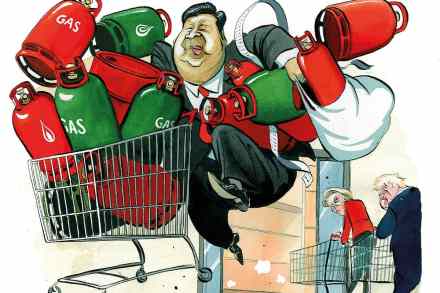
In this week’s episode: with the energy crisis picking up pace who are set to be the winners and losers in this cold war for gas? Domestically we are seeing queues for petrol, rising gas prices all in the face of the Government’s net-zero agenda. And internationally things are looking just as turbulent, with China buying up as much fuel as possible, America becoming more isolationist when it comes to its energy supply, and Russia feeling more powerful in its place thanks to its Nord Stream 2 pipeline. These are the issues that Seb Kennedy, the founding editor of Energy Flux, addresses in his cover piece this week for The Spectator.

Power grab: who’s hoarding all the gas?

Before Britain started worrying about a shortage of lorry drivers and petrol, we were fretting about a spike in wholesale gas prices. A couple of weeks and news cycles later, it would be easy to imagine that crisis had gone away. It hasn’t. On the contrary, global gas markets are preparing for a volatile winter. Britain, along with the rest of Europe, will face the full force of the crisis, raising the prospect of factory closures, if not general power cuts. Like Covid, the energy crisis came from China but has spread worldwide.