Ruari Clark

What no one tells you about dairy farming

It has been calving time in Devon and I arrive from London ready to work hard. The day starts at 6.30 a.m., when we check the field to see if any cows have calved. We check the ‘springer’ herd every two hours until 10 p.m. and intervene if a cow is in difficulty. Newborn calves are fed colostrum and taken down to the shed with their mothers. The farm I am working on keeps its cows outside all year round – not for this herd that little patch of blue some call the sky. But what the cattle gain in freedom, the farm labourers lose in comfort. The last time I was here for calving, in the spring of 2018, the weather was biblical: it was still snowing in April. Thankfully, the weather has held, but I’m not sure the same can be said of my body.

The delightful melancholy of an antiques shop

Antique shops are melancholy places. The deep leather armchairs, Anglepoise lamps and bamboo bookshelves. They ask questions: who sat, worked or read using these? Banal questions, possibly, but life is generally banal, and no less poignant for that. It’s not an unpleasant sort of melancholia. Quite the opposite. If I had to create a word to describe the feeling, I’d say it was melanphoria: ‘a state of intense excitement arising from a feeling of deep sadness’. One feels both a nostalgia for the lives of strangers and a sense of life’s possibilities. If this is abnormal, I would ask any amateur psychiatrists to write to The Spectator offices. I am physically unable to go into any antique shop without buying something. It is rarely a grand purchase.

Fraser Nelson, David Whitehouse, Imogen Yates, Sean McGlynn and Ruari Clark

31 min listen

On this week’s Spectator Out Loud: Fraser Nelson reflects on a historic week for The Spectator (1:15); David Whitehouse examines the toughest problem in mathematics (6:33); Imogen Yates reports on the booming health tech industry (13:54); Sean McGlynn reviews Dan Jones’s book Henry V: the astonishing rise of England’s greatest warrior king (20:24); and Ruari Clark provides his notes on rollies (26:18).  Produced and presented by Patrick Gibbons.

How to roll the perfect cigarette

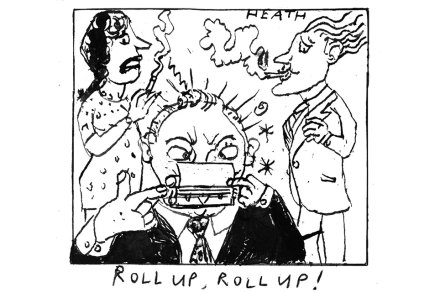
I recently estimated that, in my smoking life so far and at the age of 29, I have rolled 87,600 cigarettes. The calculation went as follows. Roughly 30 a day for the past six years, maybe 15 a day for four years before that. I attempted to make a reduction for eight months I spent in China, where the most beautiful straights could be bought for the equivalent of 40p per pack. But my mathematical faculties are almost as weak as my pulmonary ones, so I decided to balance those Chinese cigarettes with the thousands of rollies I’ve been asked to construct for friends, acquaintances and strangers. Apart from that brief and illicit fling with Chinese yen, I’ve been a roll-up man from the start.