Ross Clark

Ross Clark

Ross Clark is a leader writer and columnist who has written for The Spectator for three decades. His books include Not Zero, The Road to Southend Pier, and Far From EUtopia: Why Europe is failing and Britain could do better

How worried should we be about a third wave?

From our UK edition

At the beginning of the year, Boris Johnson and his advisers were at pains to tell us that by spring we would be in a vastly better situation with Covid. Well, spring is here, the number of new infections and deaths is falling by around 30 per cent week on week, deaths are back to

What the return of classrooms means for Covid

From our UK edition

Will the return of schools reverse, or dramatically slow, the sharp downwards trend in new Covid-19 infections, which is currently falling at more than 30 per cent a week? No one knows for sure, but it seems unlikely that the mass return of schools today will not have some effect on infections in England, especially

Is it time to measure Covid differently?

From our UK edition

According to government figures the toll of Covid 19 so far has been 124,419 deaths (if you define a Covid death as any death which occurs within 28 days of someone being confirmed as infected with the virus) or 140,062 (if you define a Covid death as one where the word ‘Covid’ is mentioned anywhere

Covid-19 and the problem with Britain’s weight

From our UK edition

How strong is the link between obesity and the danger of dying from Covid? Yesterday, the World Obesity Federation published a report containing a widely-quoted statistic that 2.2 million out of 2.5 million Covid deaths globally have occurred in countries where more than half the population is overweight. The figure is stark, although also highly

Is the fall in Covid infections really slowing down?

From our UK edition

Imperial College’s REACT study is given a prominence over other Covid data, but it is a struggle to understand why. This morning, as so often, BBC news bulletins included the latest tranche of results from the study, suggesting that the fall in new Covid infections is ‘slowing’.  The data appears to confirm a deceleration in

Rishi Sunak’s furlough trap

From our UK edition

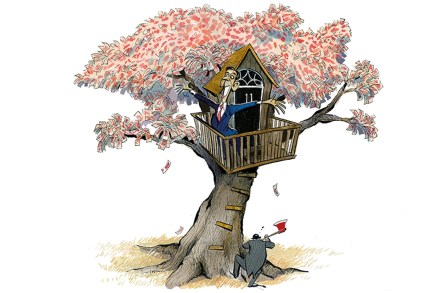
The trouble with emergency financial measures is that the crises used to justify them never seem to end. Just as the Bank of England couldn’t bring itself to think the time was ever right to reel back the ultra-low interest rates and quantitative easing it introduced at the nadir of the 2008/09 financial crisis, so

House buyers will need to move quickly after the Budget

From our UK edition

There is one certainty for every Budget day: that the chancellor will dream up some novel scheme to prop up the housing market. Rishi Sunak’s idea of providing state guarantees for 95 per cent mortgages taken out by first time buyers isn’t, however, that new. It is really just a reheated version of one branch of

Perhaps it is time to nationalise our failing railways

From our UK edition

We mustn’t abandon the railways to market forces, many on the left asserted when British Rail was broken up and privatised in the 1990s. They needn’t have worried. A quarter of a century on and we have yet to see a market force take to the tracks. Wasn’t the whole purpose of privatisation supposed to

How worried should we be about the Brazilian variant?

From our UK edition

How worried should we be about the news that P1, one of the two Brazilian variants of Sars-CoV-2, has been found in six people who travelled from Brazil to Britain before the hotel quarantine rules came into force, and that one of these people has yet to be traced? Variant P1 is of concern not

Are people tiring of lockdown?

From our UK edition

Is the decline in new Covid infections slowing down? That is the picture painted by the government’s figures for confirmed infections, arrived at via the NHS Test and Trace system. The most recent figures show that the 71,320 cases recorded in the seven days to Wednesday are 15 per cent down on the previous seven

Why do old people have fewer antibodies after the vaccine?

From our UK edition

The UK policy of delaying second doses of the Pfizer vaccine has been criticised by some as risky, with Pfizer warning that there is no data on the effectiveness of its vaccine other than for the dosing regime used in phase 3 trials: two doses, 21 days apart. But evidence is steadily trickling through. Earlier in

Blair’s back – and advising Tories on vaccine ID cards

From our UK edition

When the Prime Minister mentioned ‘Covid status certification’ as part of his route back to normal life, one man must have enjoyed the moment. For Tony Blair it was yet one more little victory in his UK comeback tour, made all the sweeter because Boris Johnson was once a principal opponent of the idea of

Face masks in schools: a note on the evidence

From our UK edition

Secondary-school children returning to school from 8 March will be required to wear masks in classrooms, at least for several weeks. That is in contrast to the initial return of children to school last summer. It wasn’t until November that they were required to wear masks at school, and then only in corridors and other

What comes after furlough?

From our UK edition

What an enriching business it is, having a global pandemic. That is the conclusion, at any rate, one might reach from reading, in isolation, the government’s figures on employment and earnings. According to the Office of National Statistics (ONS) the average earnings for employees have risen by 4.7 per cent over the past 12 months –

Latest vaccine data is even better than we had hoped

From our UK edition

The two vaccines approved and in use in Britain showed high efficacy rates in trials, but it takes time for data to creep through on efficacy in the real-world. We are, however, getting the first figures trickling through. This morning comes a paper evaluating the effectiveness of the Pfizer-BioNTech and AstraZeneca-Oxford vaccines in preventing hospitalisation

Does this Israeli study support Britain’s one-dose strategy?

From our UK edition

Is the British approach of prioritising first doses of Covid vaccines and not promising a second dose until 12 weeks later compromising our ability to fight the disease? It is not a moot point, with several EU figures asserting that it is a risky route to take. As I wrote here a couple of weeks

Covid cases have collapsed

From our UK edition

Last month, Imperial College’s React study claimed that new cases of Covid were static or even rising slightly. This contradicted the figures for confirmed new cases, obtained through the Test and Trace system, which had shown a sharp fall in new cases from the second week of January onwards. Given that React tests a randomised

Test and Trace was an expensive failure

From our UK edition

Before we had vaccines, NHS Test and Trace was supposed to be the breakthrough that would return us to a normal life. After all, testing, tracing and isolating contacts of infected people was credited with keeping Covid infections down in South Korea, Taiwan and elsewhere, so why wouldn’t it work here?  Instead, we had a

Will the economy really rebound after lockdown?

From our UK edition

Bank of England chief economist Andy Haldane last week described the UK economy as a ‘coiled spring’ waiting to rebound just as soon as lockdown restrictions are eased. But is it a spring like the one on which Zebedee from the Magic Roundabout used to bounce around, or is it like a Slinky – the