Rory Sutherland

Rory Sutherland

IQ tests: the controversy that won’t go away

I have a dim memory from 1970 of a primly dressed distant relative visiting in a Baby Austin. This, I later learned, was the anthropologist Beatrice Blackwood. I googled her 45 years later and was astonished to find she had spent several years in the 1920s and 1930s living alone among Stone Age tribes in New Guinea. Her pet kitten so enchanted the normally fierce Kukukuku that they even built her a temporary house. Aside from her travels, what also surprised me was how close-knit the world of anthropology then was. Just a few hundred people gave rise to debates which are still alive today. Nature vs nurture, for instance. Or IQ testing. Blackwood was a close friend of Hortense Powdermaker, who was later to write a fascinating study of Hollywood called Hollywood, the Dream Factory.

Why we put a man on the moon before we put wheels on suitcases

The Romans never invented the stirrup. It took 50 years after the invention of canned food for someone to invent the can opener. And we put a man on the moon before we put wheels on suitcases. This seems silly. But it is worth understanding each invention in context: often, a concatenation of other events has to occur before an invention can become widely adopted. The stirrup was of no use until the invention of the saddle-tree, which more evenly spread the rider’s weight across the horse’s back. The can opener had to wait for thinner cans: early tins were too hefty to submit to anything less than a chisel. In the case of wheeled luggage, the barrier may have been social acceptance.

Back to the future | 28 February 2019

The Romans never invented the stirrup. It took 50 years after the invention of canned food for someone to invent the can opener. And we put a man on the moon before we put wheels on suitcases. This seems silly. But it is worth understanding each invention in context: often, a concatenation of other events has to occur before an invention can become widely adopted. The stirrup was of no use until the invention of the saddle-tree, which more evenly spread the rider’s weight across the horse’s back. The can opener had to wait for thinner cans: early tins were too hefty to submit to anything less than a chisel. In the case of wheeled luggage, the barrier may have been social acceptance.

We don’t need more technology, we need better ways of using it

I’d like to propose a new scientific institution: the IUT, or Institute of Underrated Technology. Rather than trying to invent yet more bloody things, it will instead be devoted to helping us derive greater value from things we can do already using technology which already exists. Innovation is a two-stage process. First you discover something; then over time people discover how best to use it. Many ideas fall at the second hurdle: the Chinese invented gunpowder but used it only for fireworks; early Mesoamericans invented the wheel, but attached it only to children’s toys. In recent times, the internet seems to have delivered a lot more in entertainment value than in productivity. What we need is not more technology, but better uses for it.

We need to get better at using technology

I’d like to propose a new scientific institution: the IUT, or Institute of Underrated Technology. Rather than trying to invent yet more bloody things, it will instead be devoted to helping us derive greater value from things we can do already using technology which already exists. Innovation is a two-stage process. First you discover something; then over time people discover how best to use it. Many ideas fall at the second hurdle: the Chinese invented gunpowder but used it only for fireworks; early Mesoamericans invented the wheel, but attached it only to children’s toys. In recent times, the internet seems to have delivered a lot more in entertainment value than in productivity. What we need is not more technology, but better uses for it.

HS2 doesn’t work, but one simple tweak might make it worthwhile

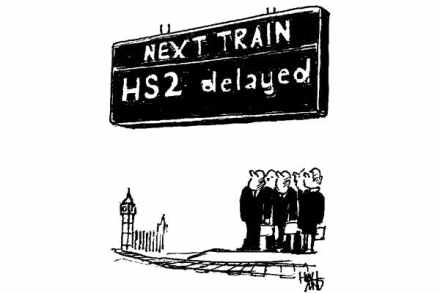
In past years, I have been a critic of HS2. I might now change my mind. One simple tweak might make HS2 worthwhile — while saving the taxpayer most of its £60 billion cost. For this to work, all you need to understand is that 1 x 200 is not the same as 200 x 1. To put it another way, commuting is not commutative. At present, all transport investment is driven by an economic model based on the purported economic value of overall time-savings for passengers. This, as David Metz shows in his excellent book Travel Fast or Smart? is a daft way to plan transport. Never mind that time spent travelling nowadays need be no less productive than time spent stationary: the model is dumb for a bigger reason.

The test of time

In past years, I have been a critic of HS2. I might now change my mind. One simple tweak might make HS2 worthwhile — while saving the taxpayer most of its £60 billion cost. For this to work, all you need to understand is that 1 x 200 is not the same as 200 x 1. To put it another way, commuting is not commutative. At present, all transport investment is driven by an economic model based on the purported economic value of overall time-savings for passengers. This, as David Metz shows in his excellent book Travel Fast or Smart? is a daft way to plan transport. Never mind that time spent travelling nowadays need be no less productive than time spent stationary: the model is dumb for a bigger reason.

The TWaT revolution: office on Tuesday, Wednesday and Thursday only | 22 January 2019

I recently saw a series of photographs depicting a rural home in China. Pride of place in a grimly furnished main room was given to a gargantuan new flat-screen television, while the sole toilet was a hole in the ground in an outside shed. What strange priorities, I thought. On reflection, though, under the same circumstances, I suspect quite a few of us would do the same thing. In Britain, for a hundred years or so, we never faced such a choice: you could install a decent indoor toilet, but not a Samsung 75in 4K LED TV, because the latter hadn’t been invented yet. So in Britain we almost all installed plumbing before we bought televisions — because that is the order in which they became available.

The TWaT revolution: office on Tuesday, Wednesday and Thursday only

I recently saw a series of photographs depicting a rural home in China. Pride of place in a grimly furnished main room was given to a gargantuan new flat-screen television, while the sole toilet was a hole in the ground in an outside shed. What strange priorities, I thought. On reflection, though, under the same circumstances, I suspect quite a few of us would do the same thing. In Britain, for a hundred years or so, we never faced such a choice: you could install a decent indoor toilet, but not a Samsung 75in 4K LED TV, because the latter hadn’t been invented yet. So in Britain we almost all installed plumbing before we bought televisions — because that is the order in which they became available.

Why economics is anthropologically tone-deaf

It has become commonplace for news reports to refer to almost any civic unrest, or even unusual patterns of voting, as evidence of ‘resurgent nationalism’ — implicitly suggesting a visceral hatred of foreigners and a desire to set the clock back to the glory days of racial homogeneity and casual homophobia. We should be wary of accepting this media trope: for one thing it may arouse far more fear than is warranted. But apart from the needless fear it generates, it is also slightly dubious to suggest that it is the gilets jaunes or the Five Star Movement or the supporters of Brexit or even Donald Trump who are acting intemperately.

Economics is having an identity crisis

It has become commonplace for news reports to refer to almost any civic unrest, or even unusual patterns of voting, as evidence of ‘resurgent nationalism’ — implicitly suggesting a visceral hatred of foreigners and a desire to set the clock back to the glory days of racial homogeneity and casual homophobia. We should be wary of accepting this media trope: for one thing it may arouse far more fear than is warranted. But apart from the needless fear it generates, it is also slightly dubious to suggest that it is the gilets jaunes or the Five Star Movement or the supporters of Brexit or even Donald Trump who are acting intemperately.

The most underpriced present you can buy

During the second Gulf war, simply out of curiosity, I found myself visiting the website of a giant American mercenary organisation. At the top of its home page I was surprised to see the words ‘online shop’. Thinking I could perhaps order an airstrike, or a fleet of Humvees to collect my daughters from school, I clicked on the link. All that was on offer was a range of brightly coloured beach towels displaying the company’s logo — a giant bear’s pawprint next to the word ‘Blackwater’. Needless to say, I bought two: one in orange and one in pink. In all honesty, I don’t think my wife was entirely thrilled with them that Christmas. So I’d never claim to be one of the world’s great gift-givers.

The tech timewasters

I have just spent a weekend planning a family trip to Chennai and Hyderabad. Since some of the flights are booked with reward points and some are not, our flights are under three separate booking numbers, each of which requires a separate login. I also had to print out booking confirmations from three different hotels, four boarding cards for the internal flights from Madras to Hyderabad, and a separate docket for my airport parking. That doesn’t include the two hours my wife spent applying for online visas, or the 90 minutes I spent getting approval to use a British credit card on an Indian airline website. Or the time I spent inputting my family’s passport details into another airline website, while also pre-ordering vegetarian meals for my pinko daughter.

Trump may have a point about fake news

In recent years, much scrutiny has been paid to the workings of social media algorithms. Driven by escalating competition for human attention, social media sites became filled with negative or controversial posts, because these attract more protracted engagement than anything else. Since reader attention attracts revenues, any profit-seeking algorithm will learn to highlight divisive content at the expense of more important topics. So a story about Hawaiian pizza might be more lucrative than one about human trafficking, since the idea of pineapple on pizzas polarises opinion more than a story about something universally agreed to be bad. But this problem is not confined to digital media.

Creating inequality by degrees

Imagine a world where employers judged applicants solely on their dress. Anyone in frayed clothes or scuffed shoes would never get a job. This would be unfair to poorer applicants so, in the name of equality, the government might offer favourable loans up to £1,000 to buy interview clothing. At first glance this would seem a wonderful way to promote fairness. Yet if the number of jobs remained constant, such a policy would have the opposite effect: it would merely ratchet up the level of wasteful, zero-sum competition for what limited chances exist. Soon, anyone not sporting Savile Row tailoring and handmade shoes would be written off. Rather than widening opportunity, it would raise the bar to existing opportunities still higher.

John McDonnell’s right – the four-day week could work

Most people were scandalised by John McDonnell’s proposal to promote a four-day working week. But before we get incensed about giving people more leisure during their working life, we need to ask another question. If it really is so vital to the economy that people spend more time at work, then why does the government spend £41 billion every year (a third of the cost of the NHS) providing tax relief on pension contributions? This merely encourages older and more experienced employees to leave the workforce several years earlier than necessary. Remember, five years needlessly spent in retirement is 20 years that could have been spent enjoying a working life of three-day weekends.

Why a four-day working week isn’t such a bad idea

Most people were scandalised by John McDonnell’s proposal to promote a four-day working week. But before we get incensed about giving people more leisure during their working life, we need to ask another question. If it really is so vital to the economy that people spend more time at work, then why does the government spend £41 billion every year (a third of the cost of the NHS) providing tax relief on pension contributions? This merely encourages older and more experienced employees to leave the workforce several years earlier than necessary. Remember, five years needlessly spent in retirement is 20 years that could have been spent enjoying a working life of three-day weekends.

Why the four-day week could work

Most people were scandalised by John McDonnell’s proposal to promote a four-day working week. But before we get incensed about giving people more leisure during their working life, we need to ask another question. If it really is so vital to the economy that people spend more time at work, then why does the government spend £41 billion every year (a third of the cost of the NHS) providing tax relief on pension contributions? This merely encourages older and more experienced employees to leave the workforce several years earlier than necessary. Remember, five years needlessly spent in retirement is 20 years that could have been spent enjoying a working life of three-day weekends.

Why better beats bigger

A few weeks ago I flew to Sydney to speak at a conference. The first leg was on the new Qantas route non-stop from London to Perth, the UK’s longest flight. Two million people live in Perth, of whom 250,000 were born in the UK, so the route makes sense. But I was dreading the length of the flight. Granted, I wasn’t travelling at the back of the plane, but I was surprised to find the 16-hour flight little worse than an eight- or ten-hour one. For one, there is the unexpected bonus that you can fall asleep whenever you like. On shorter flights, if you miss a narrow window-of-nod an hour or so after take-off, you are doomed to get too little sleep; here you could flip between sleeping, watching films and reading at your whim. But the real difference is the airliner.

Clever websites only make the market dumber

A month ago I wanted to travel to Bath for a 60th birthday party. From Kent, this either involves a Tube journey to Paddington or traversing the south-western stretch of the M25, where — in the rare moments you are not in stationary traffic — you have the even worse experience of driving over 10,000 misaligned slabs of ribbed concrete. But deep in my hippocampus, I remembered seeing a train to Bath on the departures board at Waterloo. This would let me travel from Seven-oaks to Waterloo East, avoiding the Tube. I looked online, but the website denied all knowledge of such trains. It told me to take the Underground to Paddington and board there. Following a hunch, I searched Waterloo to Bath via Salisbury.