Raymond Keene

Catalan

From our UK edition

The Catalan opening looks as if it should be relatively harmless, combining as it does the Queen’s Gambit with the modest fianchetto development of White’s king’s bishop. But various endgame virtuosi, notably Petrosian, Korchnoi and Kramnik, have demonstrated that the Catalan can be dangerous. In particular, the nagging pressure exerted at first by White’s light-squared bishop may persist long into the middlegame and endgame. The following notes are based on those by Neil McDonald in The Catalan: Move by Move (Everyman Chess)   Grischuk-Potkin: Villarrobledo 2009; Catalan Opening   1 Nf3 d5 2 c4 e6 3 d4 Nf6 4 g3 dxc4 5 Bg2 a6 6 0-0 Nc6 7 Bg5 Other moves for White leading to a sharp game are 7 Nc3 and 7 e3. 7 ...

no. 455

From our UK edition

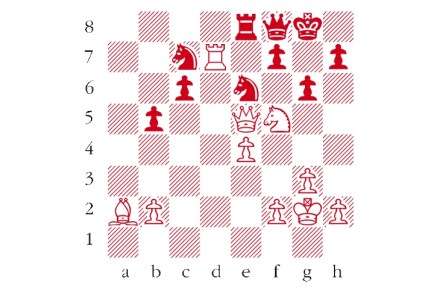
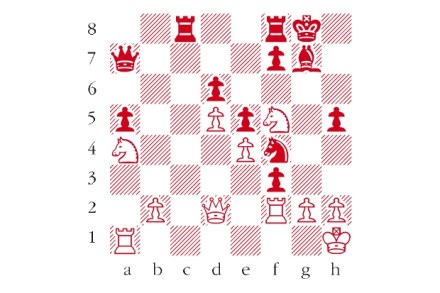
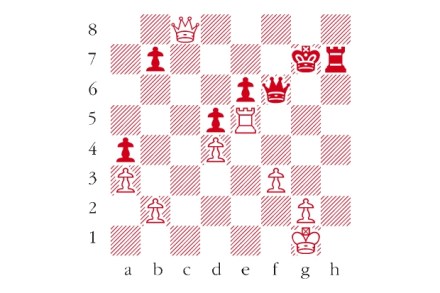
White to play. This position is from So--Kramnik, Gashimov Memorial 2017. So retreated with 1 Ne3 and eventually won. How could he instead have initiated a winning attack? Answers to me at The Spectator by Tuesday 9 May or via email to victoria@spectator.co.uk. There is a prize of £20 for the first correct answer out of a hat. Please include a postal address and allow six weeks for prize delivery.   Last week’s solution 1…Qxh2+ Last week’s winner C.J.

Bugged

From our UK edition

Polish grandmaster Akiba Rubinstein was one of the strongest players never to win the world title. Up to 1914 he seemed unstoppable, but then the Cuban genius Capablanca burst on to the scene and after the first world war Rubinstein was a changed man. In Chess and Chessmasters (Hardinge Simpole), Gideon Stahlberg wrote: ‘A latent disease of the mind was slowly weakening the titan’s creative powers and sapping his ability … but one could still recognise that he was a great master; his play was almost more subtle than before and his art more remarkable’.

no. 454

From our UK edition

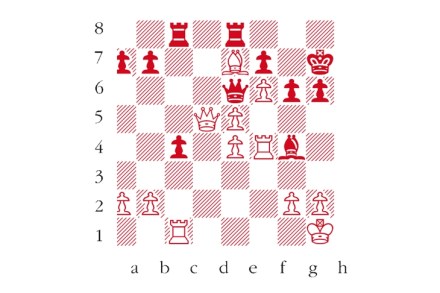
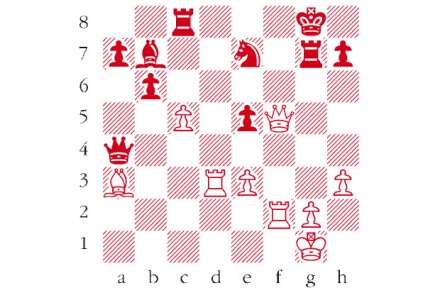
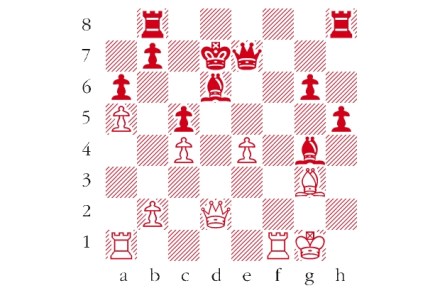
Black to play. This position is from Belsitzman-Rubinstein, Warsaw 1917. How did Rubinstein finish off? Answers to me at The Spectator by Tuesday 2 May or via email to victoria@-spectator.co.uk. There is a prize of £20 for the first correct answer out of a hat. Please include a postal address and allow six weeks for prize delivery.

BCM

From our UK edition

The British Chess Magazine is the oldest continuously published chess magazine in the world. Recently it has been boosted by the appointment as co-editor of the Belgrade journalist Milan Dinic, who cut his teeth on the news journal Svedok (Witness). The last issue contained an interview with the entertaining and controversial Nigel Short, as well as excellent comments on some of Short’s wins from Bunratty, where he won first prize with 6/6.   Short-Hunt; Bunratty Masters 2017; Queen’s Gambit Declined   1 Nf3 d5 2 d4 Nf6 3 c4 e6 4 Nc3 Be7 5 Bg5 Nbd7 6 e3 0-0 7 Bd3 b6 This is not good as the fianchetto of the queen’s bishop and ... Nbd7 do not work well together.

no. 453

From our UK edition

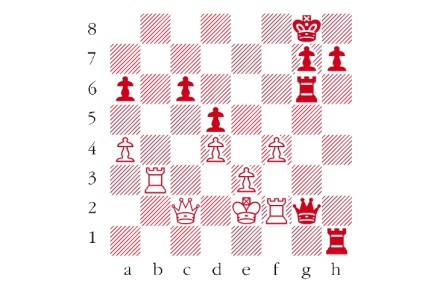
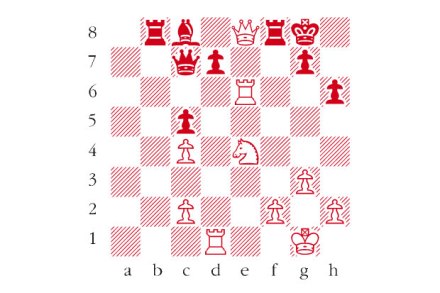
White to play. This position is from Costachi-Toma, Calimanesti 2017. Can you spot White’s winning coup? Answers to me at The Spectator by Tuesday 25 April or via email to victoria@spectator.co.uk. There is a prize of £20 for the first correct answer out of a hat. Please include a postal address and allow six weeks for prize delivery. Last week’s solution The question should have said that White had two winning tries. 1 Qf5 is a good one but 1 Rb8+ wins.

no. 452

From our UK edition

White to play. This position is from Euwe-Fischer, New York 1957. White has two winning moves in this position. Can you find both of them? Answers to me at The Spectator by Tuesday 18 April or via email to victoria@spectator.co.uk. There is a prize of £20 for the first correct answer out of a hat. Please include a postal address and allow six weeks for prize delivery.

Presidential panic

From our UK edition

This month, watch out for unidentified fleeing presidents. Kirsan Ilyumzhinov, president of Fidé, the World Chess Federation, and a self-confessed alien abductee, seems to have a revolution on his hands. Several of his closest lieutenants, such as Giorgios Makropolous and Nigel Freeman from the Athens HQ, are insisting that Kirsan has resigned, while Kirsan himself is insisting that something has been lost in translation.   We shall know more about whether the president has been blasted into outer space after a board meeting which is due to take place soon.   This week’s game and puzzle feature Dr Max Euwe, Fidé president from 1974-1978.

Stakhanovite

From our UK edition

Before leaving the topic of the 50th anniversary of the 1967 tournament to mark the half-century of the Russian revolution, I must mention the Hungarian grandmaster Lajos Portisch, another hero of that prestigious competition. (Leonid Stein being the overall winner.) Portisch was famed for his immense hard work and profound erudition in the openings. At Moscow he outgunned both the reigning world champion, Tigran Petrosian, and his recent challenger, the future champion Boris Spassky, as a result of his Stakhanovite exertions in the field of openings analysis.   Portisch-Spassky: October Revolution, Moscow 1967, Nimzo-Indian Defence   1 d4 Nf6 2 c4 e6 3 Nc3 Bb4 4 e3 b6 5 Nge2 Ba6 6 Ng3 0-0 7 e4 Nc6 8 Bd3 d5 This move is not seen any more, 8 ... e5 being preferred.

no. 451

From our UK edition

White to play. This position is a variation from Portisch-Petrosian, Moscow 1967. Can you spot White’s winning coup? Answers to me at The Spectator by Tuesday 11 April or via email to victoria@-spectator.co.uk. There is a prize of £20 for the first correct answer out of a hat. Please include a postal address and allow six weeks for prize delivery.

Fifty glorious years

From our UK edition

Whatever else you may say about it, the USSR certainly created the greatest national chess-playing machine the world has ever seen or is likely to see. The Soviet Union perceived itself to be regarded as a pariah by the international community. One way to counter this was by winning the World Chess Championship, as it would establish the state’s intellectual credentials.   In 1967 a great tournament was held to celebrate the first 50 years of the revolution. The USSR failed to survive the next half century, but the anniversary of that tournament, won by Leonid Stein ahead of such luminaries as Vassily Smyslov, Mikhail Tal, Boris Spassky and the reigning world champion Tigran Petrosian, is worth marking.

no. 450

From our UK edition

Black to play. This position is from Gligoric-Stein, Moscow 1967. Can you spot Black’s winning coup? Answers to me at The Spectator by Tuesday 4 April or via email to victoria@spectator.co.uk. There is a prize of £20 for the first correct answer out of a hat. Please include a postal address and allow six weeks for prize delivery.

Pauline conversion | 23 March 2017

From our UK edition

Paul Keres is the only chess player to have appeared on the euro currency, his face adorning the two-euro piece in Estonia, where he remains a national hero. Keres has a powerful claim to be regarded as the strongest player never to have won the World Championship. His scalps included Capablanca, Alekhine, Botvinnik, Smyslov, Tal, Petrosian, Spassky and Fischer.   This week’s game, with notes based on those by Zenon Franco in Keres: Move by Move (Everyman Chess) is a crushing victory against another grandmaster who also has claims to be seen as the strongest ever non-world champion.   Korchnoi-Keres: Tallinn 1965; Torre Attack   1 d4 Nf6 2 Nf3 e6 3 Bg5 h6 4 Bxf6 Qxf6 5 e4 b6 6 a3 The idea of this is to be able to play Nc3 without fearing ...

no. 449

From our UK edition

White to play. This position is from Mareco-Nakamura, Pro-League, chess.com 2017. Can you spot White’s winning coup?Answers to me at The Spectator by Tuesday, March 28, or via email to victoria@spectator.co.uk or fax to 020 7961 0058. The winner will be the first correct answer out of a hat, and each week I shall be offering a prize of £20. Please include a postal address and allow six weeks for prize delivery.   Last week’s solution 1 Nf6+. Last week’s winner Dr Richard Craven, Montpelier, Bristol.

Oxford v Cambridge

From our UK edition

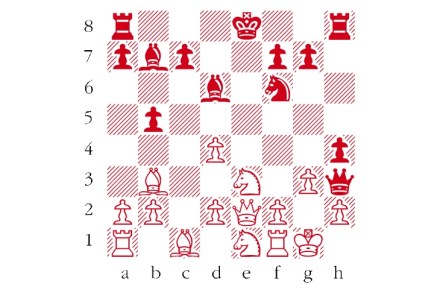
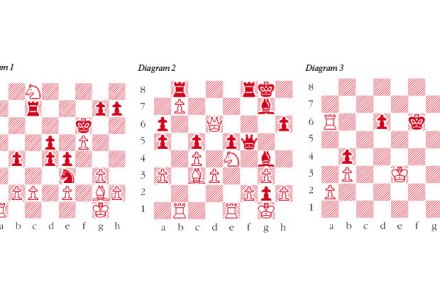
The 135th Varsity Match hosted by London’s Royal Automobile Club last Saturday resulted in a narrow win for Oxford, who have reduced their overall deficit. The score is now 59 wins to Cambridge, 54 to Oxford. The brilliancy prize, judged by grandmasters Jon Speelman and Luke McShane and named in honour of Bob Wade OBE, was awarded to the Cambridge player Daniel Fernandez. When we join the position he is a piece down for very little compensation.   Gerlagh (University College, Oxford)- Fernandez (Queens College, Cambridge) See diagram 1   27 Ra6+ Much better is 27 Nb6 with the idea 27 ... Rxc2 28 Nxd5+ Nxd5 29 Bxe4 Rc5 30 Ra6+ winning. 27 ... Kg5 Despite the extra piece, White is in difficulties.

no. 448

From our UK edition

White to play. This is from Horton--Murphy, Varsity Match 2017. Can you spot White’s winning coup? Answers to me at The Spectator by Tuesday 21 March or via email to victoria@spectator.co.uk. There is a prize of £20 for the first correct answer out of a hat. Please include a postal address and allow six weeks for prize delivery.   Last week’s solution 1 ... Rh1+ Last week’s winner P.A.

Mutkin’s masterpiece

From our UK edition

This Saturday, 11 March, the annual Oxford v Cambridge Varsity match is being hosted by The Royal Automobile Club Pall Mall. Cambridge lead the series with 59 wins to Oxford’s 53 in a contest which goes back to the 1870s. Primum mobile at the RAC is Henry Mutkin, who himself led the Oxford team in the mid-1950s. This week’s game sees Mutkin felling not one but two former British champions, both grandmasters, with a series of mighty blows. Thanks to Henry for providing variations.   Hodgson/Sadler-Mutkin: London 2016, Trompovsky Attack   1 d4 Nf6 2 Bg5 Ne4 3 Bf4 d5 4 e3 e6 5 Bd3 Bd6 6 Ne2 Nd7 7 Bxe4 dxe4 8 Nd2 Nf6 9 Bg5 c5 This leads to complicated play. White wins a pawn but Black gains practical counterchances.

no. 447

From our UK edition

Black to play. This position is from Kozera-Wang, Varsity Match 2016. White has powerful threats and Black has only one way to stay in the game. Can you see it? Answers to me at The Spectator by Tuesday 14 March or via email to victoria@spectator.co.uk. There is a prize of £20 for the first correct answer out of a hat. Please include a postal address and allow six weeks for prize delivery.

Mr Hundred Per Cent

From our UK edition

Nigel Short has distinguished himself by scoring 100 per cent, winning all six games, in the Bunratty tournament which finished towards the end of last month in Ireland. Anyone who has competed in a chess tournament of almost any strength will realise how hard it is to win all the games. In Short’s case he played consistently solid yet aggressive classical chess and in the process defeated two grandmasters, Peter Wells and Alexander Baburin, the victim of this week’s game.   Next year sees Bunratty’s silver jubilee and they are hoping to attract as many previous winners as possible. Nigel will surely be high on the list.

no. 446

From our UK edition

White to play. This position is from Tabatabaei-Vakhidov, Aeroflot Open, Moscow 2017. White has sacrificed a piece for a powerful attack. Can you spot his crushing breakthrough? Answers to me at The Spectator by Tuesday 7 February or via email to victoria@spectator.co.uk. There is a prize of £20 for the first correct answer out of a hat. Please include a postal address and allow six weeks for prize delivery.   Last week’s solution 1 ...