Raymond Keene

no. 476

From our UK edition

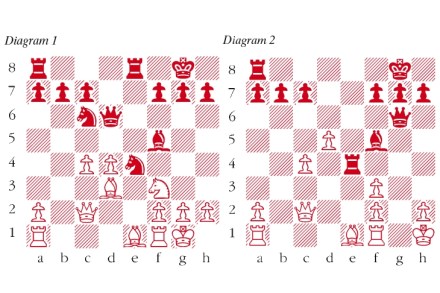
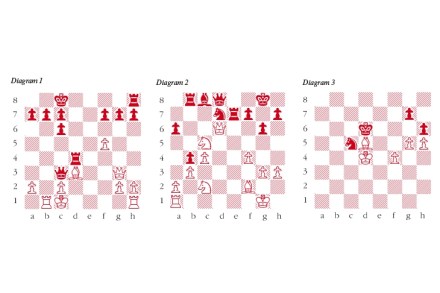
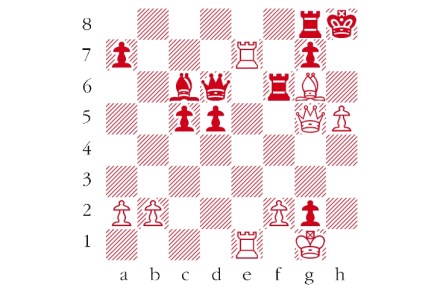
White to play. This position is from Paul-Jonsson, Isle of Man 2017. How did White make a decisive material gain? Answers to me at The Spectator by Tuesday 3 October or via email to victoria@spectator.co.uk. There is a prize of £20 for the first correct answer out of a hat. Please include a postal address and allow six weeks for prize delivery.
Bronstein’s legacy

From our UK edition

Last week I focused on the games and somewhat tragic career of the ingenious David Bronstein. Before his time the King’s Indian Defence was viewed with a certain degree of suspicion, not least because of the early and gigantic concessions it makes to White in terms of occupation of central terrain. It was Bronstein who resurrected and then espoused that previously neglected defence, paving the way for later practitioners, such as Tal, Fischer and Kasparov. Nowadays,the KID has become one of the main highways of opening theory, along which both grandmaster and neophyte may travel, secure in the knowledge that the defence is essentially sound. A new book, The King’s Indian Defence: Move by Move (Everyman Chess) by Sam Collins brings the theory of this opening fully up to date.

no. 475

From our UK edition

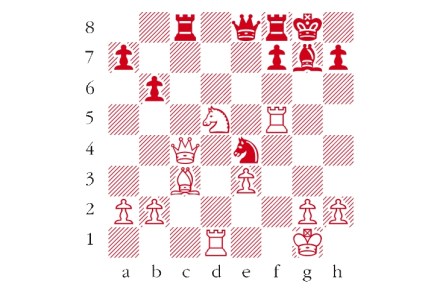
White to play. This position is from Jobava-Nepomniachtchi, FIDE World Cup, Tbilisi 2017. Can you spot White’s winning coup? Answers to me or via email to victoria@spectator.co.uk by Tuesday 26 September 2017. There is a prize of £20 for the first correct answer out of a hat. Please include a postal address and allow six weeks for prize delivery.   Last week’s solution 1 ...

Study in obsession

From our UK edition

Genna Sosonko is a writer and grandmaster who straddles two great chess cultures, Holland and the USSR, his chosen and native lands. His latest book, The Rise and Fall of David Bronstein (Elk and Ruby Publishing House), does not contain any actual chess analysis but instead focuses on Bronstein’s decade-long obsession with his narrow failure to become world champion in his 1951 match with Botvinnik. Bronstein was one of the most creative players in the history of the game, yet his inability to unseat Botvinnik gnawed at his soul and acted as a block on any future attempt to seize the supreme title, or even to win a major tournament.

No. 474

From our UK edition

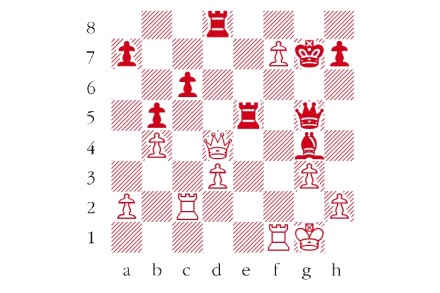
Black to play. This position is from Carlsen-Bu, Fidé World Cup, Tbilisi 2017. Can you spot Black’s winning coup? Answers to me at The Spectator by Tuesday 19 September or via email to victoria@spectator.co.uk. There is a prize of £20 for the first correct answer out of a hat. Please include a postal address and allow six weeks for prize delivery.   Last week’s solution 1 … Qxc6+ Last week’s winner D.V.
David and the Giants

From our UK edition

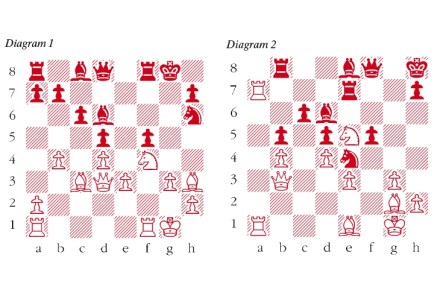
The overall scores of the exceedingly strong combined rapid and blitz tournaments in St Louis were as follows: 1. Aronian 24½;   2= Karjakin and Nakamura 21½; 4. Nepomniachtchi 20; 5= Dominguez, Caruana and Le 16½; 8. Kasparov 16; 9. Anand 14; 10. Navara 13. As an indication of the elite nature of this competition, the bottom-placed contestant, David Navara from the Czech Republic, succeeded in defeating former world champion Garry Kasparov and Sergei Karjakin, the outright winner of the blitz section.   Karjakin-Navara; St Louis Blitz 2017; Caro-Kann Defence   1 e4 c6 2 Nf3 More usual is 2 d4. 2 ... d5 3 Nc3 dxe4 4 Nxe4 Nf6 Against the variation chosen by White this knight challenge is eminently feasible.

no. 473

From our UK edition

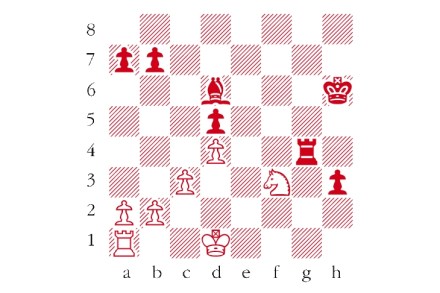
Black to play. This is from Kasparov-Navara, St Louis Blitz 2017. White has just given what appears to be a powerful check on c6. How did Black respond? Answers to me at The Spectator by Tuesday 12 September or via email to victoria@-spectator.co.uk. There is a prize of £20 for the first correct answer out of a hat. Please include a postal address and allow six weeks for prize delivery.
Hou dares wins

From our UK edition

Hou Yifan, the leading female grandmaster, is beginning to place strain on Judit Polgar’s record as the best woman chess player ever. At the Biel Grandmaster tournament, Hou seized first prize ahead of a phalanx of elite male rivals. Her win against the veteran grandmaster Rafael Vaganian (see below) was outstanding.   There have been occasional controversies, including one in which our own Nigel Short once became embroiled, about the relative powers of the male and female brain.

no. 472

From our UK edition

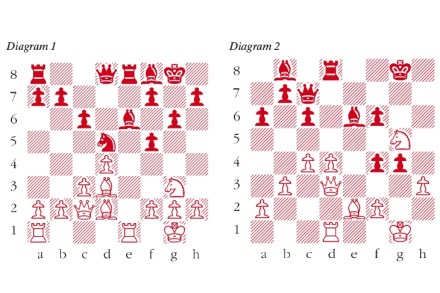
White to play. This position is a variation from Hari-krishna-Studer, Biel 2017. Can you spot White’s winning thrust? Answers to me at The Spectator by Tuesday 5 September or via email to victoria@spectator.co.uk. There is a prize of £20 for the first correct answer out of a hat. Please include a postal address and allow six weeks for prize delivery.
Philidor’s heir

From our UK edition

There was a time when France was the dominant power in world chess. When Howard Staunton commenced his remarkable series of match victories in the mid-1840s, his ascent was seen as an assumption of the sceptre wielded by that great 18th-century master of the game, André Danican Philidor. After Philidor came Labourdonnais, who was succeeded by St Amant, and it was Staunton’s annihilation of the French champion at the Café de la Regence in Paris in 1843, which heralded the end of French hegemony over the chessboard.   It is true that Alexander Alekhine, the mighty Russian champion, represented France in the chess Olympiads of the 1930s, but he was anything but a homegrown Francophone.

no. 471

From our UK edition

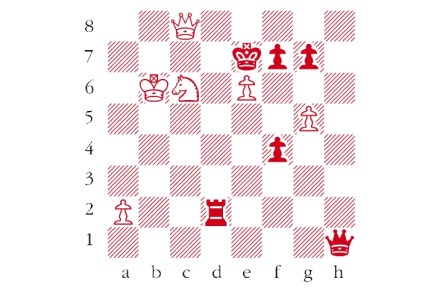
White to play. This position is a variation from Vachier-Lagrave–Nepomniachtchi, St Louis 2017. How can White make a decisive material gain? Answers to me at The Spectator by Tuesday 29 August or via email to victoria@spectator.co.uk. There is a prize of £20 for the first correct answer out of a hat. Please include a postal address and allow six weeks for prize delivery.
Magnum opus

From our UK edition

A new book on the ingenious Hungarian master Gyula Breyer ranks, in my opinion, at the very top of chess publications, along with Kasparov’s various mega series, Nimzowitsch’s My System, and Alekhine’s books of his best games. It is a compendium of games, discursive digressions, notes, discreet modern corrections, scholarly research, history, theory and perhaps most impressive of all, Breyer’s philosophy of the art, science and sport of chess. I just have one query, a strange reference by Dvoretsky in his notes to Breyer v. Esser. Tal v. Tolush 1957 USSR Championship seems to be strangely misattributed, with White (instead of Tal) being given as somebody I have never heard of, one Szucs.

No. 470

From our UK edition

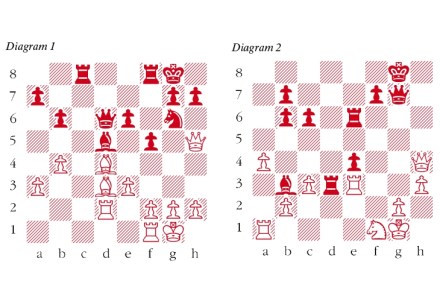
White to play. This is from Breyer-Esser, Budapest 1917. White has a multiplicity of tempting options but the best move forces mate in nine. What is it? Answers to me at The Spectator by Tuesday 22 August or via email to victoria@spectator.co.uk. There is a prize of £20 for the first correct answer out of a hat. Please include a postal address and allow six weeks for prize delivery.
Test of time | 10 August 2017

From our UK edition

Last week I pointed to the fact that games played at accelerated time limits are acquiring an official imprimatur that threatens to rival the well-established ratings, rankings and titles of chess played at classical time controls. This year’s British Championship (the 104th) last weekend concluded in Llandudno with a four-way tie for first place. In order to separate the top four, a rapidplay play-off was necessary. So the British Championship title for the coming year has now been decided by games at faster speeds.   The final leading scores in the championship and the final involving the top four were as follows: Gawain Jones 10½; Luke McShane 9½; Craig Hanley and David Howell both 7; Richard Palliser, John Emms and Ameet Ghasi 6½.

no. 469

From our UK edition

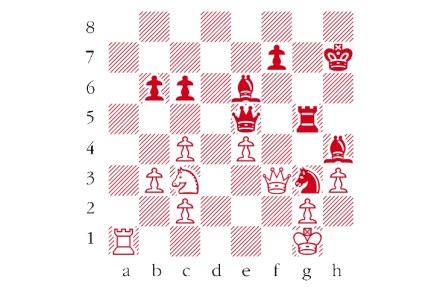
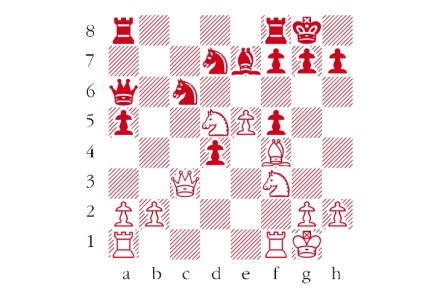
White to play. This is from Anand--Caruana, St Louis 2017. Can you spot White’s incredible winning move? Answers to me at The Spectator by Tuesday 15 August or via email to victoria@spectator.co.uk. There is a prize of £20 for the first correct answer out of a hat. Please include a postal address and allow six weeks for prize delivery.
Classical conundrum

From our UK edition

The great Mikhail Botvinnik excoriated chess played at fast time limits. Botvinnik believed that classical chess at time limits of, for example, 40 moves per player in two and a half hours each, was the purest expression of the art and science of chess. Radically faster alternatives cheapened and debased the thought processes, he believed. Of course, he also relished adjournments — now outlawed because of the possibility of computer analysis.   Modern chess faces the problem of excessive draws bedevilling elite events at classical time controls.

no. 468

From our UK edition

Black to play. This is a position from Kramnik--Carlsen, Leuven Blitz 2017. How did the world champion win even more material? Answers to me at The Spectator by Tuesday 8 July or via email to victoria@-spectator.co.uk. There is a prize of £20 for the first correct answer out of a hat. Please include a postal address and allow six weeks for prize delivery.

British championship

From our UK edition

This year’s British Championship starts on Saturday and is endowed with an outstanding prize fund supplied by Capital Developments Waterloo Ltd. The first prize alone is £10,000 and this has attracted a field which includes many of the UK’s leading grandmasters. This week, a game and a puzzle by two of the leading contenders. Gawain Jones won the championship in 2012 and this week’s game is taken from that event. The puzzle position is by Luke McShane, a hugely talented player who has been somewhat distracted from his vocation as a chess grandmaster by his day job in finance.   Jones-Turner: British Championship, North Shields 2012; Petroff Defence   1 e4 e5 2 Nf3 Nf6 3 Nxe5 d6 4 Nf3 Nxe4 5 Nc3 Nf6 This is a fashionable line in the Petroff.

no. 467

From our UK edition

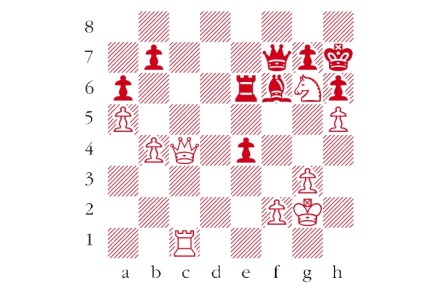
White to play. This position is from McShane-Istratescu, London 2013. How did White conclude his kingside attack with a fine flourish? Answers to me at The Spectator by Tuesday 1 August or via email to victoria@spectator.co.uk. There is a prize of £20 for the first correct answer out of a hat. Please include a postal address and allow six weeks for prize delivery.
New in chess

From our UK edition

New in Chess is one of the world’s leading chess magazines. At one time or another, every contemporary champion and leading grandmaster has contributed to it. Of particular interest are the regular columns by the English grandmasters Nigel Short and Matthew Sadler. The group also publishes many high-quality books. In Chess for Hawks, Cyrus Lakdawala regales us with a number of inspirational examples, including several from his own games. The title suggests a certain predatory attitude is necessary in striving for victory, but the prime message conveyed is: never give up, even if you only have the tiniest of edges. Persistence is everything.