Philip Womack

Philip Womack is a writer, an ex-private tutor and a parent.

Shakespeare isn’t difficult

From our UK edition

Chloe Zhao may have co-written and directed Hamnet (a film about William Shakespeare’s son), but she claims that she couldn’t understand Shakespeare’s words and had to rely on the actor Paul Mescal to help her. You might have thought that Zhao, who spent her sixth form years at Brighton College (where, one hopes, she at least sniffed at

Everyone has forgotten party etiquette

From our UK edition

Growing up, it was made very clear to us that if you RSVPed in the positive to a party, you were absolutely honour-bound to turn up. It was the height of rudeness to chuck. How things have changed. These days, people don’t even bother RSVPing: it’s too difficult. Some are even too lazy to click

No, Christmas isn’t pagan

From our UK edition

At some point during this Advent season and the coming of Christmas, you will log on to your computer, and you will see somebody smugly opining that ‘actually Christmas is a pagan festival’. This person will not know anything about pagans, bar some fuzzy ideas about equinoxes (always with the equinoxes) and sacrifice. The reasons

William Atkinson, Andreas Roth, Philip Womack, Mary Wakefield & Muriel Zagha

From our UK edition

35 min listen

On this week’s Spectator Out Loud: William Atkinson reveals his teenage brush with a micropenis; Andreas Roth bemoans the dumbing down of German education; Philip Womack wonders how the hyphen turned political; Mary Wakefield questions the latest AI horror story – digitising dead relatives; and, Muriel Zagha celebrates Powell & Pressburger’s I Know Where I’m Going! Produced

How the hyphen turned political

From our UK edition

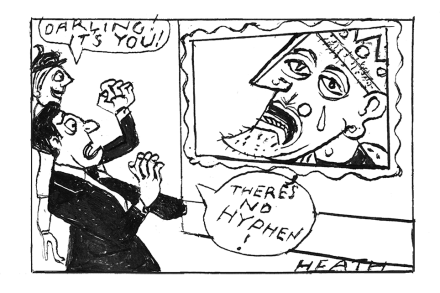
When Buckingham Palace announced that its errant prince, Andrew, would be known as boring old Andrew Mountbatten Windsor, some surprise arose at the initial omission of the hyphen from his surname. The hyphen is, unlike King Lear’s whoreson zed, a necessary thing; without it, names float, unmoored, unsure whether they are attached to first name

What makes a gentleman?

From our UK edition

The venerable magazine GQ, or Gentlemen’s Quarterly, has issued some 125 diktats about what it takes to be a gentleman in this world of Zoom calls and equality. GQ is, however, no longer quarterly, and some might say it hasn’t been read by gentlemen for some time. Ought we, then, to listen to it? Many of its ‘expert’ pronouncements

Why do people feel sorry for me for going to boarding school aged nine?

From our UK edition

Sometimes, when I’m chatting about childhood, at some point it will become clear I went to a boarding school from the age of nine. Reactions can be comical. ‘You poor thing!’ an interlocutor might gasp, gripping my forearm, no doubt picturing cold showers and cruelty. I’ve always responded with bemusement, since my experience largely featured

Tom Slater, Justin Marozzi, Iben Thranholm, Angus Colwell & Philip Womack

From our UK edition

28 min listen

On this week’s Spectator Out Loud: Tom Slater says that Britain is having its own gilet jaunes moment; Justin Marozzi reads his historian’s notebook; Iben Thranholm explains how Denmark’s ‘spiritual rearmament’ is a lesson for the West; Angus Colwell praises BBC Alba; and, Philip Womack provides his notes on flatmates. Produced and presented by Patrick

The coming crash, a failing foster system & ‘DeathTok’

From our UK edition

45 min listen

First: an economic reckoning is looming ‘Britain’s numbers… don’t add up’, says economics editor Michael Simmons. We are ‘an ageing population with too few taxpayers’. ‘If the picture looks bad now,’ he warns, ‘the next few years will be disastrous.’ Governments have consistently spent more than they raised; Britain’s debt costs ‘are the worst in

Wanted: a flatmate for the Pope

From our UK edition

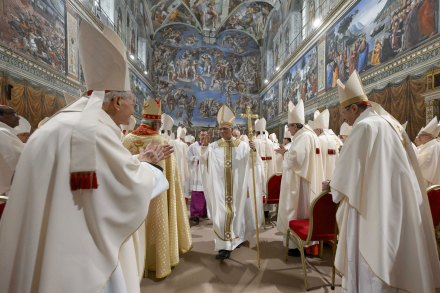
Pope Leo XIV has announced, though not in the form of a bull, that he will be sharing the Apostolic Palace not just with God, but with flatmates. (Being American, he probably refers to them as ‘roomies’.) While this might seem an odd move for God’s Vicegerent on Earth, even the sacrosanct precincts of the

Goodbye to the letters of introduction

From our UK edition

Re-reading Agatha Christie’s A Murder is Announced this week (it’s the summer holidays! I can relax like anyone else!), I was struck by one of Miss Marple’s wise pronouncements: And that’s really the particular way the world has changed since the war. Take this place, Chipping Cleghorn, for instance. It’s very much like St Mary

The tragic decline of children’s literature

From our UK edition

The other day, leafing through T.H. White’s The Once and Future King, which enchanted me as a child, I was bedazzled all over again. This time, though, it wasn’t the plot and characters that gripped me, but something better: vocabulary. ‘Summulae Logicales’, ‘Organon’, ‘astrolabe’, ‘metheglyn’, ‘snurt’, ‘craye’, ‘varvel’, ‘austringer’, ‘yarak’: all appear, exuding magic, within

The harrowing true story behind Barry Lyndon

From our UK edition

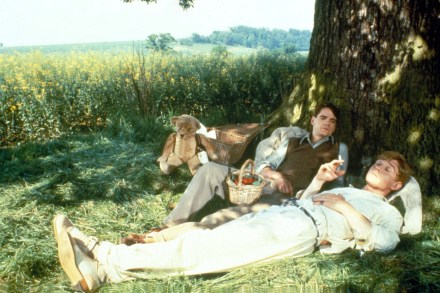
Stanley Kubrick’s swooningly gorgeous film, Barry Lyndon, has just been re-released in cinemas to mark its 50th anniversary. Much ink has been spilled about its hypnotic beauty, its lavish attention to historical detail, its dreamy, luscious, candlelit photography. Yet William Thackeray’s bitingly satirical novel of the same name is often neglected – as is the

A meeting of misfits: Seascraper, by Benjamin Wood, reviewed

From our UK edition

The sea, as you might expect, looms large in Benjamin Wood’s finely tuned novella Seascraper. Thomas Flett – one of the most touching protagonists I’ve encountered in recent years – is barely out of his teens, but he’s already battered by toil. His days are spent shanking – gathering shrimps on the beach – with

Pixels are replacing paper

From our UK edition

Those of us of a certain vintage will remember the National Record of Achievement, a brown, crummy-looking folder, sent (personally, I like to think) by Tony Blair to every schoolchild in the country. We were encouraged to keep our certificates within its corporate leaves, from Swimming Level 1 Goldfish to Duke of Edinburgh. Presumably, before

I’m pseudy and proud

From our UK edition

What does it mean to be a ‘pseud’? I hadn’t thought a great deal about it, until a passage from a piece I’d written about semicolons made it into Private Eye’s venerable Pseuds Corner. It appears just after a conversation between two AIs, and above a breathless quote from Meghan Markle (for it is she).

End of the rainbow, rising illiteracy & swimming pool etiquette

From our UK edition

50 min listen

End of the rainbow: Pride’s fall What ‘started half a century ago as an afternoon’s little march for lesbians and gay men’, argues Gareth Roberts, became ‘a jamboree not only of boring homosexuality’ but ‘anything else that its purveyors consider unconventional’. Yet now Reform-led councils are taking down Pride flags, Pride events are being cancelled

We’re losing the ability to read

From our UK edition

A recent American study, called ‘They Don’t Read Very Well’, analyses the reading comprehension abilities of English literature students at two Midwestern universities. You may be surprised to discover that the title is not ironic. That they don’t read very well is an understatement along the lines of Spike Milligan’s ‘I told you I was