Philip Womack

Philip Womack is a writer, an ex-private tutor and a parent.

A love letter to France

From our UK edition

When John Julius Norwich was a boy, his father was British ambassador in Paris.School holidays were spent in the exceptionally beautiful embassy which had been purchased by the Duke of Wellington from Pauline Borghese. He would mix dry martinis for Jean Cocteau, and sing songs to the dinner guests which he had been taught by

Paris mismatch

From our UK edition

There has been much debate recently about what exactly constitutes ‘literary’ fiction. If the term means beguiling, gorgeously crafted novels that are assured of their place alongside other writers, reacting to, and taking pleasure in discussing them; that are aware of the world’s events and their impact on humanity; that have delicately drawn characters; and

Another gone girl

From our UK edition

Adam Thorpe’s latest novel, Missing Fay, examines the lives of a disparate group of people in Lincolnshire, all touched in some way by the disappearance of the titular Fay, a sparky, gobby 14-year-old girl from a council estate. This is an England of motorways, dull campsites, immigrants and nursing homes: where transience is the norm,

Defeat by tweet and blog

From our UK edition

The Wake, Paul Kingsnorth’s Booker-longlisted debut novel, was set just after the Norman Conquest, and was told in an odd hybrid of pseudo-Anglo-Saxon and modern English. Its narrator, Buccmaster of Holland, being displaced by the incoming Frenchies, gathered a group of fighters to resist, holding them together by the strength of his personality. But something

Escaping the Inferno

From our UK edition

I read this, Meg Rosoff’s first novel for adults (though her previous fiction, aimed at teenagers, is widely enjoyed by older readers), curled up with my beautiful lurcher, Una, twitching her ears beside me. Appropriately so, as the novel concerns the relationship between a young man and two dogs, super-intelligent collie Dante and devoted spaniel

Odi et amo

From our UK edition

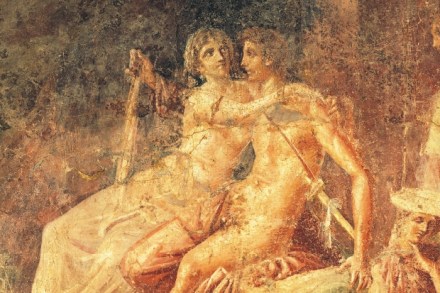
Reading Daisy Dunn’s ambitious first book, a biography of the salty (in more ways than one) Roman poet Catullus, it struck me how lucky we are: only one copy of his collection of poems survived the ages, hidden under a bushel in Verona. Catullus might have gone the way of his contemporaries, such as Cinna,

A break from sabre-thrusting

From our UK edition

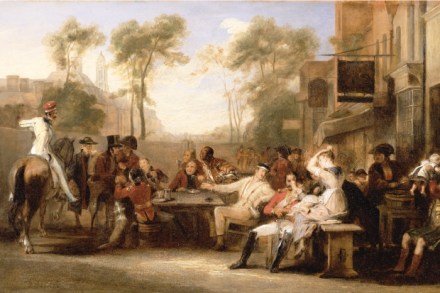
Allan Mallinson’s historical series concerning Matthew Hervey, the well-bred, thoughtful soldier, details a world where men are practical and not too clever; where the only sensible vote is Tory; where Moors make ‘uncommonly good cymbalists’. Everything gleams, buffed up to a shining surface: it is a fantasy of empire and glory. Two thirds of the

Questioning tales

From our UK edition

Tessa Hadley’s previous book, The London Train, was one of the best novels of last year, though overlooked by prize committees. It concerned the gently disentangling lives of a pair of middle-class couples, and found its strengths in numinous revelations of the everyday. These short stories (all previously printed in magazines such as Granta and

Chuckles in the middle of nowhere

From our UK edition

I really wanted to like this book. After the dire Eragon, which has now been made into a worse film, and this year’s The Meaning of Night, with its coy Victorianisms and pointless footnotes, I was longing for a ‘fantasy’ that would enchant and amuse in delicious detail. And somewhere, in the 750-odd pages of

In praise of unwanted gerundives

From our UK edition

I had a succession of brilliantly eccentric Classics teachers. Father Hunnwycke, a kindly and acerbic priest, showed his hatred of school inspections by holding up a German book called Group Sex in Ancient Rome every time the inspector’s dreary head was bowed. Another, a small, military Scottish man, would, after berating my misuse of the

Magic and mischief

From our UK edition

Susanna Clarke taps enchantingly into a vein of folkloric gold. She presents our world as existing in tandem with ‘Faerie’, but without butterfly-winged Victoriana. Instead she creates a sense of danger, as if the Faeries in question are the displaced gods of Robert Graves’ The White Goddess, still retaining elements of frightful power over mankind.

Just imagine that

From our UK edition

This is a loosely connected series of tales which make up an intriguing, sometimes frustrating and occasionally both compelling and hilarious collection of ‘snatches’ from a bizarre alternative world history, which proclaims that there is no such thing as fiction, and that we are always one step away from destruction. Trotsky’s ghost, a cannibalistic contessa