Peter Phillips

If the price is right …

From our UK edition

The question of who is going to buy EMI Classics took up most of 2012 and seems destined to run well into the new year. Given that the catalogue in question is probably the most extensive ever put together, containing priceless recordings from the earliest days of so many great artists that it would be otiose even to start listing them in this confined space, you might think that here was the sale of the century let alone of the year. In fact, no one seems to want it. The reason for putting such a property up for sale is that Universal, which already owned much of the music industry, last March began negotiations to acquire EMI as well.

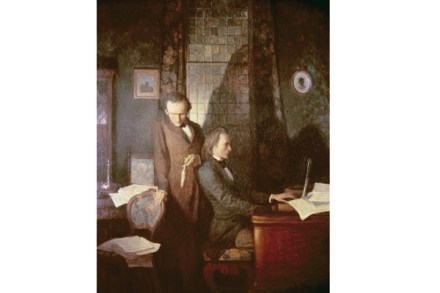
Musical rivalries

From our UK edition

Donald Greig’s first novel is a fluent knitting together of three distinct worlds: American musical academia, London professional singing and the life of a 15th-century composer. It is also something of a whodunnit, involving secret codes in combustible medieval manuscripts alongside skullduggery between some very famous historical characters. If this sounds like a remake of The Name of the Rose, it is a lot funnier. Greig is at pains to say that all the musicologists he knows are genuinely effective people, but one would be forgiven for doubting it if his main character is anything to go by. Over-earnest academics are sitting targets, of course, but the fall and rise of this one is a delight to follow.

Talking dirty

From our UK edition

Attached to the ménage of every artistic outfit these days will be an employee who believes there is a magic formula which,  once found, will bring in millions of everything: fans, column inches, money. Perhaps all artists secretly believe that what we do must have universal appeal: our insights are simply too significant to be overlooked. The only reason why other people don’t come to our concerts, buy our discs, or otherwise frequent our places of high culture is that it hasn’t yet got through to them that we exist. They only have to be drawn in by the right kind of publicity and everybody will love what we do. To find this publicity is the job of expensive professionals who spend their lives identifying the perfect image or coining the irresistible slogan.

Bolivian treasure

From our UK edition

Every so often in my line of business one reads heartwarming stories about manuscripts from the past turning up in unlikely places. The most favoured of these places over the years has probably been bricked-up chimney stacks in Tudor manor houses, where one supposes the terrified owners once thrust documents that would have incriminated them with the prevailing religious authorities. These documents might well have included music written for whichever Church was currently out of fashion; and so it is that pieces of music thought to be long lost have reappeared centuries later, both Protestant and Catholic. There is every chance that further discoveries will be made. Other places have included municipal and monastic libraries.

Night and day

From our UK edition

It is 0422, pitch black outside and pouring with rain. The candles are being extinguished one by one as the last of the congregation leave the chapel. They look tired but determined. I notice that, for the first time in my adult life when awake at this hour, I am sober. We have just sung the night Office of Lauds, which began at 0400, in the chapel of Keble College Oxford. Matins, which we sang at 0100 in Christ Church, is already a dimming memory, soon to be further overlaid by Prime, Terce and Mass, Sext, None, Vespers and Compline, each sung at its traditional time throughout the 24 hours. Since those times are spaced, punitively, at approximately every three hours for 22 hours without ceasing there is going to be little chance for sleep.

Prom power

From our UK edition

As the whole world knows, London has been putting its best foot forward this summer, and has done it very impressively. From the success of the Olympics to the best-contested Test Match I’ve ever been to (the final result, notwithstanding) it has been a pleasure to be part of the scene. But of all the glamorous events on offer the ones that have probably received the least publicity — because they happen every year — are those that unfold nightly in the Albert Hall. There, without fail, unbelievable numbers of people go to hear all kinds of classical music, some as challenging as anything in the canon.

Choral cull

From our UK edition

The Myerscough report about the future funding of the BBC, entitled Delivering Quality First, is another classic in the long-running serial about how everything will be much better once the Corporation has made further cuts to its staff and programming. This one, which follows on from another published what seems like just the other day, is the direct result of the BBC having acquiesced in freezing the licence fee until 2017 while taking on new costs, such as the World Service and the switchover to digital services. Two thousand jobs must go and this time the funding of the Performing Groups — the five full-time orchestras and the BBC Singers — is not protected.

All to play for

From our UK edition

Impressed by Alethea Hayter’s A Sultry Month: Scenes of London Literary Life in 1846 (1965), which describes the close relations between Benjamin Haydon, the Carlyles and the Brownings in the summer of 1846, Hugh Macdonald has written a similarly ‘horizontal’ and highly readable biography of intersecting musicians in 1853. His theme is the relations, not always close, between Brahms, Berlioz, Liszt, Schumann, Wagner and a host of lesser figures in that year.

Culture notes: Chart topper

From our UK edition

The iTunes classical chart hasn’t been around very long, but for the time it has been available the number one slot has usually featured Pavarotti singing ‘Nessun dorma’. Nothing wrong with that, except that the chart was invented specifically to encourage the current classical music scene and give an impression of who was doing what within it. Now a piece written 450 years ago — Tallis’s ‘Spem in alium’ — has taken over at the top, in a recording by the Tallis Scholars. Manna sure drops from heaven in unpredictable ways. This posting has come as a result of the success of an erotic novel, Fifty Shades of Grey by E L James, where it is suggested that Tallis’s music is the ultimate turn-on.

Art of myth-making

From our UK edition

The story of Allegri’s Miserere has probably become the most engrossing myth that great art of any kind has to offer. From the mists of time when it was first heard, through the threat of terrible punishment — excommunication — to those who might betray it, to the touch of divine intervention that Mozart brought it, it has everything to stimulate the pens both of those who want to rationalise it and those who are more inclined to fabulate on an inspiring theme. It helps that the music itself is so powerful, to which many figures, past and present, have paid tribute: Mary Shelley, for example, described how ‘the soul is carried away into another state of being’.

Proms promise

From our UK edition

On first opening a new Proms prospectus, the enthusiastic amateur immediately looks for the things that are there, the things that are not there and, a mixture of the two, the things he hopes will be there. What I hope for every year goes roughly like this: the Berlin and Vienna Philharmonics (yes to both); a big operatic production (two this time, one each from the Royal Opera and ENO); one or two Really Famous (and preferably Really Old) artists (Barenboim, Boulez, Dutoit, Gergiev, Haitink, Perahia); some big anniversaries to be celebrated (Debussy, Delius, Cage, Knussen and Goehr — a middling crop); symphonies by Bruckner and Mahler (three each); some top early music (very little); Saint-Saëns’s Third Symphony (no).

Counting the cost | 3 May 2012

From our UK edition

The arrival of the Proms prospectus, with its glamorous pictures of the stars of today, makes me wonder how much those very palatable-looking people are costing the BBC. The question is prompted by the style of the photography — the sexing up of the Weapons of Mass Destruction dossier has nothing on how string players enjoy curling round their instruments. It is all a far cry from the stolid, besuited look classical musicians used to affect, as if one could trust them to get their passagework right while delivering mature interpretations of intellectually taxing repertoire. The modern version says nothing if it doesn’t say expensive. The issue of what the leading names in classical music can charge was addressed recently in an article in Classical Music magazine.

Early adopters

From our UK edition

The death of Gustav Leonhardt at the age of 83 brings to an end the career of one of the giants of the early music movement. As an organist, harpsichordist and conductor he was long at the forefront of the experiments and revelations that the drive to perform music on period instruments made possible. He will be remembered for being fearless in his single-minded pursuit of what he thought his chosen repertoires required. And he was producing peerless recordings of those repertoires right from the beginning which — one forgets — was in the late ’40s. The term ‘early music’, and its demanding fellow traveller ‘authenticity’, have had a long innings.

Anthems for the Queen

From our UK edition

The Choirbook for the Queen, which has recently been launched, is a remarkable initiative, involving most of the leading Church musicians of our day and many philanthropists besides. The idea behind it is simple enough: to put together a collection of anthems (I use the word precisely) to celebrate the Queen’s Diamond Jubilee, with the added intention of showcasing ‘the excellence of choral writing and the continuation of the choral tradition by cathedral choirs and other choral foundations around the country’. Already in place is a plan for 80 of our cathedral and collegiate choirs to sing two of these anthems each this year, some to be broadcast on the BBC.

Easy listening | 11 February 2012

From our UK edition

There is only one place these days where the music of Charles Villiers Stanford (1852–1924) sends its hearers into reliable ecstasy, and that is in choirs and places where they sing. Otherwise he is something of a bust. Despite having written seven symphonies, nine operas, 11 concertos (including three piano, two violin, a cello and a clarinet), eight string quartets and countless songs, piano pieces and other chamber works, he is now celebrated for a tiny fraction of his output. Stanford himself thought that to be renowned as a composer of Anglican Church music was not enough. He wanted to be measured alongside international (i.e., German) stars, and so went to Berlin to study with the leading teachers of the day, and in particular to meet Brahms.

The 40-part challenge

From our UK edition

Embedded somewhere in the Christmas story no doubt is the idea of much being contained in a small space — or Multum in parvo as the restored road signs leading into Rutland have it. The opposite, which I will leave you to chisel into Latin for yourselves, presumably gets less attention in the Bible, yet nicely sets up any discussion of the current interest in writing choral music for 40 voices. A performance of any 40-part piece is likely to guarantee a big crowd. Like dinosaurs, they attract attention merely on account of their size, though unlike these forebears they need a quite exceptionally large brain to control their bulk. The problem for the composer is obvious: how to make something interesting of such a massive canvas.

Heavenly voices

From our UK edition

It seems that Christ was born with the sound of choral music in his ears. That, at any rate, is what is to be deduced from many of the works of art that the manger scene has subsequently inspired. There is the holy family gathered round the crib, gold and lapis lazuli everywhere, beneficent animals kind of smiling at the smiling Christ child and, raised rather above all this, angels singing. Perhaps officially they are sexless — Wikipedia isn’t very discursive on the gender of the cherubim and seraphim — but as far as I can see they look like girls and are meant to be men. This makes for all sorts of interesting speculation, not least in the matter of what they sounded like.

Brain gain

From our UK edition

The arrival of the composer Eric Whitacre and his family in London as permanent residents brings a ray of Californian sunshine to our cloud-bedraggled lives. American musicians who have chosen to move to Europe to work have always made an interesting group, headed by jazz players of the calibre of Josephine Baker and Sidney Bechet. Of course they had reasons for seeking work elsewhere which do not apply to the very white Whitacre. But, given that at a casual glance the US appears to offer so much opportunity to everyone, why come all this way? In Whitacre’s case I get the impression that he really likes the UK.

Ideal marriage

From our UK edition

In all the heavier-duty excitement of Liszt’s anniversary I had failed to register that W.S. Gilbert expired 100 years ago; and, perhaps just as significant, the copyright of the D’Oyly Carte opera company expired 50 years ago. I am old enough to remember the fuss which that moment provoked — the highbrows hoping to kill off the whole dreadful phenomenon there and then; the not so high, including Harold Wilson and Spike Milligan, trying to extend it. The company muddled through to 1982, but finally the Arts Council had had enough, and a lot of well-educated people heaved a sigh of relief that the Savoy Operas had finally passed into history. They were premature in their heaving. For a few years, the tradition did indeed seem to be down and out.

Rebellious Prommers

From our UK edition

The Promenaders have excelled themselves this year. I thought initially they were slightly more docile and slightly less dotty than usual, but no. Not only at the Last Night, but also at the Israel Philharmonic Prom on 1 September, they found their voice — so strongly that the BBC actually suspended the broadcast of the latter. One Prommer told me the atmosphere that night was verging on the violent. The members of the Israel Philharmonic must have wondered what had hit them. With this concert they were concluding a lengthy worldwide tour, which had passed without a murmur. Suddenly, in the Albert Hall, every piece they played was interrupted with raucous singing, the Webern Passacaglia, for example, with the ‘Ode to Joy’.