Peter Hoskin

Cameron’s failure to communicate?

From our UK edition

Fascinating stuff.  ConHome's Tim Montgomerie has got his hands on a letter sent on House of Commons writing paper to all Tory MPs, by - allegedly - a group of Conservative parliamentarians.  Tim has uploaded a pdf of the entire thing but, as he says, this is the key section: "We all know that the expenses crisis is a massive problem, but it has brought out clear evidence of what all of us had sensed and feared, namely that the party in parliament has ceased to be a team effort and is now just run and dictated to for the personal advantage of David Cameron and George Osborne. We are concerned that the parliamentary party is just being used and abused by the leader and his inner circle. They are treating the party as if it is their private property.

The case for pessimism

From our UK edition

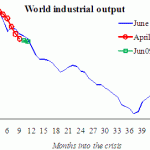
Amid all the talk of green shoots and renewed economic growth, Vince Cable and Martin Wolf pop up today to warn that the nightmare is, potentially, far from over.   Of the two, Wolf's is the more useful article; linking, as it does, to a paper by the economic historians Barry Eichengreen and Kevin H. O'Rourke, entitled A Tale of Two Depressions.  I recommend that all CoffeeHousers check that paper out, as the graphs in it are, as Wolf puts it, "worth more than a thousand words". They suggest that - across a range of indicators, from world industrial output to the volume of world trade - we remain on an equally harsh, or even worse, downwards path as during the early period of the Great Depression. I've reproduced one of the graphs below: it makes for a compelling picture.

The Speaker should become a more public figure

From our UK edition

Although I can't say I agree with his choice, Steve Richards makes a strong case* for John Bercow becoming the next Speaker in today's Independent.  The passage that struck me the most, though, was this: "The next Speaker should do away with the costumes and the rituals, make the language and the proceedings more straightforward, give media interviews when Parliament itself is the issue, put the case for politics and the Commons around the country and by personifying a modern approach put pressure on the party leaders to make their moves too. I have never understood why the Speaker should not give interviews, an elusiveness that makes the Commons seem more distant than it is. Even Bob Dylan gives the occasional interview these days.

A dividing line that’s dividing government

From our UK edition

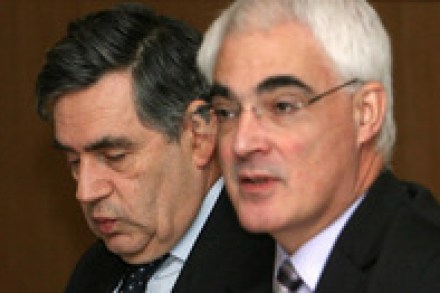
Rachel Sylvester writes a fascinating portrait of the Brown-Balls-Mandelson relationship in the Times today, suggesting that Mandelson is on the opposite site of the spending cut fence from his two colleagues: "The Business Secretary has always shied away from class war - he wants to appeal to posh and poor. He is instinctively suspicious of fighting another election on 'investment versus cuts' - a rehash of Labour's past two campaigns, which took place in a very different economic climate. An interesting alliance has formed in Cabinet between Lord Mandelson and Alistair Darling, who argue that the Government has to be honest with the voters that there will be spending cuts whoever wins power.

The Tories start to level with the public on cuts

From our UK edition

Isn't it funny how things work?  Andrew Lansley gaffes in a radio interview last Wednesday and, as a direct result, George Osborne today writes the kind of article on public spending that he should have written months ago.  Rather than shying away from the idea of cuts, he actively pushes them as a necessary measure to tackle Brown's debt crisis - an obvious point, I know, but one that the Tories wouldn't have made so bluntly even just a few weeks back.  Here's the key passage: "We've all been tip-toeing around one of those discredited Gordon Brown dividing lines for too long. The real dividing line is not 'cut versus investment', but honesty versus dishonesty.

The meeting that counts?

From our UK edition

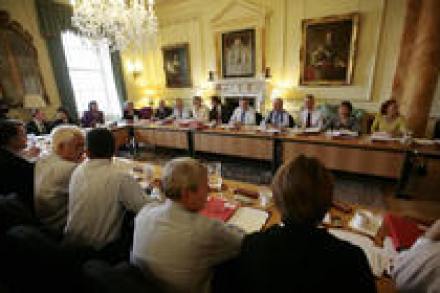
What happens when tragedy has already slipped into farce, and the farce requires new material?  Gordon Brown creates another government committee, that's what.  As the Sunday Telegraph reports, the latest Committee for Rescuing Labour and Thereby Gordon's Premiership is composed of Brown himself along with seven Cabinet ministers: Peter Mandelson, Ed Balls, Alan Johnson, David Miliband, Alastair Darling, Harriet Harman and Jack Straw.  The idea is that they'll meet every Monday morning to "plot the Government's future strategy". And there's me thinking that they did that sort of thing in normal Cabinet meetings.

Clarke clarifies and muddies the Tory position on Europe

From our UK edition

One of the questions that - understandably - just won't go away is what the Tories intend to do about the Lisbon Treaty.  Their constant refrain has been that if it's not ratified by the time they're in government, then they'll hold a referendum on it and campaign for a "No" vote.  But what if it has been ratified?  William Hague recently hinted that they'd hold a referendum anyway, but we've heard nothing certain.  Until now.  Speaking on the Politics Show, Ken Clarke has said that a Tory Government won't "re-open" Lisbon if it's ratified by Ireland.

The sword still hangs above Gordon Brown’s head

From our UK edition

And so it continues.  Gordon Brown may have prevented his own immediate demise over the past ten days, but the idea that he'll be toppled before the next election still won't go away.   The most intriguing of all the leadership stories in the Sundays is the News of the World's scoop that Ed Balls is, allegedly, planning to wield the knife should Brown fail to substantially improve Labour's position over the next few months.  Balls - so long Brown's consigliere, but now perhaps losing status to the rejuvenated Peter Mandelson - is said to have announced the plan after the PLP meeting last Monday. Whether there's anything to it, I'm not sure.  And it's certainly getting hard to keep up with all the briefing, counter-briefing and other assorted speculation.

The central tensions undermining Brown’s “Tory cuts” argument

From our UK edition

Just to prove that Brown 'n' Balls haven't locked Alistair Darling in the basement of the Treasury, the official Chancellor gets an interview in the FT today.  Plenty of stuff in there about green shoots, oil prices and those darstardly Germans, but it's this passage which jumped out at me: "The chancellor is quick to criticise what he characterises as the Conservatives’ plans to cut public spending by 10 per cent, but he does not follow Gordon Brown’s tactic of claiming public spending under a Labour government would be bountiful. In making that claim the prime minister used the longer-range Budget forecasts which are not adjusted for inflation.

So what now, Yvette?

From our UK edition

Aside from the failure of other ministers to follow his lead, one of the saddest aspects to James Purnell's resignation is that the DWP has lost an extremely capable minister.  Yes, I know he's not a particular favourite of CoffeeHousers - but he was instrumental in getting David Freud's welfare reform agenda accepted as government policy, and even hired Freud as an adviser.  Before Freud's defection to the Tories, all signs were that the duo would push through some of the radical measures that the country requires as both job queues and welfare bills soar. But now Purnell's gone, one of the questions swirling around the Westminster policy arena is what the appointment of Yvette Cooper will mean for welfare reform. The signs aren't particularly clear.

Is David Miliband still the Labour Party’s choice to succeed Brown?

From our UK edition

When the histories of Gordon Brown's premiership are written, I'm sure the events of the past week will get a prominent showing.  And I'm sure, too, that Allegra Stratton's blow-by-blow account in today's Guardian will be among the most useful first-hand sources. There are plenty of fascinating nuggets in there: how the plotters regard Hazel Blears' resignation as the "moment it started to go wrong" for them; how the Hotmail plot got an email from brownn@parliament.uk - the email address of the chief whip - not because he wanted to join them, but because he wanted to sniff them out; and how numerous MPs were dissuaded from acting against Brown by a rumour that he's gone to speak to the Queen. But the most noteworthy passage comes at the end.

Now Lansley is sackable

From our UK edition

Well, well, well - it sounds as though Andrew Lansley's loose lips may have cost him his hitherto "unsackable" status.  Tim Montgomerie spoke to a source in Cameron's office about the shadow health secretary's "10 percent cuts" comment on Today this morning, and got the following response: "No one is unsackable ... [Lansley] will not be forgiven another gaffe." As Tim says, though, the main upshot of all this could be a more mature, more public debate about spending cuts than we've had at any point over the last decade.  If you want to prime yourself, then Fraser's earlier post is essential reading.

The Lansley commitment

From our UK edition

ConHome's Tim Montgomerie - instrumental in getting the Cameroons to ditch their pledge to match overall Labour spending plans - has launched his most acerbic attack  yet on the Tories' commitment to hefty real terms spending increases in health, as reiterated by Andrew Lansley on Today this morning. His points deserve repeating: "There is indeed something incredible about the Conservative position on health spending.  It's a leftover from George Osborne's 2007 pledge to match all Labour spending.  It's the wrong policy for at least three reasons; -- At a time when Britain's debt mountain is causing international rating agencies to reconsider Britain's credit status it is unaffordable.  Public sector spending is set to soar to 53.

Hunting for a vision

From our UK edition

And so the Glorious Fightback begins for Gordon Brown.  Stage One is his announcement on Parliamentary reform today; but it's Stage Two, his "national plan" next week, which seems to be getting the most hype.  Indeed, an insightful article in the FT suggests that the Dear Leader's inner circle regards it as "the last throw of the dice".  And Peter Mandelson drops in words like "boldness," and phrases such as "decisive action," just for good measure. The key point, though, comes towards the end of the article: "Some doubt that Mr Brown’s plan will be able to demonstrate anything more than government impotence before the election. 'This is classic Gordon. He thinks of the story first, then tries to work out what the policies should be.

A kind tyrant | 10 June 2009

From our UK edition

‘Ajuxtaposition of incompatible elements.’ So Chris Fujiwara describes one of Otto Preminger’s more obscure films in his critical biography of the Hollywood director. But the phrase so encapsulates what I had come to think about Preminger’s entire output that I underlined it, underlined it again, and made a mental note to quote it at the beginning of this review. You see, from urbane noir flicks to period romps to weighty historical dramas, his work seems to differ in tone and content almost as much as it does in quality. Incompatible elements, indeed.

Osborne sets out the “risky choice” that is voting Labour

From our UK edition

So what's the story, George Osborne?  Reading his speech today, there's plenty of sturdy talk about lowering the national debt burden and encouraging saving - but a few gaps that need filling if the policy is to live up to the rhetoric.  Osborne seems to recognise this himself: for every reference to the Office of Budget Responsility or the IHT cut, there's an admission that the Tories will release more detailed proposals "in due course". In which light, the most striking passage reads thus (my emphasis): "The markets are saying that Britain needs a Conservative Government with a working majority if we want to avoid the costs to the British people of the country's debts rising.

Brown’s last chance (or maybe not)

From our UK edition

According to Steve Richards today, Labour figures have given Brown until this autumn to improve the party's position or they'll ditch him. Hm. Hasn't Brown been threatened with these kinds of utlimatums before? Oh yes: The Sunday Telegraph, 20 April, 2008 "The Prime Minister, who is battling a growing rebellion over his abolition of the 10p tax rate, has been given until the end of the summer to turn things round by backbenchers angry at a string of image and policy failures." (here) The Telegraph, 24 May, 2008 "It is that Mr Brown be given until the end of July to prove himself and restore morale.

Is the rebellion over for this week?

From our UK edition

So where have the emails and signed letters calling for Brown to resign gone to?  They certainly didn't appear during the PLP meeting yesterday, which leads you to wonder why.  Didn't they get enough signatures?  Did the signatories decide to hold off, to give Brown time to reconstruct his premiership?  Or are they planning to drop a bombshell over the next few days?   You feel that if the letters - and possible stalking horse challenges - were to appear, then they'd have done so last night.  After all, that was the moment for the Labour party to speak to the Dear Leader; to make their case en masse.  The Commons gets a similar chance tomorrow, during the debate over whether Parliament should be dissolved.

Behind the desk-banging

From our UK edition

One figure I'd like to see is the ratio of Labour MPs who think Gordon should go against those - all six of them - who actually told him to go during the PLP meeting yesterday. What would it be?  10:1?  20:1?  30:1?  One thing's for sure: those half-dozen honest souls aren't the only ones who'd like to see the back of Brown.  So why all the desk-banging?  It's just utterly surreal. The behind-the-scenes loathing is a theme developed by Rachel Sylvester in her Times column this morning.  She writes of Cabinet dissent; of MPs fed up with the "sense of paralysis" at the heart of government; and of the resentment that backbenchers feel.