Peter Hoskin

The Ashes come home

From our UK edition

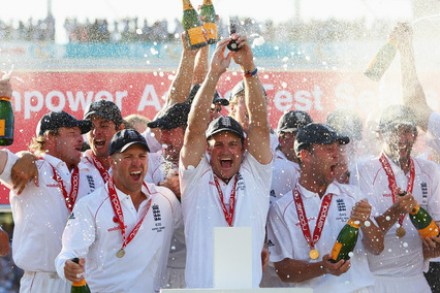
Not the greatest cricketing series ever - but who cares?  There have been plenty of wonderful and poignant moments: from Stuart Broad's emergence as a serious all-rounder, to Andrew Flintoff's last ever actions in test cricket.  And it's all ended in the best possible way: with England winning back the Ashes in a 197-run victory at the Oval.  So thank you to Messrs Ponting et al, and congratulations to the England team.  It's time to uncork the bubbly...
Gove pushes his agenda

From our UK edition

If you can divert your attention away from the Ashes for a second, then I'd recommend you read John Rentoul's fascinating interview with Michael Gove in today's Independent on Sunday.  The two most eye-catching passages concern Gove's "ultra-Blarism" and his thoughts on foreign policy.  The Blairism first: "And when I ask if it is wise to paint himself as a Blairite, given the former prime minister's latter unpopularity, he says: 'He's not as popular as he deserves to be, and he's emphatically not as popular within Labour as he deserves to be – amazing ingratitude on their part.

Another Sunday, another set of damaging rumours for Brown

From our UK edition

Brace yourselves, it's leadership speculation time again.  A story in the Mail on Sunday alleges that Alistair Darling has been attacking Brown in private - "I am trying to talk sense into that man..." - before adding this: "Last night there were claims that backers of Home Secretary Alan Johnson - widely seen as the stop-gap leader if Mr Brown quits before the General Election - were secretly canvassing 'non-aligned' Labour MPs not closely linked to any potential successor. Sports Minister Gerry Sutcliffe, who ran Mr Johnson's unsuccessful Labour deputy leadership bid in 2007, was accused of quietly taking names." Whether true or no', these rumblings tell you everything you need to know about Brown's beleagured premiership.

Tories more trusted on NHS than Labour

From our UK edition

The Tories will be pleased.  After the #welovetheNHS brouhaha of the past couple of weeks, a ComRes poll in tomorrow's Independent on Sunday gives them a healthy lead on the NHS.  In response to the statement "The NHS would be safer under Labour than the Conservatives," 39 percent of respondents said they agreed, while 47 percent said they disagreed.  That's an 8 point advantage for the Tories. It's pretty devastating stuff for Labour, but - oddly - comes in one of the Tories' weakest policy areas.  Let's hope this encourages Cameron & Co. to think and talk more about health service reform.

Do the Tories need an “-ism”?

From our UK edition

So what overarching theory do Cameron & Co. believe in now?  Is it Phillip Blond's "Red Toryism"?  Are they still invigorated by "libertarian paternalism"?  Or have they struck on something else?  This week's Bagehot column in the Economist gives us a useful overview of all the -isms the Tories have gone through recently, before landing on a conclusion that the policy wonks in CCHQ may not like: "The Tories should stop worrying about whether their view of the world works in theory, and concentrate more on generating ideas that will work in practice. They can live without an ideology; what they urgently require is balls." Bagehot's take is certainly attractive.

The biggest failure of the Tory opposition years

From our UK edition

Fantastic, thought-provoking stuff by Matthew Parris in the Times today, as he looks back on the past 12 years of Tory opposition and asks: "Just what did they achieve?"  His response is generally unfavourable: that, until more recently, the wilderness years have largely been wasted years.  And he highlights the Tories' inability to take on Labour over their wasteful spending and burgeoning deficit: "But it was on the central domestic question of the era that the Tories’ nerve failed almost fatally. At first new Labour held to the tight spending plans that it inherited from John Major’s outgoing administration. Then the Government let go. The letting go was, in retrospect, fairly spectacular.

Labour may not be able to exploit one of the Tories’ biggest weaknesses – but that doesn’t mean others won’t

From our UK edition

Here at Coffee House Towers, we frequently point out the risks with the Tories' pledge to keep on increasing health spending in real terms.  As I suggested last week, the two main problems are that it plays up the Brownite idea that spending is a good thing in itself, and it could force the Tories into a position from which they can't row back in government.  Now, in a acerbic article in the Guardian - in which he describes Tory policy as "an incoherent mishmash of ideas designed by focus group" - Larry Elliot kicks off by highlighting the confusion the Tory line creates: "On Tuesday night David Cameron warned that Labour's mismanagement of the public finances meant Britain might default on its debts.

An essential entry in the NHS debate

From our UK edition

There will be few more moving entries in the NHS debate than Ian Birrell's article in the Independent today, and I'd urge all CoffeeHousers to read it.  Birrell recounts his attempts to get his disabled daughter treated in the system, and the result is a catalogue of ineptitude, frustration and - even - deception.  One story Birrell tells is of how a doctor assured him a crucial blood-test had been sent for analysis to Germany, when actually it had been "dumped in storage and forgotten". What makes this all the more powerful is that it comes from someone who doesn't hate the NHS, but who can see the need for extensive waste-cutting measures and reform.

Cameron planning to set out “fine print” of spending cuts before election

From our UK edition

I've just got round to reading the Economist's interview with David Cameron, and this passage jumped out at me: "If a fiscal squeeze is on its way the Tories will want to win a mandate for it. 'Getting the deficit under control will make or break my government,' he admits. Accordingly, more fine print will emerge before the election. But by accepting the principle that spending must fall, Mr Cameron says he has already been braver than the government. 'I can’t think of an opposition party going into an election promising spending cuts since 1929.'" It's crucial for the Tories that they set out more "fine print" in advance.  The next government needs to show not only that they have the will to deal with Brown's debt crisis, but that they have a mandate for it too.

Cameron should avoid these Twitter traps

From our UK edition

Oh dear.  The Twitter wars are continuing apace, now that David Cameron has risen to John Prescott's challenge of a debate on the NHS.  The mediators are the Manchester Evening News, who have just published Cameron's response to Prescott on their Twitter feed.  So what is it?  Erm, this: "The real question is why won't Labour match the Conservatives' pledge for year on year real-terms increases in NHS spending over the next Parliament" As I said last week, there are definite dangers with the Tories pushing this line quite so eagerly – not least because it plays into the Brownite idea that spending is a good thing in and of itself.  But, more generally, it demonstrates why Cameron should steer clear of Prescott's Twitterific hunting ground.

The loser from the Kevan Jones storm is Gordon Brown

From our UK edition

Guido went there, and the newspapers decided to follow.  After the political blogosphere's favourite son outed Kevan Jones as the minister behind the attempted smear campaign against Richard Dannatt, the defence minister gets namechecked in all of this morning's publications. Jones is, naturally, distancing himself from the accusations - but there are intriguing hints that Dannatt himself knows who the culprit is, and may act against him.  This in today's Sun: "The General knows the identity of the man behind the bid, The Sun can reveal. He has considered forcing his resignation." If Jones - or any other member of the government - can be tied to the smear plot, then it's certainly a resigning matter.

Why high pay restrictions are a bad idea

From our UK edition

I'm not sure how I missed Hamish McRae's latest column in my morning dash through the papers but, now I've seen it, I'd recommend it to all CoffeeHousers.  Why?  Well, it's the bottom line on the debate about limiting high pay that has been rumbling on for the past few days; a cogent reminder of how futile and destructive such a move would be.  I was particularly struck by McRae's description of how his former employer, the Guardian, got around restrictive pay policy in the 70s:   "Because an employer could not increase people's pay they had to find other ways of retaining them when another company tried to bid them away. I worked for The Guardian then and its particular wheeze was giving its staff cars supplied with free petrol.

Why Cormack’s proposal makes the case for greater public involvement

From our UK edition

So, Sir Patrick Cormack has proposed a solution to the expenses row: doubling MPs' pay to around £130,000 and then banning all allowances, save those which pay for staff and the maintenance of a constituency office.  The general response has been dismissive - a "Tory grandee" sparking "outrage" - and both Labour and the Lib Dems have quotes on the wire attacking this "out of touch" idea. But, to my mind, this is one of those cases where both sides of the argument can be understood and - paradoxically - perhaps even agreed with.  Doubling MPs' pay, while removing allowances, would streamline the system, make it much more transparent and could be cheaper for taxpayers.

Something the Tories shouldn’t admit to

From our UK edition

There's an intriguing story in today's Telegraph about how the Tories plan to "decapitate" - that is, target and win the seats of - certain Labour ministers come the next election.  The list is said to include Alastair Darling, Ed Balls and Jack Straw.  Here's what a "senior shadow cabinet source" told the paper: "Certain Labour Party big beasts, and they know who they are, are already experiencing more activity on the ground from us. We are going to make Ed Balls and Alistair Darling and some of their ministerial colleagues feel very uncomfortable. They will not only be fighting their most difficult general election campaign on a national front in two decades but they will also have really tricky contests in their own constituencies.

Cameron’s Afghanistan balancing act

From our UK edition

It's frequently pointed out that our involvement in Afghanistan is based more on a political consensus than a public one.  Deep swathes of the country want to get out troops out of harm's way - but many in Westminster feel that the job needs seeing through to the end, to help prevent the spread of terror to British shores.  This is the essential struggle the next government will find itself caught up in.  Does it cede to public or to political consensus?  Or does it try something else? Interviewed on Sky just now, David Cameron toed a line somewhere in the middle of the two extremes.

Cameron courts the public academics

From our UK edition

I've just got back to my desk after watching David Cameron in conversation with Nassim Nicholas Taleb - the author of The Black Swan, and one of those folk hailed as a "prophet" of the Crash - over at the RSA.  Although, to be honest, "conversation" might be stretching it.  Until it came to questions from the floor, Cameron largely left Taleb to it; letting him riff on everything from the national debt to biodiversity in Europe.  No bad thing, I assure you. As for the details of Taleb's address, there were plenty of decent quotes and observations.  He warned of the "high risk" of hyperinflation, for instance, and laid into debt as a sign of systemic "overconfidence".

While the cat’s away, the mice will undermine his authority

From our UK edition

So the Times reveals something we all half-knew already: that Alistair Darling dug his heels in when there was talk of him being ousted from the Treasury during the last reshuffle.  Here's the lowdown: "Alistair Darling remained as Chancellor of the Exchequer in the June reshuffle after telling Gordon Brown that he would leave the Government rather than move to another job, The Times has learnt. The Chancellor, who is in charge of the Government this week while Mr Brown is on holiday, told him that as the Prime Minister he had every right to put whoever he wanted into the Treasury. But his insistence that he would not take another role left Mr Brown powerless to move him.

Andy Burnham goes way too far<br />

From our UK edition

There's little denying that the planets aligned just right for Gordon Brown last week: a Tory in cahoots with those dastardly folk on the "American right"; a chance to defend that popular cause, the NHS; and all wrapped up in a funky new medium which the papers love to write about.  But there are signs that, in their desperation to keep the #welovetheNHS story running, Labour are taking things way too far.  I thought it a few days ago, when Andy Burnham called Dan Hannan "unpatriotic".  But now the Health Secretary has exceeded himself, with a press release he sent out last night which makes a series of bizarre demands of David Cameron.

Why the Tories are right to tackle IB claimant numbers

From our UK edition

So far as political stories are concerned, the Sunday papers are surprisingly action-packed.  Few are more eye-grabbing, though, than this item on p.2 of the Sunday Times, headlined "Tory benefit cuts may raise jobless to 4m".  Sounds bad, huh?  But, when you read the full thing, it turns out that the Tories may have had a good, honest idea. Basically, the ST story claims that "senior Tories" are planning to move around 1.5 million people who claim incapacity benefit (IB) on to jobseeker's allowance (JSA) within a year of taking office.  Hence the big leap in jobless figures, from what will be around 3 million, up to 4 million.  It's unclear whether this is the anticipated result of existing Tory welfare policy (e.g.

Mandy continues his anti-Osborne operations

From our UK edition

I know most CoffeeHousers have more than had their fill of Peter Mandelson stories, but it's worth reading the quotes from an interview with him in today's Times.  Why so?  Well, because they distill some of the main attacks Labour will aim at the Tories over the coming months. The central charge is that - while Cameron and Osborne are, in Mandelson's words, "crowd-pleasers" and "good image-makers" - they have not "changed the thinking of their party".