Peter Hoskin

A man apart

From our UK edition

The great days of cinema are not over: they live on in Terence Davies, writes Peter Hoskin How to write about the cinema of Terence Davies? Words just don’t stand a chance. I could deploy every superlative going, and reduce every one of the three short films and five feature films he’s directed into their constituent parts — a dash of low-key acting here, some liquid camera movements there — but nothing could convey or explain the unique emotional power they have. Quite simply, his films need to be seen and experienced. And preferably on the silver screen, so the magic can really take hold. It’s fortunate, then, that the fifth of those feature films — Of Time and the City, a documentary about Liverpool — is about to be released into cinemas.

What to make of Woolas’s immigration claim?

From our UK edition

Difficult times call for different messages.  And that's what the new Immigration Minister, Phil Woolas, seems to be offering as he tells today's Times: “This Government isn’t going to allow the population to go up to 70 million. There has to be a balance between the number of people coming in and the number of people leaving.” Or at least it's a different to what we've previously heard from this Government; they've never been quite so open about limits on immigration in the past.  Whereas - as Tim Montgomerie points out over at ConservativeHome - it's a message that the Tories have been peddling for around two years. But questions abound about Woolas's claim.  Is this new Government policy?

The Cameroons need to be blunter

From our UK edition

You’ve got to hand it to the Brownite spin operation – for once, their bludgeoning approach seems to be working.  The terms they’ve coined, and which are repeated ad nauseum by Labour figures – “Global financial problem which started in America”; “We’re meeting with world leaders”; and even that “Whatever it takes” chestnut – really do seem to be filtering down to the national consciousness, if some of the latest polling on economic competence is anything to go by. Why?  Well, it’s not because our Dear Leader is economically competent – the past eleven years have put pay to that idea.

For old times’ sake

From our UK edition

A hundred chorus girls sashaying through a Busby Berkeley musical. Bugs Bunny munching nonchalantly on a carrot. Errol Flynn and Basil Rathbone in Hollywood’s greatest swordfight (‘The Adventures of Robin Hood’ or ‘Captain Blood’ — take your pick). Bette Davis pulling the trigger in ‘Deception’. James Cagney smashing a grapefruit into a moll’s face. Alex and his droogs in the Korova Milk Bar. Heath Ledger’s Joker hissing, ‘Do you know how I got these scars?’ The lilting music of Erich Wolfgang Korngold. Raoul Walsh. ‘Bonnie and Clyde’. Michael Curtiz. ‘Rio Bravo’. Sam Peckinpah. ‘Dirty Harry’. ‘Made it, Ma! Top of the world!

The FTSE takes a hammering

From our UK edition

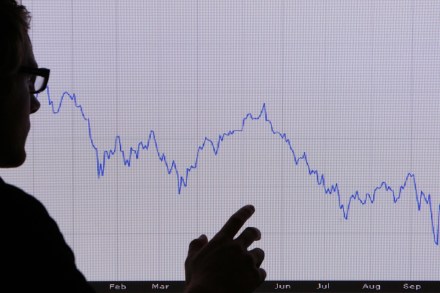
At close of play, the FTSE was down a hefty 8.85 percent - putting it below the 4000 mark, and sealing what has been the worst week for the index since 1987.  No.s 10 and 11 will be praying furiously for a change in the tide.  As I wrote earlier, the longer this market slump goes on, the more their bailout package will appear to be one colossal waste of public moolah.  Problem is, investors are panicking over the prospect of a global recession - and there's very little Brown and Darling can do to change that.

Brown’s get-out plan

From our UK edition

Is this the sound of Brown changing his story?  Seems to me he's deploying a slightly different version of his "I'm trying to get other world leaders to follow my lead" theme.  Here's what he said in a BBC interview earlier, explaining why the fruits of his financial labours will only start showing up in the medium term: "What we need now - as I said this morning - is other countries to do similar things [to our bailout package], because this is a global financial system." It's a subtle but significant shift.  The implication being that if other countries don't do "whatever it takes", then our bailout may not have the effect our Dear Leader expects it to.  It's his get-out-of-jail-free card - only it may not work like that.

Martti Ahtisaari wins the Nobel Peace Prize

From our UK edition

The former President of Finland Martti Ahtisaari was awarded the Nobel Peace Prize earlier today for his "important efforts, on several continents and over more than three decades, to resolve international conflicts."  He's worked towards resolving disputes in regions including the Balkans, East Timor, Iraq and Northern Ireland.

The early signs aren’t promising for Brown

From our UK edition

It's down, down, down for the markets - and how.  The Dow Jones closed down by 7.33 percent; Nasdaq down 5.47 percent; and the Nikkei down 9.62 percent.  Whilst the DAX is currently down by 9.25 percent, and our very own FTSE has plummeted by 7.34 percent. What's more, three-month LIBOR rates - the rates at which banks tend to lend to each other - aren't showing much sign of downwards momentum after the series of coordinated interest-rate cuts by central banks. Of course, it's early days as far as the bailout package is concerned, but these latest indicators do suggest that the banks, the brokers and the analysts have their eyes more firmly rooted on an impending recession, than on Brown's efforts.

Why Brown is so happy

From our UK edition

There is something unnerving about seeing Gordon Brown smile so much on television. Yesterday he saddled the British public with more debt than any peacetime Prime Minister – taking a massive gamble with money the public haven’t even earned yet. What’s he got to smile about? Well he believes that he has finally moulded the crisis into a party political weapon and whacked David Cameron with it. There is now plenty of polling evidence that the crisis is playing into his hands. Just three weeks ago, the Tories had a 17 point lead on economic competence (YouGov/Telegraph). After more news cycles dominated by the financial crisis this had narrowed to 3 per cent (ICM/Guardian) and in the marginal seats it’s a 7 point lead (ICM/News of the World).

Clegg adopts the right level of cooperation

From our UK edition

The most impressive moment in yesterday's PMQ's came courtesy of an unlikely source - Nick Clegg.  The Lib Dem leader generally toed the "we'll cooperate with the Government" line, but he also stirred in a punchy addendum: that some of the money Brown's splashing around might be better spent on reducing the tax burden for low-income earners. I happen to agree with him, but - whatever your views on that front - there's little denying that Clegg's found a message which enables the Lib Dems to operate in a spirit of cooperation whilst also saying something a little bit different and eye-catching.

Global turmoil, local dilemmas

From our UK edition

As Vince Cable pointed out yesterday, events sure are fast-moving.  The latest is that over 20 councils have cash sunk in troubled Icelandic banks.  And that's aside from organisations such as Transport for London, which - according to Boris - has £40 million at stake here.  Accordingly, the various heads of these local bodies are seeking to meet with the Treasury, to try and get assurances that their money will be safeguarded.  It's not looking too promising for them.  In the Q&A session following his statement yesterday, Alistair Darling seemed to suggest that - in effect - councils should have known better.

Will the Government follow the IMF?

From our UK edition

The Tories tried to make political capital out of the International Monetary Fund's latest growth forecasts in today's PMQs.  You can see them on page 2 of this pdf.  What's so significant about them?  Well, they're pretty gloomy for starters - they put the UK's economic growth at only 1.0 percent for 2008, and -0.1 percent for 2009.  And they're also the most signficant growth predictions made since the financial crisis really blew up a few weeks ago, meaning they're more likely than most to account for just how bad things are.  Indeed, the 2008 figure is down by 0.8 percent on the forecast made in the IMF's last World Economic Outlook document; the 2009 figure down by a hefty 1.8 percent.

Live blog: PMQs

From our UK edition

1157, Peter Hoskin: Welcome to Coffee House's live blog of the first PMQs of this Parliamentary session (you can watch it here).  Expect a lot of back-and-forth about the £50 billion bailout, all in a spirit of aggressive cooperation.  And stay tuned for Fraser's detailed report later. 1204, PH: Here we go... 1204, PH: Brown confirms that interest rates have been cut by 0.5 percent.  That could be the most significant thing to come out of this PMQs. 1206, PH: First question from Robert Goodwill - "Does the PM agree with the IMF that the economy will contract next year?" Brown's response: the usual "Every across the world is facing this..." and that "everything that can be done will be done".

The £50 billion bailout: Brown’s statement

From our UK edition

You can watch Brown's statement on the bailout here.  It's full of the usual reminders about "global problems" which "started in America", and platitudes about "fresh and innovative intervention" and "long-term challenges".  But, to be honest, this is an arena in which Brown thrives.  His dour bank manager shtick lends itself to talk about liquidity, assets and guarantees.  The question now is whether voters and companies are convinced by it. MARKET UPDATE: The FTSE is down 4.51 percent at 10:35.

Will the rescue plan work?

From our UK edition

What to make of Brown and Darling's £50 billion rescue plan for the banks? As with so much during this financial crisis, there's a distinct air of uncertainty around it. There are potential upsides: it should help restore some degree of confidence in the banking system, help banks lend to each other, and stabilise the markets. But there are potential downsides as well, including: 1) Debt. The £50billion will be funded by increased national borrowing. And there could be more on top of that if HMT ever has to act on its promise to underwrite loans between the banks. As Fraser's pointed out, the deficit is already daunting enough. This latest could make it hit the stratosphere. 2) Precedent. What happens when the £50 billion runs out?

Meetings as theatre

From our UK edition

Hold the front pages.  Brown's just called a "crisis meeting" with Alistair Darling, Mervyn King and Adair Turner, the head of the Financial Services Authority - three people he should be (and is?) in round-the-clock contact with anyway.  Of course, our PM's been milking this financial crisis for every drop of its theatrical worth all along - few in Westminster think his economic council (which met yesterday, by the way) will actually do anything substantive.  But this latest move deserves its own run in the West End.  Instead, it will most likely get a run in tomorrow's papers.  If so, mission accomplished for Brown and his cadre of spinners.

Under pressure?

From our UK edition

Prepare for the next round of one of Westminster's favourite parlour games of the past few months: "Will Alistair Darling get the sack?"  After all, our Chancellor's hardly excelled himself over the past few days -- his statement to the Commons yesterday was less-than-inspiring and did nothing to reassure the markets, whilst his behind-the-scenes work seems to amount to little more than dithering -- and the thinking is that Gordon Brown will be looking for scapegoats should anything undermine his "serious people for serious times" mantra.  So who's waiting in the wings?  Three Line Whip's Iain Martin highlighted one potential candidate earlier, by asking: "Could Peter Mandelson be Chancellor of the Exchequer by Christmas?"  Certainly, stranger things have happened.

Darling speeds up recapitalisation plans

From our UK edition

Having finally caught onto what the banks want, it seems that Alistair Darling is going to dance to their tune and speed up plans for a recapitalisation package.  According to the Standard, around £50 billion could be pumped into the sector "within days". Sure, the dither-o-meter has just receded a notch.  But now comes the separate question of whether recapitalisation is the right course of action.  Truth is, it could help stabilise the markets for the time being (they're currently plummeting on the back of banking losses).  But will the effect be anything other than temporary?  Can the public finances afford the hit?  Will future taxpayers be shielded from any undue burden?