Paul Wood

Paul Wood was a BBC foreign correspondent for 25 years, in Belgrade, Athens, Cairo, Jerusalem, Kabul and Washington DC. He has won numerous awards, including two US Emmys for his coverage of the Syrian civil war

Big trouble in little Qatar

From our UK edition

 Washington DC At 8:06 on Tuesday morning the Tweeter-in-Chief reached for his Android phone and told the world: ‘During my recent trip to the Middle East I stated that there can no longer be funding of Radical Ideology. Leaders pointed to Qatar — look!’ At 9:36 a.m. we heard from @realDonaldTrump again. ‘So good to see the Saudi Arabia visit with the King and 50 countries already paying off. They said they would take a hard line on funding… extremism, and all reference was pointing to Qatar. Perhaps this will be the beginning of the end to the horror of terrorism!

The madness of King Donald

From our UK edition

 Washington DC Trump is a fighter - he seems to thrive on pressure - and he is lawyering up The panhandlers outside the White House hold signs saying: ‘Trump is President — saving to leave the country.’ Those signs will have to be updated if Trump’s enemies are right and the 45th President is driven from office by a scandal called ‘Putingate’. Inside 1600 Pennsylvania Avenue, Trump is said to be in a fury about the allegations that he is Russia’s pawn. Washington is gripped by rumours of a president sitting up in bed at night, a cheeseburger balanced on his stomach, raging at the television news. He does not, like Nixon, wander the halls at night talking to the portraits. Instead, he reaches for his phone to tweet.

One missile strike alone will not change Syria. So what’s the American plan?

From our UK edition

President Trump’s missile strike on Syria seemed as determined to stick it to President Obama as to the Assad regime. The initial statement from the White House on the Sarin gas attack that prompted the strike had more words of condemnation for Obama than for the Syrian ruler. In the matter of airstrikes, as in other things, it is important to Trump to be the un-Obama. But one night of missiles is not a decisive blow. Beyond the ruined aircraft hangars, the Syrian battlefield is little changed. What is the American plan? What’s next? Perhaps President Trump has not thought about this. His decision to bomb seemed emotional, justifiably so you might think, faced with images of the doll-like corpses of children poisoned by nerve gas.

Poison, spies and lies

From our UK edition

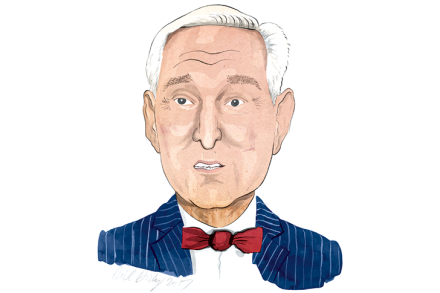
 Washington DC   Roger Stone — political consultant, agent provocateur, friend and confidant of Donald Trump — arrives for lunch with a bodyguard in tow. ‘I’ve had way too many death threats,’ he explains. He says he’s recovering from poisoning by polonium, a radioactive substance used to kill the Russian defector Alexander Litvinenko in London. Litvinenko, he says, had ‘a much larger dose, probably done by British intelligence’. But the British government named the Russian agents responsible, I reply. ‘What was the proof?’ he asks. ‘It’s all mirrors. You know that.’ Stone blames his ‘poisoning’ on ‘the deep state’, a term that in Trumpworld means the intelligence community.

‘Isis? Bomb those suckers’

From our UK edition

These are the last days of the ‘caliphate’. The place Isis made their capital, Raqqa, in Syria, is encircled and cut off. They have already lost half of Mosul in Iraq, their largest city. Really, what did they expect? This was inevitable from the moment Isis declared war on everyone not in Isis. Defeat was even foreseen by one of the group’s leading thinkers, Abu al-Farouq al-Masri. ‘Announcing enmity to the world will strangle the caliphate in its cradle,’ he said last year. ‘This will bury our project alive.’ Al Masri (the ‘Egyptian’) is or was an elderly cleric and he was delivering a sermon in Raqqa meant as a warning to the leadership.

Trump’s foreign policy seems designed to terrify everyone – including his own government

From our UK edition

‘Plan, prepare, and train for the outbreak of chaos,’ says al Qaeda’s handbook, The Management of Savagery, a blueprint for building the Caliphate through what might be called creative destruction. ‘At the outbreak of chaos, the onset of jihad: ride the wave…exploit the situation.’ Did Steve Bannon, Donald Trump’s new chief strategist, read The Management of Savagery? He has been accused of implementing a ‘chaos theory of government’. Create chaos. Destroy the old order. Build paradise. The Trump administration has seemed busily engaged in phase one during its first two, hair-raising weeks in office.

The plots against Trump

From our UK edition

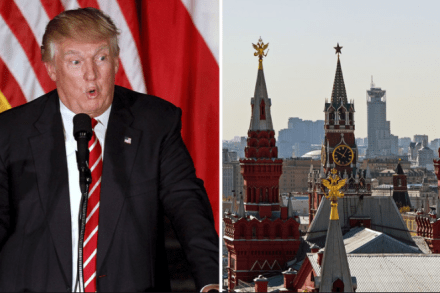
The ‘most deadly adversaries of republican government,’ wrote Alexander Hamilton, arise ‘chiefly from the desire in foreign powers to gain an improper ascendant in our councils. How could they better gratify this, than by raising a creature of their own to the chief magistracy of the Union?’ Hamilton’s warning against ‘intrigue, and corruption’, published in 1788, speaks eerily to the Washington of today, where Donald Trump’s enemies imagine he is a Russian ‘agent of influence,’ bought or blackmailed by the Kremlin.

Can Donald Trump really be a compromised agent of Russian influence?

From our UK edition

During the Clinton-Lewinsky scandal, American parents found politics to be a painfully embarrassing subject to discuss in front of their children. The TV news stayed off at dinner time. But even before taking office, Donald Trump has surpassed Bill Clinton. The details of what’s said to have taken place in a Moscow hotel room with a group of prostitutes are lurid enough to damage even someone with Trump’s sexual history. Trump himself has described the allegations as “fake news”. Their significance is that, if true, the President-elect of the United States would be vulnerable to blackmail by the Russians.

The Brits behind Trump

From our UK edition

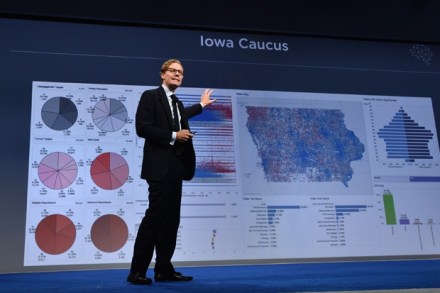
It’s the Brits wot won it. That is, the US presidential election was won for Donald Trump with the help of a bunch of British nerds — data scientists from a company called Cambridge Analytica. This was the claim, at least, made by the company in a press release a couple of days after the election. ‘No one saw it coming. The public polls, the experts, and the pundits: just about every-body got it wrong. They were wrong-footed because they didn’t understand who was going to turn out and vote. Except for Cambridge Analytica…’ Frank Luntz, a famous pollster and one of those so embarrassingly mistaken, said: ‘They figured out how to win. There are no longer any experts except Cambridge Analytica.

Donald Trump proved most people wrong

From our UK edition

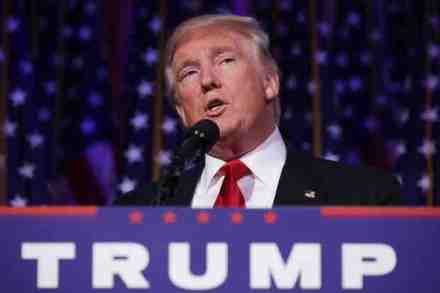
Washington D.C. So, Trump was right, and everyone else was wrong. Most of all the pollsters – my advice to them: McDonalds and Starbucks are hiring, $9.00 an hour; that might be your best option for a while. A period of humility might be required from a few pundits and journalists, too. No one, it seemed, understood what kind of country America has become. Hillary Clinton had been measuring the drapes for the White House. In the final days of the race, her staff privately predicted she would get 315 votes in the electoral college. ‘We’d like 340,’ a member of her staff said smugly. David Plouffe – President Obama’s campaign manager – tweeted that her path to 300+ was ‘rock solid’.

Putin’s next move

From our UK edition

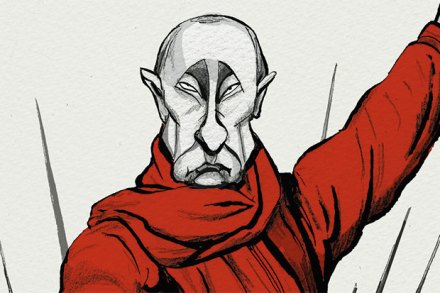
The old KGB headquarters in the Lithuanian capital, Vilnius, is a sinister place, full of ghosts. It is a solid 19th-century neoclassical building with walls thick enough to have muffled the screams of those under interrogation. The cells in the basement are as cold and damp as they were in Soviet times and there are stone steps down to an airless, claustrophobic chamber where prisoners were executed, a thousand of them, the wall still pock-marked with bullet holes. You can imagine people hurrying by on the other side of the road in the old days, not daring to look up at the pale grey façade, knowing what took place behind it.

Syrian nightmare

From our UK edition

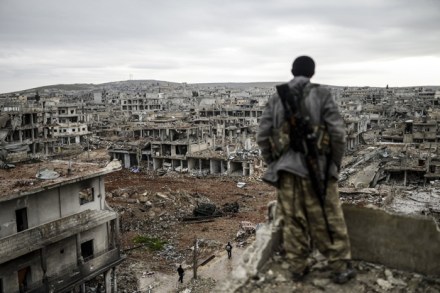
'We are used to death,’ said Ismail. He had been to the funerals of four friends in a single week, all killed by aerial bombs. ‘We’re used to bloodshed. We’re adapted to the situation and this style of life now. It’s normal. If you lose someone, then the next day you say, OK, life must go on.’ Ismail spoke to me from eastern-Aleppo, where as many as 250,000 people are under siege by the Syrian regime and ‘living on rice’, as he described it. He is in his late twenties and is one of the White Helmets, the civil defence volunteers who dig people out of the rubble after an attack. He could not endure the despair on the faces of the injured who knew they would not survive, he said.

Bombs astray

From our UK edition

Soon, soon, you will see a wondrous sight,’ says the Isis anthem, ‘for your destruction, my sword has been sharpened. We march by night, to cut and behead… We make the streets run red with blood, from the stabbing of the bayonets, from the striking of the necks, on the assembly of the dogs.’ The people of the Syrian town of Deir Ezzor were left in no doubt that they were the dogs in question. This nasheed — or chant — was posted on the internet, played over video from Syrian state TV of Deir Ezzor residents criticising the Isis siege. The message was clear. That was at the beginning of this year, when fighters from Islamic State were closing on the city and seemed about to storm it.

Clueless in Syria

From our UK edition

The other day I was speaking to a Kurdish journalist who was held in Isis captivity for ten months. He and a colleague had had the bad luck to run into an Isis checkpoint in Syria. ‘How do you perform the midday prayer?’ they were asked after their car was waved to a halt. Unable to answer — they were not believers — they were immediately beaten around the head. Then one of the jihadis from the checkpoint was put into the back of their car and they were told to drive to the Isis base. The fighter had a pistol pointed at them the whole time, which was superfluous because he was also wearing a suicide belt. ‘Make a move and I’ll detonate myself,’ he said. ‘We’ll all die together.

The trouble with the Kurds

From our UK edition

On Nawroz, the Persian New Year, last March, Isis sent a holiday greeting to the Kurds. They published several videos of Peshmerga fighters, now prisoners, kneeling, handcuffed and wearing the usual orange jumpsuits. In one video, a prisoner is shot in the back of the head; the rest have their heads sawn off with a knife. In a deliberate twist, no doubt relished by the leadership of the so-called Islamic State, the killers were themselves Kurds. ‘You all know the punishment for anyone who fights the Islamic State,’ says one. ‘It is death.’ The executioners did not wear masks and were quickly identified by Kurdish intelligence. Retribution followed.

Desperate state

From our UK edition

The latest video from Isis introduces a new British executioner, a successor to ‘Jihadi John’, and it is a classic of the genre: bombastic, pompous, ridiculous yet terrifying. ‘O slave of the White House, O mule of the Jews,’ says a man in a ski mask, addressing David Cameron, ‘how strange it is that the leader of a small island threatens us with a handful of planes. Only an imbecile would dare to wage war against a land where the law of Allah reigns supreme.’ He has a cold, arrogant look in his eyes and brandishes a pistol held sideways, aping American ‘gangsta style’. Kneeling before him are five men in orange jumpsuits identified as ‘British spies’.

How far can Bernie Sanders go?

From our UK edition

[audioplayer src="http://rss.acast.com/viewfrom22/thedeathoffeminism/media.mp3" title="John R. Macarthur and Freddy Gray discuss how far Bernie Sanders can go " startat=1764] Listen [/audioplayer]Boston A woman’s voice carried through a lull in several conversations around the table at a smart East Coast dinner. ‘But he’s not even a fucking Democrat…’ She was one of the party’s stars and was talking about Senator Bernie Sanders. He is inducing as much red-faced apoplexy in the Democratic party’s great and good as Donald Trump is causing among the Republican establishment: outsiders both, each upsetting the smooth coronation of the party leadership’s candidate for president.

The man to stop Trump

From our UK edition

   Washington DC Ben Carson is relaxed. ‘He’s always relaxed,’ says an aide. The next televised Republican primary debate is two days away, but Dr Carson is about to begin his first rehearsal for it. The preternatural calm he exudes is presumably what gave him his steady hands during the 22-hour operation that led to him becoming the first surgeon to successfully separate Siamese twins fused at the head. That operation is part of the Carson legend: growing up poor, black, becoming chief of neurosurgery at Johns Hopkins aged 33. This life story has aided an improbable presidential bid that is now starting to look more plausible. Carson is polling second in a Republican field of 16 and he has momentum.

Iowa notebook

From our UK edition

 The Iowa State Fair ‘Donnnaaallldd!!! Donnnaaaaallldd!!!’ Donald Trump was surrounded by fans. He looked happy. He took a bite out of a pork chop on a stick — eating one is a campaign ritual for every politician visiting the Iowa State Fair — and raised his arm in salute. ‘We love you,’ a woman shouted. Someone else yelled: ‘Save our country! Save America!’ No other Republican candidate visiting the fair — no candidate from either party — has generated such crowds and such excitement. ‘I touched him,’ said one woman running over to her friends. ‘I got a selfie.

‘The smugglers don’t care’

From our UK edition

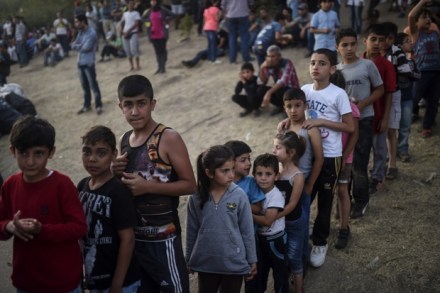
 Lesbos A young woman in a headscarf stumbled over some rocks and onto the beach. She stood there, rigid, stunned, then burst into tears. A grandmotherly German tourist hugged her. ‘It’s over now, you’re safe,’ she said. ‘You’re in Europe.’ A Burmese man from the same boat looked around anxiously and asked: ‘Will the police here beat us?’ It was after dawn on the Greek island of Lesbos, the sun glinting off the turquoise sea, an idyllic holiday-brochure landscape of hills with whitewashed houses. But the Turkish coast is so close that you can see it, and so this tiny island has become the front line in Europe’s migration crisis. Hundreds of people arrive here every day in rubber dinghies.