Olivia Potts

Olivia Potts

Olivia Potts is the Guild of Food Writers’ Cookery Writer of the Year 2025. She hosts The Spectator’s Table Talk podcast and writes Spectator Life's The Vintage Chef column

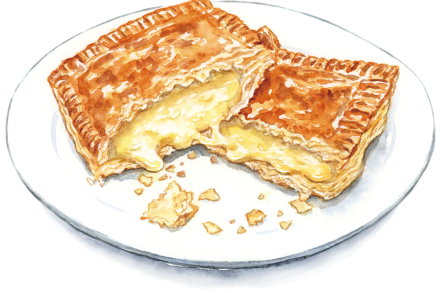
Cheese and onion pasties: how to make a Greggs classic at home

From our UK edition

‘That’s not a pasty!’ my husband declares loftily, eyeing up what most definitely is a veritable clutch of cheese and onion pasties emerging from my oven. Handsome, puffed up, golden brown (the pasties, not the husband), filled with a cheese, potato and onion filling, contents threatening to splurge. The steam rises from them like in a cartoon, almost beckoning us towards them. ‘Oh, OK,’ I reply, sweetly. ‘I shan’t trouble you with them.’ He backtracks. No, no, perhaps he was hasty. What did he know about pasties? Shouldn’t he just try them anyway?

How dirty is your Michelin-starred restaurant?

From our UK edition

Michelin stars were pitted against hygiene scores when Gareth Ward, chef-patron of the two-Michelin starred restaurant Ynyshir, was recently given a hygiene rating of… one.  Ynyshir, which sits on the edge of Eryri national park near Machynlleth in Ceredigion, has held its second Michelin star since 2022, making it the first restaurant in Wales to receive two of the accolades. The restaurant offers a single 30-course tasting menu, to which changes cannot be made for allergies or preferences, at a cost of £468 per person. Its most recent food hygiene inspection found that its management of food safety required ‘major improvement’.

When life gives you lemons

From our UK edition

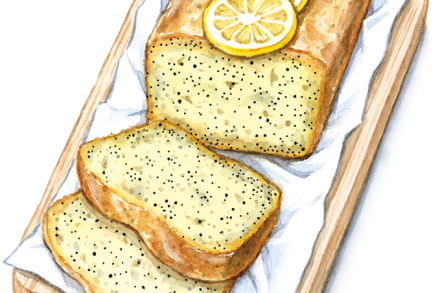
As always, I begin my year with lemons. Regular readers must forgive me for my citrus evangelism. But, as the spice and richness of Christmas fare gives way to the drudge of the diet industry and the reality of the back-to-work routine, all framed by short, dark days and cold, icy pavements, the cobalt yellow orb is a literal light in the darkness. What began as a way of bringing brightness and culinary optimism to the new year now feels like a battle cry. Lemons are magical: they come into season during the winter months, their vibrancy at odds with the drab mornings, a flash of lightning in your fruit bowl. Their zipply zest and bracing sourness remind you that you are alive. I, for one, need that reminder.

Why are roast potatoes so hard to get right?

From our UK edition

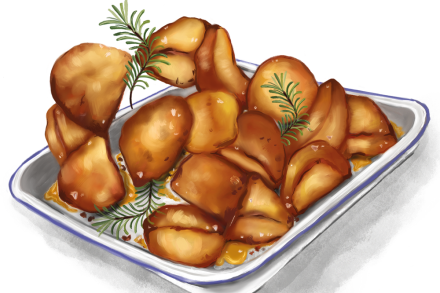
Roast potatoes shouldn’t be complicated. We’re talking two ingredients, plus some salt and maybe herbs if you’re feeling fancy. It’s just shoving some parboiled potatoes in a hot oven, right? Yet I can count on one hand the number of times that I’ve had a decent roast potato in a pub or restaurant. Bad ones are to be found all over the place. I don’t just mean school dinners, mass-catering, hospital-canteen potatoes here. The most carefully prepared Sunday roasts at charming establishments feature beautiful melting meat and thoughtfully cooked veg, all sitting alongside miserable roasties. Clammy. Dark brown. Soft (but not in a good way). A waste of a good potato. No one doesn’t like a roast potato; they’re practically our national dish.

With Tom Gilbey

From our UK edition

31 min listen

Tom Gilbey, the internet’s most charismatic wine expert, sits down with Olivia Potts for Table Talk. Tom is a winemaker, merchant, educator – and also an author. His new book, Thirsty, is part-memoir, part guide to his life through wine in 100 bottles, and is available now.  On the podcast, Tom discusses his family’s love for winemaking that stretches back to the nineteenth century, and how he became captivated by the trade thanks to Beaujolais and a pike’s head. He explains how a glass of pinot gris in an ice bath propelled him to social media fame – where he’s known for taking a fun approach to wine tasting. Tom also reveals the best way to pair drinks with dishes and the unconventional way he’ll be cooking his turkey this Christmas.

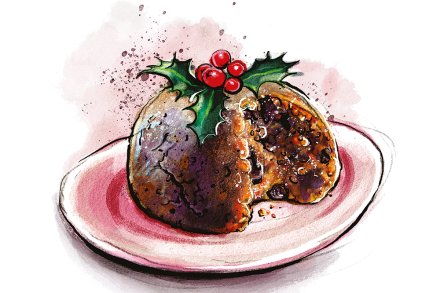
I’m a Christmas pudding convert

From our UK edition

I used to be a Christmas pudding denier. I couldn’t see the attraction of a dense pudding made mostly of currants; frankly, I’d rather have a trifle. Of course, I was wrong: I was judging Christmas pudding by poor examples, those that sat on the edge of a Christmas lunch tray at school or were half-heartedly doled out by other pudding sceptics (I’m looking at you, Mother). My conversion came about thanks to a party – a Christmas pudding party. Not a party for eating Christmas puddings but rather one where the guests made Christmas puddings. It was hosted by my friend Kate and I went along out of love for her, rather than love for the pud. Under Kate’s keen eye, and following her great-granny’s recipe, we creamed kilos of butter and sugar in a big plastic tub.

The glory of gravy

From our UK edition

In Robert Louis Stevenson’s Treasure Island, when Ben Gunn is found by Jim Hawkins, sunburnt and wide-eyed after three years of being marooned on the island, the first thing he asks Hawkins for is cheese: ‘Many’s the long night I’ve dreamed of cheese – toasted mostly.’ As a greedy person prone to daydreaming, I’ve often wondered what my ‘cheese – toasted mostly’ would be. A dozen oysters? A cold negroni in a fluted tumbler? A perfect quivering soufflé? I think it’s gravy. That’s my desert island dream, the idea I can’t shake, the touchstone I’d return to. I’d take gravy in any form: thick and rich, made from meat scraps, a thin, boozy jus whisked up from pan scrapings, even the ‘from granules’ stuff, stirred in a plastic jug moments before serving.

How to make the perfect pecan pie

From our UK edition

A pecan pie has been on my kitchen table for the past few days, due to circumstances rendering every other surface or shelf unusable, thanks to badly timed building work and an absent fridge. A mixing bowl sits over it, protecting it from dust and sticky fingers. I’ll tell you what I’ve learned: everybody loves pecan pie. Everyone who has walked past it has stopped dead, done a double take, and then rhapsodised unprompted about the pie’s virtues. At one point, excitement was generated simply by the pie being in the background of a video call. Pecan pie, one of America’s traditional celebration (especially Thanksgiving) puddings, is adored by children, but it has a dark, complex sweetness that wins over grown-ups too, and the toasty nuts bring texture as well as richness.

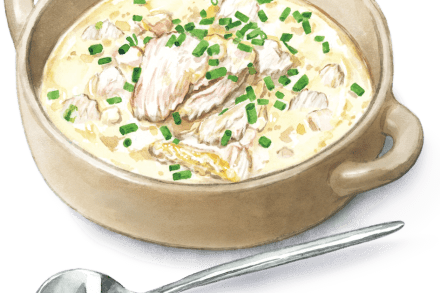
Cullen skink is comfort in a bowl

From our UK edition

They say not to judge a book by its cover – but what about judging a recipe by its name? Some sound like a disease or worse. Spotted dick, toad in the hole, lady’s fingers, Dutch baby, I’m looking at all of you. Cullen skink is one that has been accused of having an off-putting name. But in its defence, Cullen skink is descriptive. There’s a suggestion that the word ‘skink’ comes from an Old German word for ‘beer’ or ‘essence’, but given that Cullen skink is a creamy, thick soup, with no beer constituent and no obvious German connection, this seems an unlikely origin.

With Stephen Harris

From our UK edition

33 min listen

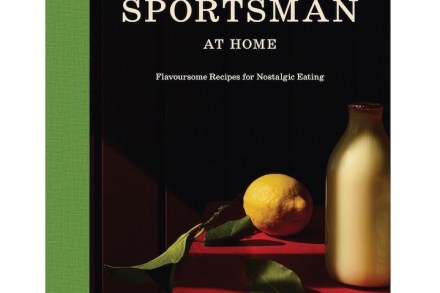
Stephen Harris, a self-taught chef who has run the Michelin-starred restaurant The Sportsman for over 25 years, sits down with Olivia Potts on Table Talk. Based just outside of Whitstable in Kent, The Sportsman has won national restaurant of the year multiple times, and Stephen is also an executive chef at Noble Rot. The Sportsman At Home is his second cookbook, available to pre-order now and out everywhere from the 6th November. Stephen tells Liv about his earliest memories of food from school dinners to sweets, how he started out as a history teacher and in the City of London – before getting his big break, and which restaurants he loved most in 1980s London – from Marco Pierre White's to Pierre Koffmann.

Would you spend £30 on a Charlie Bigham’s ready meal?

From our UK edition

Ready meals: the after-work time-saver, the dinner-party cheat – or a poor imitation of proper, cooked food? The proto-ready meal – an entire meal that can be cooked in its packaging, with little or no preparation – was invented in 1945 and called the Strato-Plate, but used only in aviation and military settings. The first mainstream ready meal was the TV dinner. The story goes that in 1953, an American company, Swanson, who produced frozen, oven-ready poultry and pies, had 260 tons of turkey left over after lacklustre Thanksgiving sales.

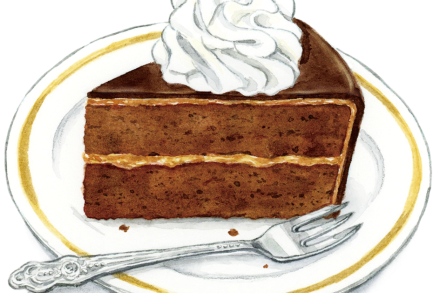
The secrets of sachertorte

From our UK edition

My theory is that sachertorte is a victim of its own success. Over the past 150 years, it has become an Austrian icon and, as such, can be found throughout Vienna. And that’s the problem: its ubiquity means that inferior versions abound. It has developed an unfortunate reputation for being dry, dull, tasteless – a pale imitation of a chocolate cake. It is often described – even by its supporters – as a ‘grown-up’ chocolate cake or an ‘elegant’ chocolate cake, but I feel like this does it a disservice. Both feel a little like euphemisms for ‘not that nice’, but this couldn’t be further from the truth.

When is a drink not a drink?

From our UK edition

How do you drink a £37,000 whisky? That’s what I’m wondering as I make my way to Speyside to try the Glenrothes estate’s latest release, the Glenrothes 51. I don’t mean physically; I assume they’re going to pour it into an appropriately expensive glass for me, and I haven’t yet met a whisky I don’t enjoy in some way. I mean: how do you get your head around consuming something so expensive? I’m the sort of person who squirrels nice things away for a rainy day, and doesn’t eat the expensive chocolate bar because it seems like a waste. How do I square this with drinking a dram that must cost £1,300?

Bacon and egg pie, the perfect throw-it-together, please-the-whole-family dish

From our UK edition

There are a handful of elements that make me nervous about tackling particular classic recipes. First, if it’s a dish that I didn’t grow up with and can’t speak to personally; secondly, if it’s a dish that a lot of other people did grow up with, and feel very strongly about. Thirdly, if it requires an ingredient that we don’t have in Britain, which I then have to imitate, or simply ignore. That can be pretty restrictive. I didn’t encounter a Staffordshire oatcake until I was 28, so they’d be out. Risotto, which I’m fairly sure doesn’t hail from the north-east coast of England, would be untouchable. Gorgeous vintage puddings like bananas Foster or pecan pie would be out of the question, too.

With Andrew Turvil

From our UK edition

28 min listen

Writer Andrew Turvil is the former editor of the Good Food Guide, the AA Restaurant Guide and the Which? Pub Guide. His new book Blood, Sweat and Asparagus Spears: The Story of the 1990s Restaurant Revolution is out now. On the podcast, Andrew tells Olivia Potts and Lara Prendergast about how his journey began through journalism, the importance of Marco Pierre White's influence on food culture in the 1990s and which red flags he looks for when reviewing a restaurant. Plus: why did he decide to buy a pub?

The secrets of a British apple pie

From our UK edition

‘As American as apple pie’, or so the saying goes. But what happens if the apple pie in question isn’t actually American? America is the source of many of my most beloved vintage recipes, especially puddings, and particularly pies. But the knock-on effect is that sometimes they can overshadow similar dishes that come from other places. The British apple pie is not quite an underdog in this fight, but it’s certainly less celebrated than its cousin from across the pond. It took a while for apples to take hold in the US. Only crab apples were native to America, and they were small and sour – no good for baking with.

Save our sausages!

From our UK edition

Who first thought of grinding up all those little unused odds and sods from an animal carcass and stuffing them into a bit of intestine? Many people, apparently. Sausages are one of those products which, while seemingly not intuitive, emerged independently all around the world thousands of years ago. As far as we can tell, sausages have been produced since we began butchering animals. The first record of sausage-making is from around 2,000 bc: an Akkadian cuneiform tablet from Mesopotamia mentions intestines filled with forcemeat. Sausages feature in The Odyssey as a simile for Odysseus tossing and turning in bed (‘When a man besides a great fire has filled a sausage with fat and blood and turns it this way and that and is very eager to get it quickly roasted’).

With Raymond Blanc

From our UK edition

40 min listen

In a bumper episode, the legend that is Raymond Blanc joins Olivia Potts and Lara Prendergast. The self-taught chef heads up the double Michelin-starred Le Manoir aux Quat' Saisons, has trained chefs from Heston Blumenthal to Marco Pierre White, and received an honorary OBE in 2008. His new book Simply Raymond Kitchen Garden is out now. The chef tells Liv and Lara about his earliest memories of food – from eating worms to easter eggs, how his love of food is connected to the garden and why he owes his existence to General de Gaulle. He explains how he ended up becoming 'exiled' to Great Britain, how he fell in love with Le Manoir and why he would have to choose an English chef to cook his dream meal. Plus: Lara's daughter makes a guest appearance. Produced by Patrick Gibbons.

Whatever happened to chicken à la king?

From our UK edition

As sure as eggs is eggs, what was once comfort food will be reinvented as fine dining. Lancashire hotpots will be turned fancy, served with teapots of lamb jus. Fish and chips will become canapés, spritzed with atomisers filled with malt vinegar. French onion soup will be served in teeny-tiny shots; Scotch eggs gussied beyond recognition. I once ate a (large and unwieldy) single bite of shepherd’s pie from a Chinese soup spoon at a posh party. Chefs just can’t resist the joke. Chicken à la king – chicken braised in a cream sauce with onions, mushroom and peppers – has gone in the opposite direction, from fine dining to comfort food.

With Ben Lippett

From our UK edition

28 min listen

Ben Lippett is a chef and food influencer whose recipes and cooking tips are hugely popular online. His new book How I Cook: A Chef's Guide To Really Good Home Cooking is out on the 2nd September. On the podcast, Ben tells Lara and Olivia about how he went about writing his debut cookbook, what makes really good online food content, and his grandma’s birthday cakes.