Olivia Potts

Olivia Potts

Olivia Potts is the Guild of Food Writers’ Cookery Writer of the Year 2025. She hosts The Spectator’s Table Talk podcast and writes Spectator Life's The Vintage Chef column

With Jonathan Drori

From our UK edition

25 min listen

Jonathan Drori CBE is a Trustee of the Eden Project and Cambridge Science Centre, an ambassador for WWF, and was for nine years a Trustee of the Royal Botanic Gardens, Kew. In a previous life at the BBC, he was executive producer of more than 50 prime-time science documentaries and popular series, and he is now the author of Around the World in 80 Plants.On the podcast, he talks to Lara and Olivia about the diverse diet he had as a child of Eastern European Jewish refugees, how he got into botany through eating plants and the time he accidentally ordered a raw chicken milkshake.

Pistachio soufflé: a small act of faith

From our UK edition

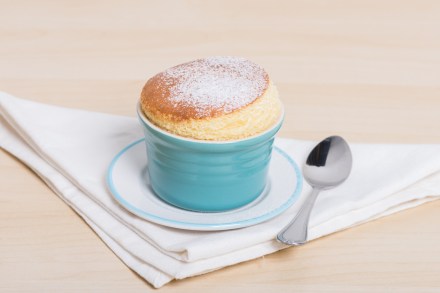
I often think (and write) about how much faith baking requires. Every time you entrust a batter, a dough or a sponge to the oven, there’s little you can do to change its fate. Sure, you can make sure you don’t open the oven dough (don’t open the oven door!), you can double check your temperatures and timings, but really, it’s a waiting game. Hoping, trusting that the cake or the bread or the pastry will have risen, turned golden, or crisped. Cooking is different: in general, you can fiddle when you’re cooking. You can taste, and add, and adjust. Cooking isn’t a done deal until you serve the finished dish, and you can lift the lid, remove from the oven, season and stir to your heart’s content without any detrimental effect.

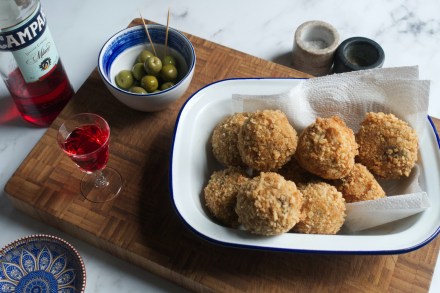
The art of arancini

From our UK edition

As I write this, I am wearing a thick jumper and sitting under a blanket, having just put the heating on. Earlier, rain fell on our skylight so heavily, the dog jumped up as if we were being invaded. I changed my schedule this morning so I could bake, just to take advantage of the oven’s warmth. It certainly doesn’t feel like sunny days are in our near future. I’ve read that the last year has felt warped time-wise, that it’s been hard to form memories that stick in the usual way, because we don’t have the events, the change in daily routine, the hooks onto which we peg our days, our weeks, our minds.

With Sebastian de Souza

From our UK edition

30 min listen

Sebastian de Souza is an English actor and author. On the podcast, he tells Lara and Liv about eating too much on set, enjoying cornflakes, double cream and sugar, and writing after a drink. His new book, Kid, is out now.

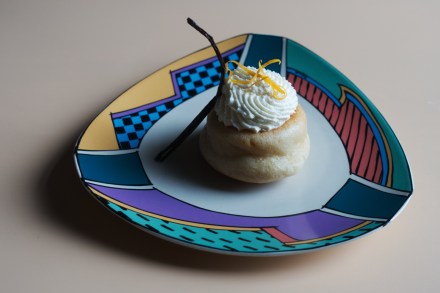
Rum baba: a boozy, make-ahead pudding

From our UK edition

The rum baba sits somewhere between a cake and a pudding: made from an enriched, yeasted dough, full of butter, called savarin, which is like a very dry brioche. It isn’t quite as enriched as brioche and, after baking, it can be left to stale, and dry out further, which means that when it’s soaked in the sweet boozy syrup, it will drink up even more. Savarin dough can be used to make enormous bundt cakes, often decorated with fresh cream and fruit, but I have a soft spot for the individual baba. Once soaked, they are squidgy and extremely alcoholic – put it this way, I wouldn’t want to drive after eating one.

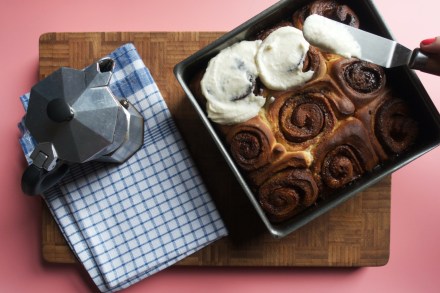
Cinnamon buns: a true treat for the breakfast table

From our UK edition

Cinnamon rolls never used to grace my breakfast table. First of all, they struck me as the sweetness equivalent of drinking a triple espresso first thing: it might seem like a good idea at the time, but the crash that accompanies it is surely inevitable. And secondly, I was certain that to be the sort of person who can put cinnamon rolls on the table at breakfast time, you must be immensely practical, organised and competent – and tied to the kitchen. And that’s simply not me. Happily, neither of these things are true. While cinnamon rolls are sweet – if you don’t have at least a little bit of a sweet tooth, I’d probably stick to marmite on toast – they’re not the one-note sweetness I had assumed they were.

With Carole Hayman

From our UK edition

38 min listen

Carole Hayman is a writer, broadcaster, actor and director. On the podcast, she tells Lara and Liv about facing anorexia, London in the late 70s, and cooking while writing.

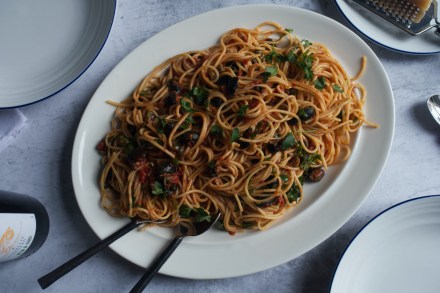
Spaghetti puttanesca: turn your leftovers into something special

From our UK edition

If you’ve heard a story about puttanesca it is likely that it translates as whore’s spaghetti – that it was born in the brothels of Naples’ Spanish quarters, a favourite of the prostitutes who worked there, for its quick, cheap and easy nature. But – ah, isn’t it always the way? – the truth is perhaps a little more prosaic. The word puttanesca is indeed derived from the Italian for prostitute (‘puttana’), but the same word is also used as a catch-all profanity, an Italian ‘crap’. In this vein, the dish would come to mean ‘any old crap’ pasta. This makes sense, because puttanesca is a true store-cupboard dish, made almost entirely from tins and jars and dried pasta (entirely if you forgo the parsley).

Eggs Benedict: Hollandaise sauce made simple

From our UK edition

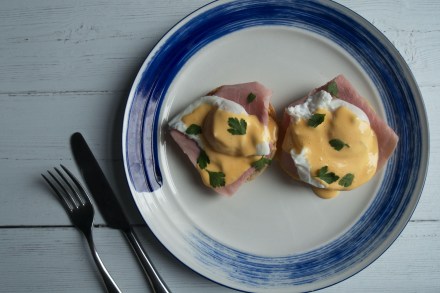
Eggs benedict is, I think, the perfect brunch dish. It combines the best bits of breakfast – eggs, some kind of pig product, a good sauce and bread – with sufficient elegance and composure that it doesn’t feel weird to be eating it after 10am. Although it is the balance of the individual components that make it such a successful dish, that hasn’t stopped restaurants and chefs the world over creating a host of variations. Swap the ham for smoked salmon to turn it into Eggs Royale, or spinach for Eggs Florentine.

With Lydia Forte

From our UK edition

21 min listen

Lydia Forte is the Group Director of Food & Beverage at Rocco Forte Hotels. On the podcast, she tells Lara and Liv about missing Martini's, cooking in lockdown, and hosting a family Come Dine With Me.

How to find the perfect Easter egg

From our UK edition

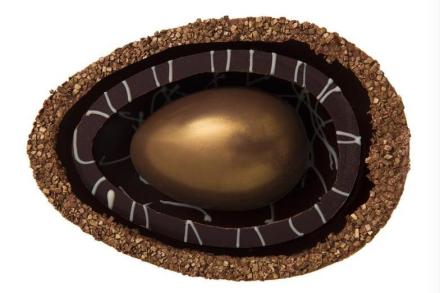
I unironically love Easter eggs. I love the posh, fancy ones, the high street ones, the budget ones. From the sublime to the ridiculous, I have time and space in my heart for all of them. My husband is sick of hearing my grand theory that Easter egg chocolate is, in fact, the best of all chocolate, probably because the theory really only extends to the fact that Easter egg chocolate is thinner and snappier than that of chocolate bars. When it comes to trends this year, we’re seeing more Russian doll-style eggs (which rose in popularity last year), which as well as being visually impressive mean a variety of flavours of chocolate within one egg.

Sticky toffee hot cross buns: the ultimate Easter indulgence

From our UK edition

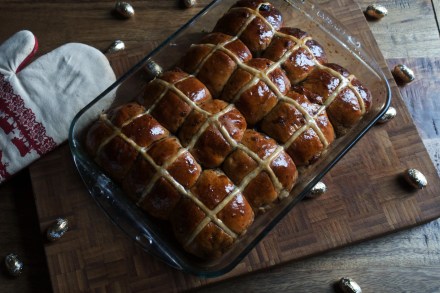
When it comes to cooking, I make no secret of the fact that I’m something of a traditionalist: I like old-fashioned steamed puddings, I like the classic and the heritage. I like blancmange and rice pudding and suet. I am unashamedly unfashionable. I’m not sure whether I chose the Vintage Chef recipe writing life, or whether the Vintage Chef recipe writing life chose me. I just don’t see the point in reinventing the wheel, or injecting unusual flavours and twists just for the sake of it. But, as I look back through recipes I’ve written, Easter has always been my exception: hot cross bun ice cream sandwiches, hot cross bun bread and butter pudding, cakes topped with mini eggs.

Neapolitan pizza in a pan: no fancy gadgets needed

From our UK edition

We are lucky to live in an age of domestic culinary convenience: whatever your heart desires, there’s an appliance, gizmo or specific spoon for it. Want to make cakes in the shape of a shoe? Not a problem. Need twenty different ways to crush garlic? Your needs can be met. Looking for a boiled egg, but in the shape of a square? Or a teddy bear, or a duck? Easy, you can make all three. So it seems remarkable that when it comes to effective gadgets or assistance for something as popular as pizza, we’re high and dry. It seems virtually impossible to get your hands on something that will help you replicate the thin, crisp crusted Italian-style pizza at home for anything other than seriously big money.

With Geordie Willis

From our UK edition

19 min listen

Geordie Willis is the creative director and brand experiences director of Berry Brothers and Rudd, Britain's oldest wine merchants. He is the eighth generation of his family to work in the business, which was founded in 1698. On the podcast, he tells Lara and Liv about his grandmother's homemade mayonnaise, being kicked out of the family business, and the secret to matching wine with food.This episode is sponsored by Berry Brothers and Rudd.

Fig rolls: this classic biscuit is better home-made

From our UK edition

I don’t often find myself longing for the industrial rigours of a factory when I’m baking in my kitchen at home. But as I patted the squiggle of fig paste with wet hands, corralling it into a rough sausage shape I thought ruefully of Charles Roser of Philadelphia and his patent for a fig roll machine. In the late nineteenth century, poor digestion was thought to be the cause of a number of wider ailments and, as with breakfast cereal, biscuits were seen as an aid to digestion – and figs, of course, were a particularly digestion-friendly fruit. Brought over from Britain to America, the fig roll tended to be made by hand in small batches.

Steamed chocolate pudding: the king of desserts

From our UK edition

I am an unapologetic pudding pusher. Now, by pudding, I don’t simply mean that more people should eat dessert – although I do think we might feel a little more sweetly-disposed towards others if that were the case – but the peculiarly British tradition of steamed sponge puddings. Once terribly popular, now they are criminally underrepresented in the pudding canon. But for me, they are king. Far from their reputation of being dense or heavy – stodgy – proper steamed puddings are airy, fluffy, by far lighter than most cake sponges.

With Max Halley

From our UK edition

36 min listen

Max Halley is one of Britain's pre-eminent sandwich aficionados. He is the founder of Max's Sandwich Shop, and the author of Max's Picnic Book. On the podcast, he tells Lara and Liv about being exposed to obscure ingredients, working in a pudding factory, and the six essential components in every great sandwich. This episode is sponsored by Berry Brothers and Rudd.

Glamorgan sausage: a cheesy St David’s Day treat

From our UK edition

St David’s Day approaches. I’ve been marking just about every high day and holiday that I possibly can recently, in a bid to differentiate my lockdown days. But with a Welsh husband and Welsh in-laws, I don’t need any extra encouragement to celebrate St David’s Day. Joining the obligatory Welsh cakes, and possibly some bara brith, this year is the Glamorgan sausage. If you’re thinking ‘what the hell is a Glamorgan sausage?’, then come over and join me in my corner, it’s cosy here, and we have snacks. I confess that when I first decided to make glamorgan sausages, I wasn’t 100 per cent sure what they actually were. It’s a vegetarian sausage, but not the Linda McCartney variety.

Cheering dishes to get you through lockdown

From our UK edition

Now that there's a chill in the air and it's getting dark at 4pm, it's time to turn to those comforting winter staples that get us through the bleaker months of the year. And with lockdown 2.0 in full swing, we have never needed these satisfying dishes more: Braised lamb shanks Lamb shanks are one of my favourite cuts to braise. When it comes to meat, braising is great for cooking tougher cuts – like shanks, but also the shoulder, neck and shortribs. It breaks down the connective tissues in the muscles; it’s this connective tissue that makes the meat chewy if cooked hot and fast. If cooked slowly, the connective tissue turns into gelatine, making the meat soft and tender – and also gives body to the sauce that forms around the meat, making it rich and luscious.

Wild mushroom risotto: immeasurably comforting

From our UK edition

I don’t know about you, but I’m finding it a little hard to get out of my own head, these days. I’m trying not to think about how long life has felt stalled, how many days we have spent inside the same four walls, save for a daily constitutional, how many more we have to do. Those projects of early lockdown – jigsaws, learning a new language, finally reading Moby Dick – have lost their allure. There’s little to define the days, or break them up; the weekends feel the same as the weekdays. In an attempt to get close to culinary mindfulness (or mindlessness, I really don’t mind) I’ve found myself reaching for dishes that don’t require a lot of thinking, but do need attention.