Michela Wrong

Michela Wrong is the author of Do Not Disturb: The Story of a Political Murder and an African Regime Gone Bad, published by HarperCollins.

Our man in Africa

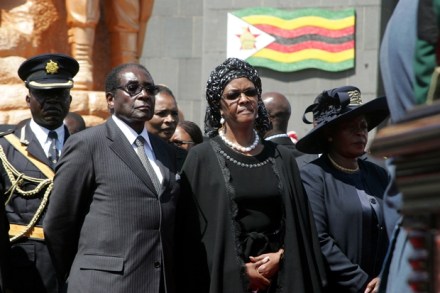
This novel comes with two mysteries attached, one substantial, the other superficial. The big mystery is the author’s identity. Gender-neutral, nominally Anglo-Saxon, almost provocatively bland, ‘C.B. George’ screams ‘pseudonym’ to any reader. A call to the literary agent confirms the suspicion: the author is keeping his identity secret ‘for personal reasons’, which may or may not be connected to Zimbabwe’s political situation. The second puzzle is why said author chose The Death of Rex Nhongo as his title. The preface explains that ‘Rex Nhongo’ was the nom de guerre of Solomon Mujuru, the Zimbabwean general whose body was discovered lying in the charred debris of a farmhouse he had seized from a white farmer in 2011.
Refugees and resilience: a story of Africa

I would love to sit in on a Jonny Steinberg interview. Over the years this South African writer has perfected a form of reverse ventriloquism, in which he becomes the mouthpiece for the Africans whose lives intrigue him. I’d like to know how he does it. The process must require relentless badgering, as interview is piled on interview, memory upon memory. One suspects his subjects occasionally come to regret agreeing to cooperate. As a reader, I can only thank them for their patience. For the results are true, relevant, modern narratives conveyed with such eloquence and poignancy they acquire almost Shakespearean gravitas. In his previous books, Steinberg told the stories of South African mobsters, beleaguered Afrikaner farmers, Aids sufferers and exiled Liberian refugees.

Witnesses in the heart of darkness

When presented with a 639-page doorstopper which includes 82 pages of closely-written sources, notes and index, most of us feel a bit like a patient about to swallow a strong dose of antibiotics: ‘This isn’t going to be pleasant, but it’ll be good for me.’ First published in Dutch in 2010, translated into French and German, and only now coming out in English, Congo arrives trailing prizes and praise. And yet I quailed. What I hadn’t realised was that David Van Reybrouck, who spent a decade on this extraordinary work, is not primarily a historian.

In the shadow of Mau Mau

When the Kenyan human rights campaigner, Maina Kiai, recently addressed the House of Commons, his list of policy recommendations probably surprised many MPs. Be tough on Kenya’s fractious government, he urged. Crack down on British companies which bribe African politicians. And it was well past time, he added, that Britain made a formal apology for Mau Mau. A chasm yawns between the soft-focus memories of a former colonial master and the less happy recollections of the colonised. Never more so than with Mau Mau, the 1950s uprising against white rule which traumatised the Kikuyu community, the country’s biggest tribe, eventually paving the way for independence.

How to get around South Africa’s many boundaries

There are writers whose prose style is so fluid, so easy, the reader feels as though he has been taken by the hand and is being gently led down a path by a guide who can be trusted to point out interesting landmarks, allow the odd meander, but always keep firmly on course. Mark Gevisser, who published a praised biography of former South African president Thabo Mbeki a few years ago, is one such, and the metaphor seems apt in view of this book’s title, which comes from a game the author played in childhood. Perched on the back seat of his father’s Mercedes, he would pore over a map of Johannesburg, sending imaginary emissaries out into the city and trying to ferry them home.

The making of a president

When presented with a title of this kind, many readers think they know what to expect: drugged-up child soldiers, wince-inducing brutality, ranting demagogues, rebels in women’s wigs. This, thankfully, is not that book. It is something more nuanced, elliptical and elegant. Ghana is in a different league from Liberia, Guinea or Sierra Leone, its traumatised West African neighbours. Even before the recent discovery that it was sitting on large oil reserves, it was routinely hailed as one of Africa’s success stories. As the ‘first’ in the title makes clear, it has certainly been through its share of political upheaval since independence from Britain in 1957.

Letter from Somaliland

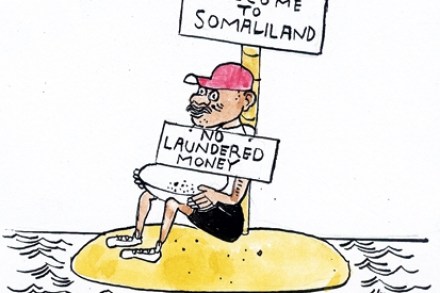
Ayan Mahamoud, one of the organisers of Hargeysa’s International Book Fair, has all the girly vulnerability of a factory-tested steel girder. So it was disconcerting when, having called to the stage the western writers attending in the teeth of strict travel warnings, she burst into tears. ‘I’m sorry. It’s just so hard when the whole world is against you,’ she sobbed. The word ‘beleaguered’ constantly comes to mind when visiting Somaliland, a country that doesn’t officially exist.

Africa’s election aid fiasco

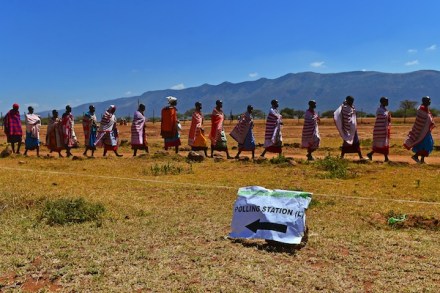
The development industry is as fashion-prone as any other. Fads come and go. There are a few giveaways when it comes to spotting them. Deceptive simplicity is one indication. The idea should have a silver-bullet quality, promising to cut through complexity to the nub of a problem. Even better, it should be a notion that can be rolled out across not just a country, but a region. Covering the Kenyan elections, which climaxed with the inauguration last week of Uhuru Kenyatta as the country’s fourth president, I suddenly realised I was watching a fad hitting its stride: the techno-election as democratic panacea. We’ll see it again in Mali’s elections this summer. Like most of these trends, it is premised on the best of intentions.

Change of heart | 7 February 2013

A stomping bestseller is a hard thing to recover from. The author is doomed to see all future works compared and found wanting. Is his new book vivid? Certainly. Funny? Yep. Insightful? Sure — but not as good as that first, cherished work. Readers are loyal creatures. So it will always be for Rian Malan, whose My Traitor’s Heart came out in the dying days of apartheid, a tortured bellow of racial anguish that immediately found a place on the reading list of any student of modern Africa. An Afrikaner descended from a famous family of Voortrekkers and statesmen, the rebellious young Malan fled to Los Angeles, only to return eight years later, bored and homesick.

The first casualty

Some years ago, I was included in a round- robin from a group of African writers trying to whip up support for an anti-Ryszard Kapuscinski campaign. The plan, as I recall it, was that members of the African intelligentsia should loudly denounce the legendary Polish reporter’s depiction of their continent at the readings he was due to give during a US book tour. I ignored the email, which had the tang of a witch-hunt. The determination of a group, whose members presumably embraced the principle of free speech, to crush a colleague’s work had echoes of the Rushdie affair. A colleague, what was more, who was old, ill and clearly reaching the end of his productive life.

Not for sissies

Nigeria is not exactly a tourist destination. A colleague chortles over the memory of trying to wangle his way in — without a journalist’s visa — during Sani Abacha’s military regime. ‘Purpose of visit?’ barked the immigration man. ‘Tourism,’ he lied. ‘No one comes to Nigeria for tourism,’ said the official. He was promptly expelled. The official was voicing a truism. Even seasoned Western adventurers avoid Nigeria — ‘is Lagos airport as terrifying as they say?’ you are often asked — while the country’s oil-fattened elite, oscillating between the national superiority complex and hardened self-loathing, regard an international flight as the obligatory start to any holiday.

Who Killed Hammarskjöld? by Susan Williams

When I was a Reuters trainee, long hours were spent in Fleet Street pubs absorbing the folklore of journalism from seasoned veterans. One popular story concerned the hapless correspondent sent to verify that Dag Hammarskjöld, head of the United Nations, had safely landed at Ndola airport in Northern Rhodesia on his way to talks with separatist Congolese leader Moise Tshombe. A plane landed, the police confirmed it was the UN secretary general, the hack duly filed his story. Trouble was, the disembarking white man was someone else. Hammarskjöld was dead, killed as his DC-6 crashed on night-time approach to Ndola. Rival reporters, drinking at a nearby hotel, heard the news and rushed to correct their stories.

Lucky miss

In Dreams From My Father, his exploration of race and roots, Barack Obama recalled the tales heard in childhood about the man who gave him his name. His father, they said, was a brilliant economist who grew up herding goats in western Kenya, then won a scholarship to the University of Hawaii, where he fell in love with a white woman. ‘There was only one problem: my father was missing. Nothing my mother or grandparents told me could obviate that single, unassailable fact.’ My boy, I thought on finishing this book, you have no idea how lucky you were. Sociologists may worry about the impact absent fathers are having on a generation of young black men robbed of male role models. But there are worse things in life than being abandoned by your father.

Fear and loathing in the Congo

Jason Stearns is a brave man. He once worked for the UN’s disarmament programme in eastern Congo, a job which required him to probe the forests around the town of Bukavu, seeking out members of the local Mai Mai militia. Jason Stearns is a brave man. He once worked for the UN’s disarmament programme in eastern Congo, a job which required him to probe the forests around the town of Bukavu, seeking out members of the local Mai Mai militia. When the UN peacekeepers made contact — and there was always a risk they would run into Rwandan rebels with very different priorities — his job was to persuade twitchy, traumatised child fighters to down their weapons. Arguably, what he attempts to do in this book is even braver.

When words fail

Ignore the title, with its subliminal echoes of Mills & Boon. Aminatta Forna’s magnificent second novel is not really about love. Its themes are far grittier, and all the more compelling for it: war, loss, and how a society emerging from civil strife must reinvent its own history, fabricating a tolerable narrative in order to remain semi sane. The country in question is Sierra Leone. Its charming capital, Freetown, dotted anomalously with chimney-potted villas recalling an era when this was a British colony, is framed by green hills which tumble into a beach-fringed sea. It doesn’t attract many tourists, though.

A sage on his laurels

Last year, at a gathering in a London bookshop, the Nigerian writer Chinua Achebe read poetry and mused over his long career. The evening was a sell-out, the mood adoring. At the end, a Scandinavian blonde raised a hand to ask whether, if he could do it all again, there was anything about Things Fall Apart he would change. There was patronising laughter from the audience, tinged with disapproval. Didn’t the silly girl know the novel was perfect in every way? Achebe did not engage with the question. ‘No, I wouldn’t change a word.’ I was reminded of the exchange reading this slim book, Achebe’s first for more than 20 years.

Bluff and double-bluff

Like Philip Larkin in ‘Posterity’, imagining an American lecturer yawning over his research into an ‘old-type natural fouled-up guy’, J.M. Coetzee places himself in the shoes of a notional English biographer gathering the material that will make sense of the years that followed his 1972 return to South Africa. The result is Summertime, third part of Coetzee’s semi-fictionalised biographical trilogy. Two previous volumes — Boyhood and Youth — recounted the author’s childhood in the Western Cape as the son of middle-class Afrikaners and his move to London, where he tried his hand as a computer programmer.

Black humour

‘The trouble with most people,’ a reporter friend of mine once remarked, ‘is they just don’t grasp the funny side of genocide.’ He was a rather eccentric friend, possessed of a none-too-healthy fascination with guns and violent death, but he had a point. As any soldier knows, horror lends itself to black humour. An uncontrollable fit of the giggles is often a spontaneous reaction to the utterly grotesque. Gripped by post-colonial guilt, few Westerners have the nerve to admit this when it comes to Africa, which does a strong line in genocide, and the continent’s non-fiction suffers from the kind of po-faced earnestness that would make a missionary yawn. Jane Bussmann is a gloriously irreverent, genitally-fixated exception to the rule.

When hopes were high

Dons don’t usually appear to much advantage in fiction. For those who follow African affairs, these are not happy times. Once regarded as passé, the military coup is enjoying something of a come- back. Men formerly hailed as Renaissance leaders seem bent on being crowned presidents-for-life. From Sudan to Kenya, Somalia to Zimbabwe, carefully negotiated peace deals and coalition governments have either already foundered or quiver on the brink of collapse. So this book possesses a terrible poignancy. The years it covers — a time when black nationalists in the territories that went on to become today’s Zimbabwe, Malawi and Zambia campaigned to shrug off white rule — are still comparatively recent history.

Killing with kindness

When I wrote a regular column on Africa for this magazine’s left-wing rival, I was always intrigued by the contrast in responses to any sceptical article on aid. ‘This reactionary bigot is clearly happy for millions of Africans to starve,’ pretty much summed up the fury of white readers at having their Oxfam direct debits questioned. ‘No, she’s right!’ replied my defenders. ‘These corrupt, thieving governments should be cut off without a penny.’ Those ones always came from Africans.