Michael Tanner

Meditation on Gandhi’s life

From our UK edition

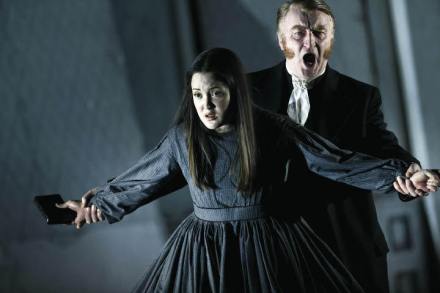
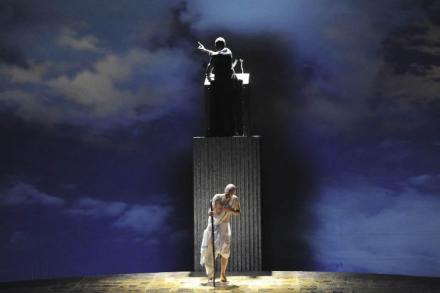
Satyagraha English National Opera, in rep until 26 March When Philip Glass’s opera Satyagraha was first put on by ENO in 2007, I found it intolerably tedious, to the point where I felt that if I didn’t leave the theatre I might start to scream. Yet I came across quite a few people, some of them serious non-trendies whose views I share over a wide range of artistic and other matters, who found it compelling, moving, thought-provoking. So I felt that I needed to go back when it was revived last week for seven performances, having been by far the most successful contemporary opera that ENO has mounted. Obviously I was dreading the occasion, obviously I hoped I would change my mind. And I did change my mind.
Class act | 27 February 2010

From our UK edition

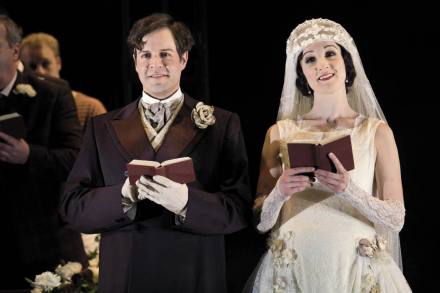
Ruddigore Opera North, touring What is wrong with me? I kept asking myself that question as I endured the two hours and 40 minutes of Gilbert and Sullivan’s Ruddigore in the Grand Theatre, Leeds, while most of the audience rocked with laughter and regularly burst into delighted applause. I hadn’t originally intended to go, but the reviews were so unanimously ecstatic that I finally decided that I’d better make the effort. This show has been compared to Jonathan Miller’s famous Mikado at ENO, and that is something I see whenever I can and enjoy enormously — but the musical merits of that work apart (they are very high), Miller’s production is a brilliantly sly commentary on the piece, while in no way reducing its stature.

Losing streak

From our UK edition

Prokofiev’s opera The Gambler adapts Dostoevsky’s novella of the same name, an audacious enterprise. Prokofiev’s opera The Gambler adapts Dostoevsky’s novella of the same name, an audacious enterprise. Unfortunately, it fails, as I think all the composer’s operas do, apart perhaps from The Love for Three Oranges, and mainly because he gives no evidence of interest in individual human beings, and hence of the musical means which he might develop to express their individuality. War and Peace is Prokofiev’s most spectacular failure in that respect, but the war scenes do something to salvage it. There are no compensations in The Gambler, so what is quite a short opera, a bit more than two hours, comes across as a long, stagnant one.

Family values | 13 February 2010

From our UK edition

Lucia di Lammermoor English National Opera, in rep until 26 February When David Alden’s production of Donizetti’s Lucia di Lammermoor was first staged by ENO two years ago it was so beset by cast illnesses that it was difficult to tell to what extent the director’s intentions were executed. Even so, the musical side of things, under Paul Daniel, was admirable.

Distorted account

From our UK edition

Così fan tutte Royal Opera Phaedra Barbican When Jonathan Miller’s production of Così fan tutte was first mounted at the Royal Opera in 1995, it was the Armani clothes which received the most attention. Over the years there have been many modifications, and it now bears little relationship, certainly in the direction of the singers, to its original conception.

In sight of the <em>Ring</em>

From our UK edition

Anniversary-consciousness is no doubt primarily commercially driven, certainly in the music world, where the fact that a scarcely remembered composer has been dead for exactly 300 years is a reason for featuring him as This Week’s Composer on Radio Three, but more importantly for many record companies to persuade us that it is time to revalue his contribution to the Orpheus myth, the first to have a bass hero, etc., etc.

Ocean of ugliness

From our UK edition

Elektra Barbican La bohème Opera North In his little-read but wonderful book Daybreak, Nietzsche writes: Our composers have made a great discovery: interesting ugliness too is possible in their art! And so they throw themselves into this open ocean of ugliness as if drunk, and it has never been so easy to compose...But you will have to hurry! Every art which has made this discovery has turned out to have only a short time to live. Written in 1880, with Wagner in mind but unmentioned, the words fit Richard Strauss’s Elektra with uncanny precision. Everyone exclaims about Strauss’s alleged retreat from modernism after Elektra, but where was there to go?

Golden olden

From our UK edition

La bohème Royal Opera House Thanks to the cautiousness of the major opera companies over the festive season, I saw Puccini’s La bohème twice in five days, with another couple of productions to go. The most fascinating aspect, for me, of seeing the Royal Opera’s 577th performance of this masterpiece, in John Copley’s production from 1974, was to compare it with the shoestring production which I saw at The Cock Tavern in Kilburn on New Year’s Eve. Many dimensions of comparison suggest themselves, the most obvious being that of cost. Tickets for The Cock are £15, those for much of the Royal Opera House about £205, with even the centre amphitheatre at £89.

Cut-price treat

From our UK edition

La Bohème Cock Tavern The Enchanted Pig Linbury Studio Puccini’s La Bohème has oddly become the Christmas opera of choice, broadcast on BBC TV on Christmas afternoon (an especially ludicrous affair), and major opera houses dusting down their elderly versions. I doubt whether any of them will be as involving, indeed thrilling and upsetting, as OperaUpClose’s production at the Cock Tavern Kilburn, originally scheduled to run from early December to 20 January, but now extended by two full months, it is proving so popular. The Cock has seating for only 40, so that is not quite as amazing as it sounds, but given the comparative obscurity of the venue it is still impressive.

Equivocal masterpiece

From our UK edition

Der Rosenkavalier Royal Opera House Der Rosenkavalier is the most self-conscious of comedies, as well as being largely concerned with self-consciousness. It has two kinds of joke: one, the broad practical jokes indulged in at enormous length at Baron Ochs’s expense; the other, the sophisticated humour of youthful illusions being dashed, while others rapidly spring up to replace them. Rosenkavalier is subtle enough, just, to have counterpoises to these deflationary devices. So Ochs, though an impoverished randy aristocratic lout, also has genuine dignity, moments of thoughtfulness where the thoughts aren’t about how irresistible he is to young girls.

Rising to Verdi’s challenge

From our UK edition

Otello Barbican Die Zauberflöte Royal College of Music Verdi’s Otello has almost become a rarity since Domingo gave up singing the title role, so its inclusion in the LSO series of concert performances under Sir Colin Davis was most welcome, and all the more so when it was announced that, at extremely short notice, the young New Zealand tenor Simon O’Neill had taken over from the ailing Torsten Kerl. My first exposure to O’Neill was as Florestan at the Proms this year, where he electrified the proceedings with his intense and accurate singing and vocal acting. Otello demands even more than Fidelio, and he rose to all the challenges, from a quite magnificently authoritative ‘Esultate!’ onwards.

Suffering for art’s sake

From our UK edition

Cecilia Bartoli Barbican Messiah Coliseum After a brief but inspissatedly tedious overture by Porpora, played by Il Giardino Armonico, the curtains at the Barbican were pulled aside and Cecilia Bartoli, dressed like a highwayperson from a 1940s escapist movie, sprang on to the stage, flung off her feathered hat, rocked with superabundant energy as the orchestra played the introduction to her first aria, from another opera of Porpora’s, and launched into the first of many elaborate analogies between love and other conditions which might give an excuse for lots of drooping and even more giddy coloratura. She was on amazing form, and was greeted and received with almost hysterical rapture.

Parental indulgence

From our UK edition

Cherevichki Royal Opera Tolomeo English Touring Opera, Cambridge Semele Royal Academy of Music The week’s operatic rarity was Tchaikovsky’s Cherevichki, inaccu-rately translated as The Tsarina’s Slippers. It is an adaptation of the Gogol story ‘Christmas Eve’, and is slightly more familiar in Rimsky-Korsakov’s version, which was mounted in a spirited production at ENO in 1988. Though I never thought I’d say so, the Rimsky score turns out to be considerably more engaging, certainly more suited to his temperament, and his flair for orchestral colour. Tchaikovsky was devoted to his own opera, which had a mild success as Vakula the Smith, and which he subjected to extensive revision.

Universal truth

From our UK edition

Duke Bluebeard’s Castle English National Opera Swanhunter Opera North Bartok’s only opera, Duke Bluebeard’s Castle, shouldn’t be a difficult work to stage, to sing and to play, yet most of my worthwhile experiences of it have been listening to recordings — where it has done notably well. Though the plotline is as simple as can be, and the music matches it in urgency and directness, or rather because of these facts, it is a piece that invites and certainly receives the attentions of meddling producers who ignore what it is about and invent more or less elaborate dramatic situations which it could have been about.

Top of the class

From our UK edition

L’assedio di Calais Guildhall School of Music and Drama This is the time of year, before the long hibernation of opera companies sets in, when there is sometimes a choice of several operas per night, many of them performed by the schools of music, which often seem to adopt the unintelligent course of having their performances on in the same week. This year, however, it is possible to go to the Guildhall School this week, the Royal Academy next week, with Semele conducted by Sir Charles Mackerras, and the Royal College the week after that to see The Magic Flute.

Glorious Gershwin

From our UK edition

Porgy and Bess Royal Festival Hall Artaxerxes Linbury Studio Cape Town Opera has been on tour in the last ten days, taking its production of Gershwin’s Porgy and Bess to Cardiff, the Southbank Centre and Edinburgh. I went to the first of the two London performances, staged but without scenery. The action took place behind some of the orchestral players, with the rest either side. That is not an ideal situation, but nevertheless Gershwin’s finest score came across with enormous impact — in fact, I was freshly astonished at how much finer this work is than anything else he wrote. Whereas, I gather, the production is set in Soweto, at the Festival Hall it wasn’t set anywhere at all.

Great Britten

From our UK edition

The Turn of the Screw English National Opera L’heure espagnole; Gianni Schicchi Royal Opera House Each time I see Britten’s The Turn of the Screw I am more impressed by the brilliance of the music, and more irritated by the unprofitable ambiguities of the drama. The first revival at the Coliseum of David McVicar’s stunningly brilliant 2008 production of the piece intensified both these feelings. The overwhelming source of satisfaction was the staggering conducting of Sir Charles Mackerras. It is inconceivable that there should be a more complete realisation of the score, superbly played by 13 members of the ENO orchestra.

Lovelorn masterclass

From our UK edition

Werther; The Adventures of Mr Broucek Opera North The Truth about Love Linbury Studio Massenet’s Werther is a tricky opera, in fact may well not be susceptible of more than a production which leaves you feeling that you could easily live with its not very numerous highlights. One of its chief problems is highlighted in Gerald Larner’s incisive notes to the new Opera North production: ‘The problem with a Werther opera is that no libretto, unless it completely traduces Goethe’s original, can compensate for the obvious disadvantage that, because Charlotte is either engaged or married to Albert and is determined to give Werther no encouragement, there can be no mutual declaration of love, no full-scale duet for the two protagonists.

Plazas in pain

From our UK edition

Letters of a Love Betrayed Linbury Studio Carmen Royal Opera House Wozzeck Royal Festival Hall A hectic operatic week, three down and two (to be reviewed next week) to go, began lamentably with what I’m in danger of coming to think of as the archetypical Linbury experience. That hideous place, a kind of operatic Nibelheim under the Valhalla of the Royal Opera, has seats so cramped and uncomfortable that I can only think that their point is to ensure one stays awake, as one witnesses another première which seems destined to be also a dernière.

Musical triumph

From our UK edition

Tristan und Isolde Royal Opera House Tristan und Isolde is a masterpiece that can be given widely different interpretations, since even by Wagner’s standards it is permeated by ambiguities. He may have intended, as he wrote in that famous letter to Liszt, to write ‘a monument to that most beautiful of dreams’, that is, completely fulfilled love, but is that what he achieved? Whatever the answer, a performance that fails, in the first place, to leave you shattered, and in the second to make you think very hard about what you think passionate love is and whether you really want it, is a failure. Glyndebourne’s recent production left one in a kind of purple daze, mesmerised by its anodyne beauty. No one could accuse the new production at the Royal Opera of that.