Dave – 3 October 2012
The business of cartooning is in a pretty perilous state now that we have lost the captain of the ship. Ronald Searle was a cartoonist who could also draw — a rare thing. After the war, he became famous for a series of drawings he did for 'Lilliput' called St Trinian's. The girls Searle created did the most appalling things to each other and to their teachers. But it wasn't really about school-children. Searle was in fact using St Trinian's as a way of exorcising the horrors he encountered whilst a prisoner of the Japanese, building railways in a chain gang. After the success of St Trinian's, he ran away from England to rid himself of the naughty school girl tag and became famous for his documentary drawings.
I was born in London in 1935. By the summer of 1939, it was considered wise to get children out of the city before the war started. I wasn’t separated from my sobbing mother at Victoria station and put on a train holding a gas mask. Instead, my mother and I went down to Devon to stay with my grandmother, who had rented a house in the village of Torcross. In London, the war did not stop for Christmas. Toy shops before the war had sold small forts modelled on the Maginot and Siegfried lines. Now boys in the city wanted toy planes like the ones they saw flying overhead. But in Devon in 1940 things were still peaceful and we had a big Christmas lunch with all the trimmings. We were joined by an uncle whose job it was to pull bodies out of bombed buildings in London.
From the latest issue of the Spectator:.
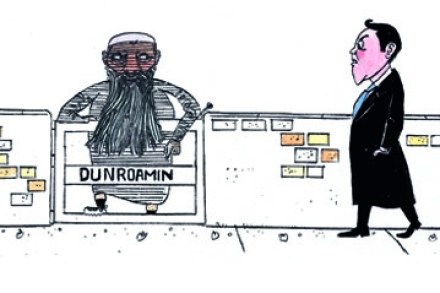
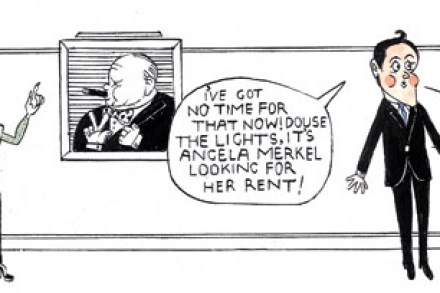
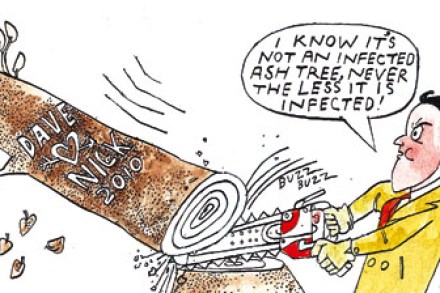
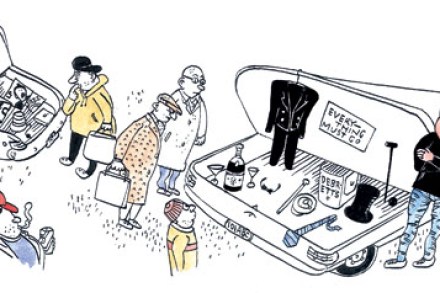
Here is a collection of some of The Spectator’s best cartoons from the last decade, put together to take your mind off the humourless PC world we are now trapped in. Some people say they only read The Spectator for the cartoons. Who am I to argue? Here is a collection of some of The Spectator’s best cartoons from the last decade, put together to take your mind off the humourless PC world we are now trapped in. Some people say they only read The Spectator for the cartoons. Who am I to argue? My sincere thanks to all the cartoonists, even the ones whose names I have inadvertently left out: Sally Artz, Bernie, Hector Breeze, Dish, Dorrance, Nick Downes, Dredge, GG, Grizelda, Hawker, Nick Hobart, Holland, Hunter, Tony Husband, Ivor, Meyrick Jones, K.J.
Are you staggered and amazed by today’s sleight-of-hand merchants? Are you staggered and amazed by today’s sleight-of-hand merchants? Perhaps David Blaine surviving in a block of solid ice for months leaves you cold? Or Darren Brown knowing your credit card number has you stifling a yawn? If something is missing from today’s masters of magic it’s not their fault; it’s our assumption that they can get away with anything on television, and that it’s all a con. Well, to put the magic back into your cynical soul, just look at this amazing collection of photographs and posters from the past. It will revive that tingling feeling that you just can’t figure out how they did it.
The restaurant-wrecker A.A. Gill has attacked the Spectator, accusing our cartoons (and those of the New Yorker) of failing to make him laugh. Well, you can go for me, A.A. - but when you go for my cartoonists, I'm bound to react (see above). Next time pick on someone your own size, beach bully!
In 1956 I joined other new kids on the block at Punch magazine: Quentin Blake, Ed McLachlan, Mike Williams, Honeysett, Ray Lowry, Ken Pyne, Bill Tidy, Pav, Petty, plus Gerald Scarfe and Ralph Steadman who were going to blow the world apart with their blood-and-guts drawings. While Punch’s pages were curling at the edges, up popped Private Eye — naughty, rude, fearless and funny. Punch took a mortal blow from which it never recovered. People said that Punch had ceased to be funny, but this simply wasn’t true, as the cartoons collected here demonstrate. Cartoonists then had room to stretch themselves and put into their drawings details of the surroundings and attitudes of the period. Look at the amazing Pont (Graham Laidler) and see how he captured the Thirties.
Alan Coren, who has just died after a long illness, was one of the finest comic writers of the past 40 years. He was very, very funny. That’s rare. I'd known him since he became editor of Punch in 1978. He was an inspiring editor, and good company. And he wasn't just a great comic writer: he was also a great broadcaster. I have seldom come across anybody who could think as quickly on his feet. As with all funny men, of course, he wasn't kidding when he joked -- his jokes were serious -- and he was especially serious about an England that has been vanishing these past 20 or thirty years. His last piece in The Spectator was an enthusiastic review of Griff Rhys Jones's autobiography, an evocation of suburban values, a sort of Tizer with Rosie, as Alan described it.
At home I work in a cupboard under the stairs just to keep me grounded, so you won’t hear me talking about my ‘studio’ — unlike some cartoonists I could name. My cupboard has in it, apart from old clothes, a cat litter tray and a collection of hundreds of jazz CDs. Do I put them back in their cases when I’ve finished playing them? I do not; anyway, I now have an iPod with all my music downloaded on to it. Fancy that! All those wonderful CDs on a machine the size of a packet of five Woodbines. Now I can have music wherever I go, so don’t even try and speak to me. I can’t hear you.
From our US edition
I see that the papers have finally given a name — ‘chavs’ — to the new working class. They are the type of people I have been drawing for years: trailer trash covered in bling bling, wearing Burberry baseball hats, white tracksuit bottoms and white trainers. They couldn’t be more different from the docile ‘pint-of-mild-please’ working class of the 1930s. I remember Mass Observation and the films by Humphrey Jennings, which collated their behaviour as if they were animals in a wildlife documentary. Try doing that now: ‘Wot you looking at?’ ‘Er ...nothing. I was just observing you drinking a large Jack Daniel’s and Coke so as to understand the sociological dynamic of the prole ...Ow! For God’s sake, don’t hit me!
Did you have a nice holiday? I know I did. Did you find yourself in a hotel bedroom in Naples looking after four children between the ages of two and six? Two girls and two boys, while everyone else went sightseeing. (‘Look! There’s a boy stealing that lady’s Prada handbag!’) The two girls have me as a father, the other two belonged to friends. They all wanted to watch something on television. After about three hours, they all agreed that they wanted to watch an animation they knew by heart called Ice Age. I fell asleep, only to be woken by four children screaming and pointing at the television set. Out of the screen came noises that sounded like someone being garrotted. In fact, it was two lesbians chewing away at each other and making orgasmic groans in Italian.
This is the first Christmas in recent years that I haven't spent in traction or immobilised by glandular fever. You may imagine that I spend my days drawing and whistling in a carefree manner, but there are tears behind the laughter. Two Christmases ago I was invited to the Erotic Review party in a club in London's Soho. I had worked for the magazine doing dodgy drawings at fifty quid a pop, so they owed me a drink. Besides, I was eager to meet the Erotic staff who, I felt sure, writhed around all day on their laptops sans knickers and headaches. I found the club, walked in and was unable to see anything except a bar, far off in the distance, full of decadent, half-naked women and helpless men being used as sex objects.